Knowledge Base
Practical reads on AI, fintech, and digital-asset regulation
Articles and alerts written by the Licentium team. Search by topic, author, or tag.
AMF Issues Warning on Unauthorized Investment Actors
The Autorité des marchés financiers (AMF) warns the public about unauthorized actors offering investment opportunities, particularly in crypto-assets, urging compliance from crypto-asset service providers and investment firms.
New York v Polymarket US: State Gambling Law and a CFTC-Designated Exchange
Observations on People of the State of New York v QCX LLC (d/b/a Polymarket US), Supreme Court, New York County, filed 24 September 2026
FCA announces special administration for ITI Capital Ltd
The Financial Conduct Authority has placed ITI Capital Ltd into special administration effective 25 September 2026, following the firm's prior agreement to cease most regulated activities on 10 August 2025.
US Files $61 Million Crypto Forfeiture Action Over Iranian Oil Proceeds, SDNY, 14 September 2026
On 14 September 2026 the United States Attorney's Office for the Southern District of New York filed a civil forfeiture complaint against approximately $61 million in cryptocurrency said to represent proceeds of black-market sales of sanctioned Iranian crude oil. The complaint names two Chinese companies, Blessed Trust and Hexa Whale, alleged to have moved oil proceeds through trading accounts at the UAE-based exchange Binance and through United States-based cryptocurrency issuers. The action sits at the pleading stage.
EBA initiates public consultation on revised technical standards for capital and liquidity requirements
The European Banking Authority (EBA) has started a public consultation on proposed revisions to the Implementing Technical Standards governing capital and liquidity requirements for banks in the EU/EEA.
EBA publishes Risk Dashboard and initiates consultation on ITS revisions
The European Banking Authority (EBA) published its Risk Dashboard for Q2 2026 and started a public consultation on revisions to the Implementing Technical Standards related to capital and liquidity requirements, impacting banks in the EU/EEA.
Irish Data Protection Commission fines Google €403 million for GDPR violations
The Irish Data Protection Commission has fined Google Ireland Limited €403 million for violating GDPR principles related to location data processing. Google must comply within six months of the decision made on 21 September 2026.
AMF updates doctrine for depositaries of UCITS and AIFs
The Autorité des Marchés Financiers has updated its doctrine for depositaries of UCITS and AIFs, impacting asset management firms.
FCA Addresses Economic Crime with New Priorities
The FCA, alongside the NCA, Home Office, and Treasury, has established nine priorities to combat economic crime, impacting all regulated entities.
ESMA announces changes to Euribor panel and new supervisory priority
The European Securities and Markets Authority (ESMA) confirmed Cecabank's withdrawal from the Euribor panel effective 30 September 2026 and announced a new supervisory priority on digital innovation starting in 2027.
ASIC Amends Market Integrity Rules to Cover AI Trading Algorithms, Australia, 24 September 2026
ASIC has made two amendment instruments changing the trading systems and automated trading obligations in its securities and futures market integrity rules. The amended rules extend testing, monitoring and governance duties to algorithmic trading that uses artificial intelligence and machine learning, apply trading system requirements to manually entered orders as well as automated ones, and confirm that the false or misleading rule reaches AI-enabled trading. The rules take effect in 2028 after an 18 month transition period.
Virginia Executive Order 22 Sets Data Centre Conditions and AI Task Force, 18 September 2026
Governor Abigail D. Spanberger signed Executive Order 22 on 18 September 2026, setting Virginia data centre accountability conditions and creating a rapid-response artificial intelligence task force. The order bars executive branch agencies from enforcing non-disclosure agreements over material information about a proposed commercial data centre, excludes projects with peak demand of 25 megawatts or more from certain state assistance, and sets 120 and 180 day deadlines for agency action on engagement, noise, water and workforce measures.
Italy Enacts Legislative Decree 160/2026 on AI Criminal and Civil Liability, 15 September 2026
Legislative Decree No. 160 of 9 September 2026 was published in the Gazzetta Ufficiale, Serie Generale No. 214, on 15 September 2026 and enters into force on 30 September 2026. The decree adapts Italian law to Regulation (EU) 2024/1689 on artificial intelligence in the matters of the use of AI systems for policing activity and of civil and criminal liability. Earlier coverage of this measure concerned draft and advisory stages; this is the enacted text.
EBA Publishes Response to MiCA Review Consultation
The European Banking Authority (EBA) has published its response to the European Commission’s consultation on the review of the Markets in Crypto-assets Regulation (MiCA), identifying key priorities for the evolving crypto sector.
EBA Responds to MiCA Consultation on 24 September 2026
The European Banking Authority published its response to the European Commission's consultation on the MiCA review, impacting crypto-asset service providers and token issuers.
Zcash Reaches Euronext Through a Swiss Secured Bond
On 22 September 2026, the Zurich issuer 21Shares AG began trading the 21shares Zcash ETP (ticker ZCASH, ISIN CH1608218801) on Euronext Paris and Euronext Amsterdam. Each unit is a Swiss-law bond secured by Zcash (ZEC). ZEC is a crypto-asset whose protocol lets users choose shielded transactions that hide sender, recipient and amount.
Legal Finality in Pontes: Central Bank Money and Tokenised Securities
Pontes is a Eurosystem service connecting distributed-ledger transactions to euro settlement in central bank money. Its launch raises a legal question: when does payment become final, and what protection reaches the securities delivered against it?
Offshore structures for crypto projects in 2026
In 2026 an offshore crypto structure usually separates a foundation, which holds protocol assets and gives legal effect to community decisions, from a company that raises equity, with further entities for the user interface or licensed virtual-asset services. Comparing thirteen offshore jurisdictions, the paper shows that offshore incorporation settles only the company law and home regulator: licensing follows the activity, while substance, beneficial ownership, tax and the US, EU and UK token offering rules follow the people and markets involved.
European Commission announces AI, Data, Robotics Forum for 2026
The European Commission has scheduled the European AI, Data, Robotics Forum for 13-14 October 2026, impacting stakeholders in the AI sector under the EU AI Act.
FCA Reports Increase in Closure of Money Mule Accounts
The Financial Conduct Authority (FCA) reported a rise in the closure of suspected money mule accounts, with 238,396 accounts closed in 2025, up from 184,935 in 2023. The FCA urges financial firms to enhance their detection measures against money laundering activities.
ESMA announces new supervisory priority on digital innovation
The European Securities and Markets Authority (ESMA) will launch a new Union Strategic Supervisory Priority (USSP) on digital innovation starting in 2027, focusing on AI and tokenisation while ensuring investor protection.
ESMA announces new supervisory priority on digital innovation starting in 2027
ESMA has set a new supervisory priority focusing on digital innovation, requiring all regulated entities to align their strategies by January 1, 2027, in response to emerging technologies and associated risks identified by the ESAs.
Ninth Circuit Rejects DMCA Section 1202(b) Claims Over Copilot Output, United States, 16 September 2026
The Ninth Circuit held on 16 September 2026 that output from a generative coding assistant is a new work rather than a copy from which copyright management information was stripped, affirming dismissal of claims under sections 1202(b)(1) and 1202(b)(3) of the Digital Millennium Copyright Act against GitHub, Microsoft and OpenAI entities. The panel rejected a literal identicality element but treated material differences between source code and model output as pointing away from removal. The training data theory was forfeited below.
EBA highlights vulnerabilities in EU financial system
The European Supervisory Authorities have identified key vulnerabilities in the EU financial system, urging firms to enhance operational resilience and risk management frameworks.
EBA, EIOPA, and ESMA Release Autumn 2026 Risk Update
The European Supervisory Authorities have issued their Autumn 2026 risk update, urging vigilance over vulnerabilities in the EU financial system, particularly for firms involved in crypto-assets and payment services.
De Nederlandsche Bank updates guidelines for MiCA qualifying holdings approval
De Nederlandsche Bank has updated its guidelines for prior approval of qualifying holdings under MiCA, affecting CASPs and token issuers.
European Commission launches European Institutional Investors Pact
The European Commission has initiated the European Institutional Investors Pact to enhance long-term investment in Europe's technology sector, supported by thirteen institutional investors and significant funding commitments.
FCA Announces Cryptoasset Authorisation Process for UK Firms
The FCA will allow cryptoasset firms to apply for authorisation starting at 7am on September 30, 2026, as part of new regulatory requirements.
Bank of England publishes consultation on fees regime for payment systems
The Bank of England has released a consultation paper on its fees regime for recognised payment systems, set for publication on 22 September 2026, impacting payment institutions in the UK.
Bank of England consults on fees regime for payment systems
The Bank of England has published a consultation paper on its fees regime for recognised payment systems, set for 22 September 2026, impacting payment institutions and other entities involved in these systems.
FCA Issues Debt Advice Warning to Consumers in the UK
The Financial Conduct Authority warns consumers about red flags in debt advice, urging vigilance against misleading practices and high-pressure sales tactics.
SEC Issues Innovation Exemption for Tokenized NMS Stock Trading, United States, 17 September 2026
On 17 September 2026, the U.S. Securities and Exchange Commission issued an order granting temporary, conditional exemptive relief to Tokenized Securities Venues from the definition of exchange in the Securities Exchange Act of 1934. The relief permits onchain trading of tokenized National Market System stock through permissioned automated market makers and liquidity pools, runs for five years from publication, and is accompanied by a request for public comment.
CFTC Staff Issues No-Action Position for Passive Software Providers, United States, 17 September 2026
On 17 September 2026, the Market Participants Division of the U.S. Commodity Futures Trading Commission issued Staff Letter 26-25, a no-action position for providers of passive software and their personnel. The Division will not recommend enforcement action for failure to register as an introducing broker or as an associated person of an introducing broker where the provider supplies and markets software that lets its users trade with registered intermediaries.
CNIL releases survey on Data Protection Officers and AI challenges
The CNIL has released a survey highlighting the evolving role of Data Protection Officers in the context of artificial intelligence, urging organizations to reassess their data protection strategies by September 22, 2026.
UK Government Introduces Certification Scheme for Digital Verification Services
The UK government has established a certification scheme for digital verification services under the UK digital identity and attributes trust framework, affecting conformity assessment bodies.
FCA initiates High Court proceedings against Hunter Jones for unauthorized activities
The Financial Conduct Authority has begun High Court proceedings against Osborne Baldwin Limited, trading as Hunter Jones, for allegedly conducting regulated activities without authorization.
Japan Adopts Generative AI Principle Code on IP Protection and Transparency, 25 August 2026
Japan's Intellectual Property Strategy Headquarters adopted the Principle Code on the Protection of Intellectual Property and Transparency for the Appropriate Use of Generative AI on 25 August 2026. The Code runs on a comply or explain basis and carries no statutory penalty. It asks generative AI developers and providers to publish model and training data information, and notification to the Cabinet Office opens on 26 October 2026.
Norway Advises Against Generative AI in Primary School Grades 1 to 7, June 2026
The Norwegian government issued a national recommendation on 19 June 2026 that pupils in grades 1 to 7 should in all essential respects not be given access to generative AI in their schoolwork. Grades 8 to 10 may introduce it gradually once teachers have the competence to guide it, and upper secondary pupils should learn purposeful use. The recommendation applies from the autumn 2026 school start and is not binding law.
Kenya's Digital Asset Licensing and Client Protection Rules
Kenya licenses businesses that hold, exchange, transfer, manage or issue virtual assets and prescribes how they protect customers. The question is how the Virtual Asset Service Providers Act, 2025, No. 20 of 2025 (Act), and the Virtual Asset Service Providers Regulations, 2026, Legal Notice 134 of 2026 (Regulations), govern market entry and continuing operations.
ESMA Confirms Binary Options Bans Cover Event Contracts and Prediction Markets, EU, 3 July 2026
The European Securities and Markets Authority published statement ESMA35-243228190-8148 on 3 July 2026, confirming that national product intervention measures on binary options already capture event contracts sold on prediction market platforms. Contracts referencing an underlying in Section C(4) to (10) of Annex I to MiFID II are financial instruments, and their marketing, distribution or sale to retail clients in the EU is prohibited. Operators serving only professional clients still require MiFID II authorisation.
MHRA Publishes National Commission Recommendations on AI in Healthcare, United Kingdom, 10 September 2026
The Medicines and Healthcare products Regulatory Agency published the National Commission into the Regulation of AI in Healthcare report on 10 September 2026. The Commission, chaired by Professor Alastair Denniston, recommends staged authorisations for new AI models, continuous real-world monitoring of AI-enabled medical devices, public access to device safety and adverse incident records, patient notification of AI use in care, and stronger enforcement powers for the MHRA.
CSBS Releases Artificial Intelligence Supervisory Framework for State Examiners, United States, 16 September 2026
The Conference of State Bank Supervisors released its Artificial Intelligence Supervisory Framework on 16 September 2026, a discretionary set of examiner materials approved by two CSBS committees in August 2026. It gives state examiners a core guide, a work program, nonbank supplements covering third-party and vendor AI, and an optional worksheet for risk tiering individual AI use cases. Each state agency decides how far to adopt it.
Ireland Enacts Regulation of Artificial Intelligence Act 2026 Establishing AI Office, 21 July 2026
President Connolly signed the Regulation of Artificial Intelligence Act 2026 into law on 21 July 2026. The Act creates the AI Office of Ireland as an independent statutory body and as Ireland's central coordinating authority for implementation of Regulation (EU) 2024/1689. The Department of Enterprise, Tourism and Employment describes the Act as a technical implementing measure that does not add to the obligations the EU Regulation already places on regulated entities. Paul Byrne was appointed its first Chief Executive Officer, with the Office expected to be operational by 2 August 2026.
SEC Proposes Transfer Agent Rule Modernization for Blockchain Recordkeeping, United States, 1 September 2026
The Securities and Exchange Commission issued Release No. 34-106246 on 1 September 2026, proposing amendments to the rules governing registered transfer agents. The package would amend ten existing Exchange Act rules, rescind Rule 17ad-4 and add new Rules 17ad-30 and 17ad-31, replacing certificate-era assumptions with technology-neutral terms that accommodate electronic and blockchain-based recordkeeping. Comments are due 60 days after publication in the Federal Register.
Compass progress report, September 2026
On a sealed set of 190 questions, Compass cited 76.5% of the articles a correct answer required and produced no quotation that differed from the published text. A new check against the EU catalogue found nine acts with no English consolidated version.
Indonesia's OJK Digital Asset Trading Reporting Regulation PADK 3/2026 Took Effect 1 September 2026
Indonesia's Otoritas Jasa Keuangan stipulated Peraturan Anggota Dewan Komisioner OJK Number 3 of 2026 on 30 June 2026, and it took effect on 1 September 2026. The regulation sets reporting duties for licensed operators trading digital financial assets, including crypto assets, covering asset evaluations, monthly trading reports, quarterly and annual activity and risk self-assessment reports, and incident notifications. It replaces Circular Letter 20/SEOJK.07/2024 in stages, with the remainder revoked on 1 January 2027.
UK Government Bans Social Media for Under 16s
The UK government will implement new rules banning social media usage for individuals under 16, enhancing online safety for children.
FCA Investigates Euro Exchange Securities UK Ltd for Potential Offences
The Financial Conduct Authority has opened an investigation into Euro Exchange Securities UK Ltd for potential offences related to the UK crypto market.
EU AI Board Discusses AI Act Enforcement
The AI Board held its ninth meeting on 18 September 2026, focusing on EU AI Act enforcement and implementation. All regulated entities should monitor developments from these discussions for potential compliance changes.
ESMA Issues Guidelines on Regulatory Classification of Crypto-Assets
ESMA, along with EBA and EIOPA, published guidelines to ensure consistent regulatory classification of crypto-assets under MiCA, effective from March 2025.
EBA publishes final Guidelines on third-party risk management under DORA
The European Banking Authority has issued final Guidelines on managing third-party risk, effective September 18, 2026, focusing on critical functions to enhance financial resilience.
UK Government Issues Guidance on 2G Switch-Off Charter and Cyber Resilience Pledge
The UK government has published new guidance on the 2G switch-off charter and released a list of organizations that signed the Cyber Resilience Pledge, emphasizing consumer protection and cybersecurity commitments.
FCA Issues Cease and Desist Letters on Illegal Crypto Trading in London
The Financial Conduct Authority has intensified its crackdown on illegal peer-to-peer crypto trading in London, issuing cease and desist letters to three premises suspected of operating unregistered crypto trading businesses.
AMF Reminds Digital Asset Service Providers of Transitional Period
The AMF has reminded Digital Asset Service Providers that the transitional period for crypto-asset services ends on 1 July 2026, requiring compliance with MiCA regulations.
California Enacts AI Auditor Registry Laws SB 813 and AB 1405, 9 September 2026
Governor Gavin Newsom signed Senate Bill 813 and Assembly Bill 1405 on 9 September 2026. Senate Bill 813 sets the terms on which independent verification organisations may assess artificial intelligence systems and models for compliance with California law, and Assembly Bill 1405 creates a state registry of AI auditors with standards governing their independence, transparency and integrity. The two measures put third party evaluation of AI systems on a statutory footing in California.
California Enacts Synthetic Performer Advertising Disclosure Law SB 1050, 16 September 2026
Governor Gavin Newsom signed Senate Bill 1050 on 16 September 2026, requiring video and audio advertisements that use AI-generated synthetic performers to carry a clear and conspicuous disclosure that the performer is not human. The measure, authored by Senator Angelique Ashby, treats an undisclosed synthetic performer as false advertising and bars an advertising medium from continuing to distribute an advertisement found to violate the law.
FCA Issues Guidance for Crypto Firms on Upcoming Regime
The Financial Conduct Authority has released guidance for crypto firms regarding the UK's future cryptoasset regime, effective 25 October 2027, with authorisation applications opening on 30 September 2026.
UK Cryptoasset Authorisation, Transition and Market Access Under the 2027 Regime
The United Kingdom will bring additional cryptoasset businesses into its financial-services authorisation system on 25 October 2027. The question is which activities and entities require permission, and which businesses may continue while applications remain unresolved. The answer depends on the asset, contractual functions, customer base and application history.
DORA Accountability Across Firms, Providers and Supervisors
The Digital Operational Resilience Act (DORA) allocates technology-risk responsibilities among financial entities, ICT providers and supervisors. Outsourcing does not erase the financial entity’s responsibility, but neither does DORA impose every requirement on every entity or turn every supervisory publication into law.
Major ICT Incidents under DORA
EU financial entities must report major information and communication technology (ICT) incidents under the Digital Operational Resilience Act (DORA). The question is how the joint supervisory staff instructions dated 16 September 2026 affect classification, reporting deadlines and the information submitted. This analysis addresses the EU rules, with particular attention to insurance and occupational pensions.
ESMA outlines policy requirements under DORA
ESMA has detailed over 20 policy requirements under the Digital Operational Resilience Act (DORA) for financial entities to enhance their operational resilience strategies.
European Commission welcomes AI IPCEI initiative
The European Commission has welcomed the initiative of 19 Member States to create and pre-notify the first Important Project of Common European Interest in artificial intelligence, aiming to foster collaboration and investment in AI technologies across Europe.
EIOPA issues operational instructions for incident reporting under DORA
EIOPA has published operational instructions detailing incident reporting requirements under the Digital Operational Resilience Act (DORA) for regulated entities.
FCA publishes new perimeter guidance for cryptoassets in the UK
The FCA has issued a policy statement on perimeter guidance for cryptoassets, effective from 16 September 2026, clarifying definitions and scope under the UK's regulatory framework for crypto-asset service providers (CASPs).
California Enacts Child Safety Chatbot and Social Media Laws, 10 September 2026
Governor Gavin Newsom signed a package of child online safety measures into California law on 10 September 2026. Senate Bill 1119, known as Adam's Law, sets safety duties for companion chatbots, including crisis protocols where a user shows suicidal ideation, parental controls, independent child safety audits and annual risk assessments. Assembly Bill 1709 imposes age restrictions on covered platforms and Assembly Bill 1856 requires age verification signals from software applications.
European Commission Proposes EU KIDS Act Covering AI Chatbots, 17 September 2026
The European Commission presented the EU KIDS Act, Keeping Internet Digital Spaces Accountable and Trustworthy, on 17 September 2026. The proposal sets one European Union age of 15 for autonomous account creation on social networking services and video sharing platforms, and it reaches AI companions and chatbots. Enforcement builds on the Digital Services Act for platforms and on the AI Act for chatbots, with fines running to 6 percent of total worldwide annual turnover.
UK Joint Committee on Human Rights Calls for AI Bill, 14 September 2026
The Joint Committee on Human Rights published Human Rights and the Regulation of AI, its Fourth Report of Session 2026 to 27, on 14 September 2026. The Committee asks the United Kingdom government to bring in a dedicated AI Bill and to set up a new independent regulator with statutory powers. It records that the legal position is patchy and confused, with many regulators charged with tackling some AI harms and no single body coordinating regulation of AI.
UK Government Launches Consultation on AI and Children's Online Safety
The UK government has initiated a consultation titled 'Growing up in the online world' to explore measures for children's online safety, including potential age restrictions on AI technologies.
FCA bans Nurul Miah from financial services due to misconduct
The Financial Conduct Authority has banned Nurul Miah from working in financial services after serious misconduct involving client funds. Miah allowed over £28 million to be misappropriated, with more than £10 million missing and used for personal benefit.
UK Artificial Superintelligence Bill Receives First Reading in Commons, 8 September 2026
Alex Sobel MP introduced the Artificial Superintelligence Bill in the House of Commons on 8 September 2026 under the Ten Minute Rule. The Bill would prohibit the development, deployment and operation of artificial superintelligence systems and would establish monitoring and control powers in respect of such systems. Parliament has listed it for Second Reading on 13 November 2026 in the 2026-27 session. A Ten Minute Rule Bill progresses only where parliamentary time allows at Second Reading.
US Senate Rejects Cloture on Digital Asset Market Clarity Act, 15 September 2026
The United States Senate rejected cloture on the motion to proceed to H.R. 3633, the Digital Asset Market Clarity Act, on 15 September 2026. Roll Call Vote 234 of the 119th Congress, 2nd Session recorded 49 yeas and 50 nays with one senator not voting, against a required majority of three fifths. The motion to proceed failed and the Senate did not begin floor consideration of the measure, leaving the division of authority over digital assets where it stood before the vote.
Poland's Act on Artificial Intelligence Systems Enters Into Force, 11 August 2026
The Act of 3 July 2026 on artificial intelligence systems was promulgated in Dziennik Ustaw 2026 item 1003 on 27 July 2026 and entered into force on 11 August 2026. It designates the Commission for the Development and Security of Artificial Intelligence as Poland's market surveillance authority under Regulation (EU) 2024/1689. Articles 8 to 18 and Chapters 3 to 5, 8 and 9 apply from 28 October 2026, setting the date on which the supervisory and penalty provisions begin to operate.
AI Risk Acceptance and Legal Responsibility in Saudi Arabia: Legal Effects of SDAIA’s 2026 AI Risk Management Framework
The Saudi Data and Artificial Intelligence Authority (SDAIA) has published a national method for assessing and managing AI risks. The question is whether adoption changes existing duties, permits residual risk, or reallocates responsibility between organisations and suppliers.
What the September 14 CLARITY Act Draft Would Change and Where Its Limits Remain
Congress is considering legislation that would allocate responsibility for digital-asset markets and impose duties on issuers, trading businesses, and public officials. The question is what the September 14, 2026 text would change, which protections depend on exceptions or later rules, and where enforcement could fail.
CSSF publishes new MiCA regulations for crypto-asset market
The CSSF has issued new Commission Delegated and Implementing Regulations under MiCA, affecting crypto-asset service providers and issuers of asset-referenced and e-money tokens.
FCA announces liquidation of Premier Payment Solutions Ltd
Premier Payment Solutions Ltd, trading as PPS Money, entered liquidation on 10 September 2026, following a decision by its directors. The joint liquidators will assess customer claims and distribute available funds.
EBA updates validation rules for reporting frameworks
The European Banking Authority has published an updated list of validation rules affecting financial services firms' reporting frameworks.
Hong Kong Privacy Commissioner Issues Agentic AI Personal Data Guidance, 25 August 2026
The Office of the Privacy Commissioner for Personal Data published Protecting Personal Data Privacy in the Use of Agentic AI on 25 August 2026. The guidance is advisory rather than binding and sets out nine recommendations for organisations deploying autonomous AI agents, together with a security checklist spanning evaluation, preparation, deployment, use and cessation. It applies existing Personal Data (Privacy) Ordinance duties to systems that act without step by step human instruction.
Nigeria SEC Exposes Proposed Digital and Virtual Assets Rules, 20 August 2026
Nigeria's Securities and Exchange Commission published the Proposed Rules on Digital and Virtual Assets Operations, Custody and Markets on 20 August 2026 for a two week exposure period. The Rules create six registrable functions covering exchanges, custodians, offering platforms, platform operators, tokenisation platforms and virtual asset service providers, and impose an eighty per cent cold storage minimum on custodians holding client assets.
European Commission Publishes Draft High-Risk AI Classification Guidelines, Consultation Closed 23 July 2026
The European Commission published draft guidelines on the classification of high-risk AI systems on 19 May 2026 and ran a targeted consultation that closed on 23 July 2026, extended from an original date of 23 June 2026. The draft is issued under Article 6(5) of Regulation (EU) 2024/1689 and addresses both AI systems tied to products covered by Annex I and the standalone use cases listed in Annex III. Final guidelines are expected before the end of 2026.
Bafin orders Cadence Growth Capital GmbH to submit documents for AML compliance
Bafin has issued an order to Cadence Growth Capital GmbH requiring the submission of contracts with placement agents and other documents necessary to meet customer due diligence obligations under the German Money Laundering Act (GwG).
FATF Risks of Gaming and Gambling (Report)
The Financial Action Task Force (FATF) examines illicit-finance risks in its September 2026 publication, Risks of Gaming and Gambling (Report). The question is how its findings and red-flag indicators should inform risk assessment, supervision and operator controls.
Gambling Commission Confirms Staged Financial Risk Assessments for British Operators, 7 July 2026
On 7 July 2026 the Gambling Commission announced that financial risk assessments will be introduced for British licensees in stages rather than at a single threshold. Stage one captures net deposits of GBP 5,000 in a rolling 24 hours for customers aged 25 and over, and GBP 2,500 for customers under 25. The final stage moves to GBP 1,000 in 24 hours or GBP 3,000 over 90 days, and GBP 750 or GBP 2,000 for the under 25 group. The stage one start date is to be confirmed in the consultation response document.
United Kingdom Criminalises Supply of AI Intimate Image Generators from 29 June 2026
Section 99 of the Crime and Policing Act 2026 inserted new sections 66I to 66L into the Sexual Offences Act 2003, creating an offence of making, adapting, supplying or offering to supply a thing designed for use as a generator of purported intimate images. The provision came into force on 29 June 2026 under the Crime and Policing Act 2026 (Commencement No. 1 and Saving Provision) Regulations 2026. Conviction on indictment carries up to three years imprisonment and an unlimited fine.
Italian Data Protection Authority Issues Conditional Opinion on AI Act Implementing Decree, 14 July 2026
The Garante per la protezione dei dati personali issued provvedimento n. 532 on 14 July 2026, a favourable opinion subject to conditions on a draft Italian legislative decree adapting national law to Regulation (EU) 2024/1689. The draft covers the powers of national authorities under the AI Act and the use of artificial intelligence in education. The Garante asked for changes to sanctioning procedure, conformity assessment responsibility and the treatment of automated decisions in employment.
European Commission Consults on MiCA Review, Targeted Consultation Closes 30 September 2026
The European Commission opened its review of Regulation (EU) 2023/1114 on markets in crypto-assets on 20 May 2026, running a targeted consultation for specialised respondents alongside a public consultation. The exercise prepares the reports the Commission must deliver under Articles 140 and 142 of MiCA. The targeted consultation closes at 23:59 CEST on 30 September 2026 after an extension, leaving a short window for issuers and crypto-asset service providers to file positions.
Hawala and Underground Banking in FATF’s 2026 Report
The Financial Action Task Force (FATF) published a September 2026 report on professional money laundering through underground banking, hawala and other similar service providers (HOSSPs). The questions are what its findings establish, how they relate to FATF standards, and what responses they support. No domestic jurisdiction, transaction or enforcement proceeding has been specified. The analysis addresses international standards and attributed country examples; it does not determine liability or operational duties under an unidentified national law.
China's Supreme People's Court Issues AI Dispute Adjudication Opinions, 7 September 2026
The Supreme People's Court of China issued the Opinions on Lawfully Adjudicating Disputes Involving Artificial Intelligence, Fafa [2026] No. 10, on 7 September 2026. The document runs to 24 articles across five parts and directs courts nationwide on infringement liability, intellectual property, procedural rules and criminal matters arising from the use of AI. It is the first national judicial guidance of its kind in China.
California CCPA Automated Decisionmaking Rules Bind Businesses from 1 January 2027
The California Privacy Protection Agency regulations on automated decisionmaking technology were approved by the Office of Administrative Law on 22 September 2025 and took effect on 1 January 2026. A business that uses automated decisionmaking technology to make significant decisions about consumers must comply from 1 January 2027. The same rulemaking sets staged deadlines for cybersecurity audits and for risk assessment reporting to the Agency.
Product Security Accountability under the EU Cyber Resilience Act
The European Union's Cyber Resilience Act regulates the security of software and hardware supplied to its market. The question is which businesses must disclose product vulnerabilities or incidents, when disclosure becomes compulsory, and how those duties interact with product support and other reporting laws.
UK Government Releases AI Risk Management Toolkit
The UK government has published an AI Risk Management Toolkit to assist individuals and organizations involved in AI projects with risk management practices.
South Korea Adopts Non-Binding National AI Ethics Principles, 21 August 2026
The Republic of Korea confirmed its national Artificial Intelligence Ethics Principles on 21 August 2026, announced by the Ministry of Science and ICT with the Korea Information Society Development Institute on 24 August 2026. The instrument sets out three values and seven principles covering human-centeredness, privacy, fairness, accountability, safety, trustworthiness and transparency. It is non-binding guidance replacing the 2020 National Artificial Intelligence Ethics Standards, with sector checklists and interpretive guides to follow.
UK HMRC Confirms Full Capital Gains Tax Exemption for Eligible Stablecoins from April 2027
HM Revenue and Customs published the outcome of its call for evidence on stablecoin taxation on 13 July 2026, confirming that eligible stablecoins will be treated more like money for Capital Gains Tax, Income Tax and Corporation Tax. A full Capital Gains Tax exemption is the preferred approach for individuals, and eligible stablecoins will fall within the loan relationship rules for companies. The measures are to be carried in Finance Bill 2026-27 with effect from April 2027.
Dutch DPA Fines Uber €824.99 Million for GDPR Article 22 Violation, August 2026
On 21 August 2026, the Autoriteit Persoonsgegevens imposed a fine of €824,990,000 on Uber B.V. for fully automated deactivation of drivers' accounts in breach of GDPR Article 22, which prohibits automated individual decision-making that produces legal or similarly significant effects on data subjects without a qualifying exception. The penalty is the second largest GDPR fine on record, behind the €1.2 billion fine imposed on Meta by the Irish DPA in 2023.
European Commission Designates ChatGPT a Very Large Online Search Engine Under DSA
On 31 August 2026, the European Commission designated ChatGPT as a Very Large Online Search Engine and Reddit and Roblox as Very Large Online Platforms under the Digital Services Act. OpenAI reported 159.1 million average monthly active recipients in the EU for the six months ending 31 March 2026, exceeding the 45 million designation threshold by more than three times. Designated services must meet enhanced DSA obligations within four months of notification.
MAS Consults on Legislative Implementation of Singapore Stablecoin Regime, 1 September 2026
On 1 September 2026, the Monetary Authority of Singapore published a consultation paper setting out draft amendments to the Payment Services Act 2019 to convert its 2023 stablecoin policy into enforceable statute. Key proposals require 100% reserve backing in high-quality liquid assets, prohibit interest payments on MAS-regulated stablecoins, and restrict the 'MAS-regulated stablecoin' label to licensed issuers only. The consultation closes on 16 October 2026.
EU Cyber Resilience Act Reporting Obligations Take Effect 11 September 2026
The EU Cyber Resilience Act's incident and vulnerability reporting requirements take effect on 11 September 2026, more than fourteen months before the Act's full compliance date of December 2027. Manufacturers of products with digital elements placed on the EU market must notify national CSIRTs and ENISA of actively exploited vulnerabilities within 24 hours and of severe security incidents within 72 hours, with a final report due no later than 14 days after a corrective measure is available.
CFTC Issues Request for Comment on Compute Derivatives Contracts, August 2026
On 19 August 2026, the U.S. Commodity Futures Trading Commission published a formal request for public comment on the listing of derivative contracts referencing computing power in U.S. designated contract markets. The CFTC seeks input on cash market size and liquidity for compute, manipulation risks, customer protection, and the design of perpetual compute futures, with a view to assessing whether computing power qualifies as a commodity under the Commodity Exchange Act.
South Korea FSC Sets Token Securities Policy Roadmap at Third Consultation, 4 September 2026
South Korea's Financial Services Commission convened the third session of its public-private Token Securities Consultation Body on 4 September 2026, publishing a policy direction that sets out a three-phase infrastructure roadmap for tokenised securities issuance and settlement. The policy direction anticipates a legislative amendment to the Act on Electronic Registration of Stocks and Bonds scheduled to take effect on 4 February 2027.
EU AI Act Enters General Application, All Provisions Enforceable from 2 August 2026
On 2 August 2026, Regulation (EU) 2024/1689, the EU Artificial Intelligence Act, entered general application across all EU member states. The European Commission and national competent authorities are now enforcing the full text of the Act, including obligations for high-risk AI systems, transparency requirements under Article 50, and the complete set of general-purpose AI model obligations under Chapter V.
APRA and ASIC Issue Coordinated Frontier AI Risk Directives to Australian Finance Sector, 2026
Australia's Australian Prudential Regulation Authority and Australian Securities and Investments Commission issued coordinated public letters and conducted nine Frontier AI Roundtables in 2026, directing regulated financial services entities to strengthen AI risk management and cyber resilience programs in response to threats posed by frontier AI models.
SEC Proposes Regulation Crypto Assets for US Markets, August 2026
On August 18, 2026, the US Securities and Exchange Commission proposed Regulation Crypto Assets (Release No. 33-11434), a tiered offering regime that would, for the first time, define how federal securities laws apply to crypto asset investment contracts. The proposal introduces two exemptions and a safe harbor pathway for issuers whose assets transition beyond investment contract classification.
Australia Enacts Interactive Gambling Amendment (Gambling Reform) Act 2026, 26 August
The Interactive Gambling Amendment (Gambling Reform) Act 2026 (Cth) became law on 26 August 2026, amending the Interactive Gambling Act 2001 (Cth). The legislation introduces the most extensive changes to Australia's online gambling laws since the original 2001 Act, addressing advertising restrictions, duty-of-care obligations, affordability checks, and expanded powers for the National Self-exclusion Register.
Bafin imposes fines for market manipulation violations
On 24 August 2026, Bafin imposed administrative fines of €1,900 and €1,650 on two individuals for market manipulation under the Market Abuse Regulation.
India Supreme Court Schedules Final Hearing on Online Gaming Act Constitutionality, 2026
India's Supreme Court, in a bench led by Chief Justice Surya Kant, has fixed a final constitutional hearing on petitions challenging the Promotion and Regulation of Online Gaming Act, 2025 (PROGA). The three-judge bench will hear the PROGA petitions together with related state gaming ban cases. The outcome will determine Parliament's legislative competence over online money-gaming and the survival of state-level gaming laws.
European Commission Designates ChatGPT Very Large Online Search Engine Under DSA, 31 August 2026
On 31 August 2026, the European Commission designated OpenAI's ChatGPT as a Very Large Online Search Engine under Regulation (EU) 2022/2065, citing 159.1 million average monthly active recipients in the EU. Reddit and Roblox received simultaneous VLOP designations. OpenAI must implement full compliance obligations by January 2027 or face fines up to 6% of global annual turnover.
SEC Proposes Crypto Asset Offering Exemptions in Bespoke Registration Regime, August 2026
On 18 August 2026, the U.S. Securities and Exchange Commission released proposed rulemaking S7-2026-27, Regulation Crypto Assets, establishing the Commission's first bespoke exemption regime for crypto investment contracts. The proposal creates two registration exemption tiers and an investment contract safe harbor, with a 60-day public comment period.
BIS Financial Stability Institute Analyses Permissible Stablecoin Issuance Entities, August 2026
On 27 August 2026, the Bank for International Settlements Financial Stability Institute published FSI Brief No. 33, examining which entity types may issue fiat-referenced stablecoins and what ancillary activities they may conduct. The brief surveys the EU, United States, United Kingdom, Singapore, and Japan, identifying MiCA's entity-type restriction as the most prescriptive among reviewed regimes.
The Platform Decision Stack on Trial
Collective data rights, automated work allocation, model training, cross-border transfers, and the limits of mass compensation in Amsterdam.
Delegated Machine Authority
Federal law is unlikely to regulate an AI agent because the software has a new legal personality. It regulates the delegated authority through which the software acts: identity, permission, supervision, revocation, and evidence.
FCA bans and fines Daniel Thomas for unauthorized pension advice
The Financial Conduct Authority has banned Daniel Thomas from financial services and fined him £742,700 for providing unauthorized pension transfer advice.
Colorado AG Files Proposed ADMT and Chatbot Safety Rules, Both Laws Take Effect 1 January 2027
The Colorado Department of Law filed proposed Automated Decision-Making Technology and Conversational Artificial Intelligence Service rules on 11 August 2026 implementing Senate Bill 26-189 (ADMT Act) and House Bill 26-1263 (Chatbot Safety Act). Both statutes take effect 1 January 2027. A formal rulemaking hearing is set for 26 October 2026.
Canada Tables Bill C-34 Creating Regulated Chatbot Services Category Under Digital Safety Act, June 2026
Canada tabled Bill C-34 at first reading on 10 June 2026, proposing the Digital Safety Act and the Digital Safety Commission of Canada Act. The bill creates a statutory 'regulated chatbot services' category with crisis intervention, AI disclosure, minor protection, and annual self-harm reporting obligations. Penalties reach C$10 million or 3% of global annual revenue. The bill sits at first reading.
Hong Kong PCPD Publishes Agentic AI Guidance Applying Data Protection Principles to Autonomous Systems, August 2026
On 25 August 2026, the Office of the Privacy Commissioner for Personal Data of Hong Kong published 'Protecting Personal Data Privacy in the Use of Agentic AI,' applying the six Data Protection Principles of the Personal Data (Privacy) Ordinance (Cap. 486) to autonomous AI deployments. The guidance targets organisations operating AI agents with multi-step autonomous decision-making capabilities.
Thailand SEC Proposes Domestic Crypto ETF Rules and Revised Foreign Custodian Requirements, August 2026
Thailand's Securities and Exchange Commission published two consultation papers on 24 August 2026 proposing rules for domestically domiciled crypto ETFs and revised qualification requirements for foreign digital asset custodians used by mutual funds and private funds. The proposals require crypto ETFs to maintain at least 80% net exposure to a reference digital asset. Comments close 20 September 2026.
CFTC Innovation Advisory Committee Inaugural Meeting Reviews Crypto, AI, and Prediction Markets, August 2026
The Commodity Futures Trading Commission's Innovation Advisory Committee held its inaugural meeting in Washington on 20 August 2026, convened by Chairman Selig. The agenda covered the regulatory evolution of crypto assets, artificial intelligence and compute capacity in derivatives markets, and the regulatory treatment of prediction markets and novel event contracts.
Bafin imposes fine on a.i.s. AG for disclosure violation in Germany
Bafin has fined a.i.s. AG €15,000 for not publishing required financial information for 2025. This action relates to the German Securities Trading Act (WpHG).
Singapore Launches Public Consultation on AI and Intellectual Property Laws, August 2026
Singapore's Ministry of Law and the Intellectual Property Office of Singapore launched a joint public consultation on 26 August 2026 to assess how Singapore's intellectual property laws should adapt to artificial intelligence. The consultation closes on 22 October 2026 and covers copyright authorship of AI-generated works, patent eligibility of AI-assisted inventions, AI-driven infringement liability, and design registration for AI outputs.
SEC Proposes Regulation Crypto Assets for Investment Contracts, August 2026
On 18 August 2026, the SEC issued a proposed rule, Regulation Crypto Assets (Release No. 33-11434), establishing two registration exemptions and a conditional safe harbor from the statutory definition of investment contract under the Securities Act of 1933 and the Securities Exchange Act of 1934. A 60-day public comment period follows Federal Register publication.
OCC, FDIC, and Treasury Propose GENIUS Act Stablecoin Implementing Rules, August 2026
The OCC, FDIC, and Treasury Department each published proposed rules in August 2026 to implement the Guiding and Establishing National Innovation for U.S. Stablecoins Act. The proposals set prudential standards for permitted payment stablecoin issuers, establish a $10 billion issuance threshold separating federal from state regulatory pathways, and extend Bank Secrecy Act AML/CFT obligations to all issuers.
California SB 1000 Expands AI Transparency Act to All Generative AI Developers, August 2026
California's SB 1000 (Becker, 2025-2026 session) passed the Legislature in August 2026 and awaits the Governor's signature. The bill amends the AI Transparency Act (SB 942, Stats. 2024, Ch. 291) by deleting the one-million-user threshold from the covered provider definition and replacing the AI detection tool obligation with an active disclosure verification tool covering AI-generated and AI-modified content.
European Commission Adopts AI Transparency Guidelines Under AI Act Article 50, July 2026
On 20 July 2026, the European Commission adopted C(2026) 5054 final, guidelines implementing Article 50 transparency obligations of Regulation (EU) 2024/1689 (the EU AI Act). Obligations entered into application on 2 August 2026. The guidelines require providers of chatbots, deepfake tools, and synthetic media generators to inform users of AI interaction and embed machine-readable content marks.
Relocation Before a Web3 Founder’s Exit: The Residence-State Layer
Can a founder who is currently tax resident in an EU Member State genuinely relocate before a future exit and change the taxation of a later liquidity event, and how do fifteen destinations compare, assuming a one-off personal disposal of ordinary unlisted shares in a non-property-rich foreign company, held as an investment by a seller who is not a securities dealer, with no binding sale, unconditional entitlement, option exercise or pre-sale contribution before the move?
CSSF Publishes New Regulations Under MiCA
The CSSF has issued new Commission Delegated and Implementing Regulations under the Markets in Crypto-Assets Regulation (MiCA), impacting crypto-asset service providers and issuers of asset-referenced and e-money tokens.
Foreign Ownership of a Delaware or Wyoming Entity: Federal Tax Classification, Information Reporting, Withholding, and State Duties
A non-U.S. person may own a Delaware or Wyoming LLC or a Delaware corporation, yet formation alone does not settle the federal tax result, the reporting burden, confidentiality, or the right to work in the country. This part takes the U.S. entity as chosen and examines classification, Form 5472 reporting, source and effectively connected income, partner and shareholder withholding, tax residence and immigration, duties beyond the formation state, real property and estate exposure, and treaty and home-country dependencies.
Structuring Cross-Border Digital-Asset Ventures (Part 2)
A cross-border digital-asset group must allocate protocol stewardship, token issuance, customer-facing regulated services, pooled investment, treasury, and founder functions before it selects any jurisdiction. The question presented is where each of those functions can lawfully sit across sixteen jurisdictions and the European Union and EEA overlay, as of 27 August 2026.
Function-First Entity Design for Cross-Border Digital-Asset Ventures
Cross-border digital-asset ventures often separate several legal roles. Those roles include the venture issuer, operating company, customer-facing licensee, token issuer, pooled vehicle, treasury body, and protocol administrator. The Question Presented is which roles eight jurisdictions can support as of 27 August 2026.
Selection of Instrument, Issuer, and Entity Arrangement in Private Pre-Priced-Round Financings Involving Contingent Token Rights
Early-stage ventures often raise capital before a negotiated share price exists, while some also promise investors rights tied to a later token launch. The question presented is which instrument, issuer, and entity arrangement best fits a private early-stage financing involving Delaware, the British Virgin Islands, or the Cayman Islands.
EU AI Act Article 50 Transparency Rules Took Effect 2 August 2026
From 2 August 2026, Article 50 of Regulation (EU) 2024/1689 obliges providers and deployers of certain AI systems to disclose AI use in direct user interactions, emotion recognition, biometric categorisation, and AI-generated content. Fines for non-compliance reach €15 million or 3% of worldwide annual turnover. A grace period until 2 December 2026 applies only to content-marking obligations under Article 50(2) for systems already on the market before the effective date.
High Court of Australia Hears Arguments on Bitcoin as Property in Poulton v Conrad
The High Court of Australia is considering in Poulton v Conrad (Case No. H1/2026) whether Bitcoin constitutes property capable of possession at common law, and whether the torts of conversion and detinue apply to Bitcoin holdings. Special leave was granted on 5 February 2026. The Australian Taxation Office has applied to intervene. No judgment has been issued; the matter has proceeded to oral argument before the Court.
EU Digital Omnibus 2026/1744 Defers High-Risk AI Deadlines, In Force 27 July 2026
Regulation (EU) 2026/1744, the EU Digital Omnibus on Artificial Intelligence, entered into force on 27 July 2026, amending the AI Act's implementation schedule. Mandatory compliance with Annex III high-risk AI system requirements is deferred to 2 December 2027. Annex I systems embedded in regulated products move to 2 August 2028. National sandbox establishment shifts to 2 August 2027. Article 50 transparency obligations and the prohibited practices ban remain on their original schedules.
SEC Proposes Regulation Crypto Assets with Dual Offering Exemptions, 18 August 2026
On 18 August 2026, the Securities and Exchange Commission proposed Regulation Crypto Assets (Reg CA), Release No. 33-11434, establishing the first dedicated securities offering regime for covered investment contracts involving crypto assets. Two new exemptions apply: up to $5 million over four years, and up to $75 million per 12-month period. A conditional safe harbor converts a qualifying token out of the investment-contract classification on network completion. State blue-sky laws are preempted for qualifying offerings.
Choice of Legal Seat for a Founder-Owned Cross-Border Services Company: Wyoming, Delaware, Singapore, and the British Virgin Islands
A founder may form a one-owner services company in a U.S. state or a foreign jurisdiction while living elsewhere. The question is which legal seat fits an unregulated digital or professional-services business with no employees or institutional investors at formation. The founder seeks liability separation, predictable upkeep, usable ownership records, and a route to later financing. Residence, work location, client locations, tax status, and the intended bank are unstated.
Offshore Structuring for a Web3 Founder's Exit
An exit is any transaction or linked sequence that changes legal title, practical control, economic entitlement, or source-vehicle continuity. It may be a token sale, share sale, distribution, contribution, settlement, redemption, liquidation, or statutory migration. A complete exit removes the founder's title, affirmative decision-making power, and unilateral economic access. A partial exit preserves identified rights or exposure. Offshore means that a holding vehicle is formed outside the founder's residence and usually outside the operating jurisdiction.
India Supreme Court: Judicial Decisions Based on AI-Hallucinated Citations Must Be Set Aside
In Pooja Ramesh Singh v. Jammu and Kashmir Bank Limited (C.A. No. 11950/2025, 2026 INSC 668), decided 2 July 2026, the Supreme Court of India held that a judicial or quasi-judicial decision relying on fabricated AI-generated case citations is unsustainable in law and must be set aside, binding all Indian courts and tribunals.
US Treasury Proposes GENIUS Act Licensing Rules for Payment Stablecoin Issuers
On 18 August 2026, the U.S. Department of the Treasury published a Notice of Proposed Rulemaking implementing Section 3 of the GENIUS Act, setting licensing requirements for payment stablecoin issuance, offer, and sale in the United States. Public comments close on 19 October 2026.
UK Solicitors Regulation Authority Issues Warning Notice on AI Misuse in Legal Practice, 17 August 2026
The Solicitors Regulation Authority published a Warning Notice on 17 August 2026 alerting solicitors and law firms in England and Wales to professional conduct risks from AI misuse, including submission of non-existent AI-generated citations and confidentiality breaches through open-source AI tools. The SRA received 42 AI-related misconduct reports between July 2025 and July 2026 and confirmed ongoing investigations.
India Supreme Court Sets Aside Judgment Relying on AI-Hallucinated Precedents, July 2026
The Supreme Court of India, in Pooja Ramesh Singh v. Jammu and Kashmir Bank Ltd. (C.A. No. 11950/2025, 2026 INSC 668), set aside judgments of the National Company Law Tribunal and the appellate tribunal on 2 July 2026, after finding that both tribunals had cited non-existent judicial precedents generated by artificial intelligence. The Court declared human oversight mandatory at every stage at which AI output is used as legal authority.
Dutch DPA Fines Uber EUR 825 Million for Automated Driver Suspensions Under GDPR
On 21 August 2026, the Dutch Data Protection Authority (Autoriteit Persoonsgegevens) fined Uber Technologies Inc EUR 825 million for violating GDPR Article 22, finding that Uber's algorithmic system suspended driver accounts without any human review and failed to notify drivers of automated decisions. This is the second-largest GDPR penalty to date.
Singapore IMDA Publishes Model AI Governance Framework for Agentic AI Systems, January 2026
The Infocomm Media Development Authority of Singapore (IMDA) published the Model AI Governance Framework for Agentic AI in January 2026, the first jurisdiction-level governance framework specifically addressing agentic AI systems. The framework identifies five categories of agentic risk and four governance dimensions, designates human oversight as mandatory, and addresses multi-agent coordination risks not covered by prior general AI governance instruments.
Australia Privacy Act Automated Decision-Making Transparency Obligation Commences 10 December 2026
The Privacy and Other Legislation Amendment Act 2024 (Cth) inserts a new automated decision-making (ADM) transparency obligation into Australian Privacy Principle 1 of the Privacy Act 1988 (Cth), requiring APP entities to disclose in their privacy policies the kinds of personal information used in ADM systems and the kinds of decisions those systems make where decisions could significantly affect individual rights. The obligation commences 10 December 2026.
US Treasury Proposes GENIUS Act Payment Stablecoin Rules, Comment Period Closes 19 October 2026
On 17 August 2026, the US Department of the Treasury published a Notice of Proposed Rulemaking under Section 3 of the GENIUS Act defining when payment stablecoin issuance and distribution to US persons triggers federal or state licensing requirements. Licensing for issuers takes effect 18 January 2027; the offer and sale prohibition on unlicensed stablecoins follows on 18 July 2028. Comments are due 19 October 2026.
UK SRA Issues Warning Notice on AI Misuse in Legal Practice, 17 August 2026
The Solicitors Regulation Authority published a Warning Notice on 17 August 2026 cautioning solicitors against AI misuse in legal practice, citing 42 reports of potential misuse between July 2025 and July 2026. Core concerns are AI-generated false citations submitted to courts and confidentiality breaches from loading client data into public AI tools.
Australia Privacy Act ADM Transparency Obligations Commence 10 December 2026 Under APP 1
From 10 December 2026, APP entities in Australia must disclose in their APP Privacy Policy the use of personal information in automated decision-making that could significantly affect individual rights or interests, under APP 1.7, 1.8, and 1.9 inserted by the Privacy and Other Legislation Amendment Act 2024. Guidance from the OAIC is expected before September 2026.
Investment and offering rules for crypto projects raising capital across key markets
Crypto projects may fall within securities, fund or investment-services law when investors contribute value for rights to profits, yield, income, assets or net asset value that depend materially on a promoter’s or manager’s work. Offering exemptions address only part of the analysis because licensing, fund-management, custody, anti-money-laundering, sanctions and transfer restrictions can apply separately across jurisdictions.
ESMA updates Q&A on MiCA for crypto-asset service providers
ESMA has updated its Q&A page with new guidance on MiCA, impacting crypto-asset service providers and token issuers. Entities must align with the latest clarifications to ensure compliance.
SEC Proposes Tailored Offering Exemptions for Crypto Assets, United States, August 2026
On 18 August 2026, the Securities and Exchange Commission published proposed rules titled Regulation Crypto Assets, establishing two Securities Act registration exemptions for issuers of crypto assets that qualify as investment contracts: a startup exemption capped at $5 million over four years and a fundraising exemption capped at $75 million annually, each with principles-based disclosure requirements. A public comment period of 60 days follows Federal Register publication.
Ninth Circuit Holds Human User Liable for AI Agent Website Access Under CFAA, August 2026
In Amazon.com Services, LLC v. Perplexity AI, Inc., No. 26-1444 (9th Cir. Aug. 4, 2026), the Ninth Circuit vacated a preliminary injunction against Perplexity AI, holding that the developer of an AI browser assistant does not "access" a third-party website within the meaning of the Computer Fraud and Abuse Act or California's CDAFA when a human user activates the tool. Legal responsibility for the access rests with the user, not the AI developer.
Cyprus Ends MiCA Transitional Period and Introduces 8% Crypto Gains Tax in 2026
On 1 July 2026, the transitional period under Article 143(3) of Regulation (EU) 2023/1114 (MiCA) expired for crypto-asset service providers operating in Cyprus under prior national arrangements. Separately, Article 20E of Cyprus's Income Tax Law, introduced as part of the 2026 tax reform, applies a flat 8% tax on gains from crypto-asset disposals effective 1 January 2026.
FASB Proposes Stablecoin Classification as Cash Equivalents Under US GAAP, August 2026
On 18 August 2026, the Financial Accounting Standards Board issued a proposed Accounting Standards Update addressing whether qualifying stablecoins meet the definition of cash equivalents under ASC Topic 230, Statement of Cash Flows. The proposal adds enhanced disclosure requirements for entities holding such stablecoins and opens a public comment period. No final standard has been issued.
EU Digital Omnibus on AI Regulation Enters into Force, July 2026
Regulation (EU) 2026/1744, the Digital Omnibus on AI, entered into force on 27 July 2026 following a political agreement on 7 May 2026. The regulation amends the AI Act to extend compliance timelines for high-risk AI systems to 2 December 2027, broadens SME-equivalent treatment to small mid-cap companies, and expands AI Office oversight over general-purpose AI systems embedded in large online platforms.
UK Jurisdiction Taskforce Issues Legal Statement on AI Liability, July 2026
The UK Jurisdiction Taskforce published its legal statement on liability for AI harms on 7 July 2026, examining whether English and Welsh private law can allocate responsibility for AI-caused harm. The UKJT concluded that existing doctrine, including negligence and product liability under the Consumer Protection Act 1987, is adequate for most cases, but identified two specific gaps requiring legislative action.
Connecticut Enacts C.A.R.T. Act on AI Regulation and Transparency, June 2026
Connecticut enacted Public Act 26-15, the Connecticut Artificial Intelligence Responsibility and Transparency Act (C.A.R.T. Act), in June 2026. The law requires AI chatbot operators to detect and respond to expressions of suicidal ideation, mandates written disclosures when AI assists employment decisions, and establishes a supervised regulatory sandbox for AI product development. Governor Ned Lamont signed the legislation following bipartisan approval.
FASB Proposes Stablecoin Classification as Cash Equivalents, August 2026
On August 18, 2026, the Financial Accounting Standards Board issued a proposed Accounting Standards Update addressing whether stablecoins qualify as cash equivalents under ASC Topic 230 (Statement of Cash Flows). The proposal would permit stablecoins redeemable on demand at a fixed fiat value to be presented as cash equivalents and introduces enhanced disclosure requirements for all entities holding relevant digital assets.
SEC Proposes Regulation Crypto Assets Offering Exemptions, August 2026
On August 18, 2026, the Securities and Exchange Commission published proposed rules titled Regulation Crypto Assets, creating two registration exemptions for certain investment contracts involving crypto assets: a Startup Exemption permitting offerings up to $5 million over four years, and a Fundraising Exemption of up to $75 million annually. The proposed rules also include an investment contract safe harbor that would allow qualifying issuers to exit securities classification.
AI Projects Across Jurisdictions
Choosing a jurisdiction for an AI project involves more than deciding where to register a company. The practical answer depends on where the team works, where users and customers are located, what data and models the project uses, and what the product actually does. A company may be based in one country while still having to follow the rules of every market it serves. The overview is current as of 24 August 2026 and does not assume any particular product, business model, or operating structure.
CSSF Updates MiCA Regulations for Crypto-Assets
The CSSF has updated its documentation on the Markets in Crypto-Assets Regulation (MiCA), impacting crypto-asset service providers and issuers of asset-referenced and e-money tokens with new compliance requirements by 20 August 2025.
EU AI Act Article 50 Transparency Obligations Enter Force 2 August 2026, Commission Guidelines Adopted
Article 50 of the EU AI Act (Regulation (EU) 2024/1689) became applicable on 2 August 2026, imposing disclosure and content-marking duties on providers and deployers of AI-generated content, chatbots, emotion-recognition systems, and deepfake tools. The European Commission adopted implementing guidelines on 20 July 2026. Non-compliance can attract fines of up to EUR 15 million or 3% of worldwide annual turnover, whichever is higher.
SEC Proposes Regulation Crypto Assets, First Bespoke Offering Regime, 18 August 2026
On 18 August 2026, the Securities and Exchange Commission proposed Regulation Crypto Assets, establishing the Commission's first dedicated offering regime for investment contracts involving crypto assets. The proposal creates two registration exemptions under the Securities Act of 1933: a startup exemption capped at $5 million over four years and a fundraising exemption permitting up to $75 million per 12-month period. The public comment period runs 60 days from Federal Register publication.
PEB for UCC Confirms Article 8 Permits Tokenized Securities Transfers Without Statutory Amendment
The Permanent Editorial Board for the Uniform Commercial Code has issued a report concluding that existing Article 8 of the UCC permits issuers to use digital tokens as the mechanism for transferring uncertificated securities and for establishing control over such securities. The report resolves a central legal uncertainty for US digital asset and securities markets without requiring statutory amendment.
Bafin imposes fines on Effecta GmbH and Companisto Trust Service XXXV UG
Bafin has fined Effecta GmbH €15,000 and Companisto Trust Service XXXV UG €9,000 for failing to publish key information documents as required by the PRIIPs Regulation.
AMF Updates MiCA Requirements for Crypto-Asset Service Providers
The AMF has updated its section on the MiCA regulation, detailing requirements for crypto-asset service providers regarding authorization and compliance obligations before 6 July 2026.
AMF Updates MiCA Regulation Guidelines for Crypto-Asset Service Providers
The AMF has updated its guidelines on the MiCA regulation, detailing obligations for crypto-asset service providers, including application procedures and compliance deadlines.
FCA Warns Consumers About Risks of Unregulated Mini-Bonds and Loan Notes
The Financial Conduct Authority (FCA) has issued a warning about the risks of investing in unregulated mini-bonds and loan notes, following the failure of Woodville Consultants Ltd. The FCA emphasizes that these investments are unsuitable for most retail investors.
The Securities And Exchange Commission Proposed Regulation Crypto Assets For Certain Investment-Contract Transactions Involving Crypto Assets
On August 18, 2026, the Securities and Exchange Commission proposed Regulation Crypto Assets for certain investment-contract transactions involving crypto assets. Regulation Crypto Assets, Securities Act Release No. 33-11434, Exchange Act Release No. 34-106150, File No. S7-2026-27 (proposed Aug. 18, 2026). The proposal would create two Securities Act section 5 exemptions, a Commission safe harbor for ending investment-contract status, and state-registration preemption for defined purchasers.
Panama VASP/PSAV Law Status
Panama does not presently have a dedicated VASP/PSAV law in force. The former Project of Law 697 was declared entirely inexequible by the Supreme Court in 2023, while the current Project of Law 326 remained in legislative committee/subcommittee proceedings. No corresponding VASP enactment was located in the Official Gazette through the latest issue displayed at the time of review, No. 30593 A of 2026-08-19.
Costa Rica VASP Registration under Law No. 10961
Costa Rica enacted Law No. 10961 to add article 15 quater to Law No. 7786. The provision places virtual asset service providers under SUGEF for AML/CFT/CPF registration and supervision. The questions presented are whether SUGEF registration was publicly available on 19 August 2026, when the law commences, which services it covers, and what territorial, implementation, process, and sanction consequences follow. The analysis assumes a prospective provider that may serve customers in Costa Rica.
FMA Sanction of Bitpanda GmbH under MiCAR
On 14 August 2026, Austria’s Financial Market Authority published a final €70,000 administrative penalty against Bitpanda GmbH for MiCA white-paper and marketing breaches.
EU Cyber Resilience Act Vulnerability Reporting Obligations Apply from 11 September 2026
From 11 September 2026, manufacturers of products with digital elements must report actively exploited vulnerabilities and severe security incidents under Article 14 of Regulation (EU) 2024/2847 (the EU Cyber Resilience Act). An early warning must reach ENISA's Single Reporting Platform within 24 hours; a full notification within 72 hours.
EU AI Act Article 50 Transparency Obligations Take Effect 2 August 2026
From 2 August 2026, Article 50 of Regulation (EU) 2024/1689 imposes binding transparency requirements on providers and deployers of interactive AI systems, generative AI, emotion recognition tools, and biometric categorisation systems operating in the EU. The European Commission published implementation guidelines on the same date.
Hungary Repeals Mandatory Crypto-Asset Conversion Validation Regime, Act XXXVIII of 2026
Hungary's National Assembly enacted Act XXXVIII of 2026, abolishing the mandatory crypto-asset conversion validation regime in force since 1 July 2025. The government cited direct conflict with Regulation (EU) 2023/1114 (MiCA). The law passed 143 votes to 46 and takes effect eight days after publication in the Magyar Kozlony.
Hong Kong SFC and FSTB Publish Consultation Conclusions on VA Advisory, Management and Stablecoin Regimes, 26 May 2026
On 26 May 2026, Hong Kong's Financial Services and Treasury Bureau and the Securities and Futures Commission published consultation conclusions on proposed licensing regimes for virtual asset advisory and VA management service providers. The SFC issued a simultaneous circular on Relevant Stablecoin services by licensed VATPs and corporations. Legislative proposals are planned for introduction to the Legislative Council in 2026.
ESMA Q&A 2883: MiCA Does Not Regulate Cryptoasset Lending, 18 June 2026
ESMA published Q&A 2883 on 18 June 2026, confirming that Regulation (EU) 2023/1114 (MiCA) does not regulate cryptoasset lending and borrowing as specific crypto-asset activities, per Recital 94. CASPs offering lending programmes remain subject to MiCA's general conduct obligations. Certain lending arrangements may trigger AIFMD authorisation requirements.
CSSF Publishes New MiCA Regulations for Crypto-Assets
The CSSF has issued new Commission Delegated and Implementing Regulations under MiCA, affecting crypto-asset service providers and issuers of asset-referenced and e-money tokens.
FCA fines and bans former SVS Securities CEO Demetrios Hadjigeorgiou
The Financial Conduct Authority has fined Demetrios Hadjigeorgiou £56,400 and banned him from senior management positions in financial services due to failures in managing SVS Securities Plc.
AMF Issues Warning on Investment Scams Targeting Crypto-Asset Investors
The AMF warns the public about increasing scams involving fake news articles promoting dubious investment schemes, particularly in crypto-assets.
Personal Data Processing by AI under EU Law
How does EU law treat the processing of personal data by artificial-intelligence systems, particularly under Regulation (EU) 2016/679 (GDPR) and Regulation (EU) 2024/1689 (AI Act), and how does the answer change across training, deployment and sector-specific use cases?
White House Hosts Crypto and Prediction Market Summit as CFTC Invokes Emergency Authority, August 2026
On 19 August 2026, President Donald Trump hosted cryptocurrency and prediction market executives at the White House alongside SEC Chair Paul Atkins and CFTC officials, one day before the CFTC's inaugural Innovation Advisory Committee session on crypto, prediction markets, and AI. On 11 August 2026, the CFTC separately invoked emergency authority under Section 8a(9) of the Commodity Exchange Act, ordering a prediction market exchange to continue operating after New York state sought a restraining order against the platform. The SEC also postponed a vote on Regulation Crypto and staff issued a no-action letter on tokenized fund custody.
FCA Leads First Enforcement Operation Against Illegal Peer-to-Peer Crypto Trading, 22 April 2026
On 22 April 2026, the Financial Conduct Authority conducted its first multi-agency enforcement operation against illegal peer-to-peer crypto trading in the UK, inspecting 8 London premises alongside HM Revenue and Customs and the South West Regional Organised Crime Unit. The FCA served cease and desist letters at each site and confirmed that no peer-to-peer crypto businesses are currently FCA-registered to operate in the UK, making all commercial peer-to-peer crypto exchange activity per se non-compliant. Evidence gathered supports ongoing criminal investigations.
Australia's Digital Assets Framework Act 2026 Mandates AFSL for Exchanges and Custody Platforms
The Corporations Amendment (Digital Assets Framework) Act 2026 passed Australia's Parliament on 1 April 2026, received Royal Assent on 8 April 2026, and commences on 9 April 2027. The Act creates two regulated categories under the Corporations Act 2001 (Cth): Digital Asset Platforms and Tokenised Custody Platforms. Both must obtain an Australian Financial Services Licence from ASIC. A statutory trust structure protects client digital assets in the event of operator insolvency, bringing exchanges and custody providers under obligations equivalent to those applied to brokers and fund managers.
EDPB Finalises Blockchain GDPR Guidelines and Launches Anonymisation Consultation, 7 July 2026
On 7 July 2026, the European Data Protection Board adopted version 2.0 of Guidelines 02/2025 on the processing of personal data through blockchain technologies, finalising the text after a public consultation in April 2025. The EDPB simultaneously adopted Draft Guidelines 02/2026 on anonymisation, open for consultation until 30 October 2026, replacing Opinion 05/2014 on Anonymisation Techniques. The finalised blockchain guidelines apply GDPR obligations to both public and permissioned chains; the draft anonymisation guidelines introduce a relative identifiability standard derived from Case C-582/14 (Breyer).
EU AI Office Activates Full Enforcement Powers for GPAI Model Providers, 2 August 2026
On 2 August 2026, the European AI Office gained full enforcement authority against general-purpose AI (GPAI) model providers under Regulation (EU) 2024/1689. The Office may now investigate GPAI providers, demand technical documentation, require corrective measures, and impose fines of up to the higher of EUR 15 million or 3 per cent of worldwide annual turnover. The prohibited practices ban, covering social scoring and real-time remote biometric identification in public spaces, has been in force since 2 February 2025; maximum penalty authority over those prohibitions activated on the same date.
EU AI Act Article 50 Transparency Rules Enter into Force on 2 August 2026
Article 50 of Regulation (EU) 2024/1689 became enforceable across the EEA on 2 August 2026, imposing disclosure duties on providers and deployers of chatbots, emotion-recognition systems, synthetic-media generators, and AI-generated text services. The European Commission adopted final guidelines on 20 July 2026. A transitional provision gives providers of systems already on the EEA market until 2 December 2026 to implement machine-readable content marking.
FTC Proposed Policy Statement Treats AI Output Steering as Deception Under 15 U.S.C. Section 45
On 1 July 2026, the Federal Trade Commission issued a proposed policy statement asserting that AI systems configured to steer outputs toward undisclosed ideological or commercial objectives likely violate Section 5 of the FTC Act as deceptive practices. The statement distinguishes deliberate steering from AI hallucinations and asserts that state accuracy-alteration mandates may face implied federal preemption. The public comment period closed 31 July 2026.
BitMEX Announces Permanent Closure of Cryptocurrency Exchange on 23 September 2026
On 23 July 2026, BitMEX published an official notice announcing the permanent closure of its cryptocurrency exchange on 23 September 2026 at 04:00 UTC. New account registrations ceased immediately. From 26 August 2026, users may only reduce existing positions. BitMEX previously settled US Department of Justice and Commodity Futures Trading Commission charges; the 2026 closure is a voluntary commercial decision, not a regulatory directive.
Ireland Gambling Regulation Act 2024 Part 4 Advertising Restrictions Await Ministerial Commencement
Part 4 (sections 139 to 165) of the Gambling Regulation Act 2024 (No. 35 of 2024) enacts advertising, sponsorship, and inducement restrictions on all licensed gambling operators in Ireland, including a broadcast watershed, a ban on child-targeted gambling advertising, and restrictions on deposit-conditioned inducements. Part 4 has not yet been commenced by ministerial order. The Gambling Regulatory Authority of Ireland began issuing remote betting licences from 1 July 2026.
Colorado Department of Law Files Proposed ADMT and Chatbot Safety Rules on 11 August 2026
On 11 August 2026, the Colorado Department of Law filed proposed rules implementing the Automated Decision-Making Technology Act and the Conversational Artificial Intelligence Service Operator Requirements Act. Both statutes take effect on 1 January 2027. The proposed rules detail consumer disclosure requirements, opt-out procedures, age-assurance obligations for minor users, and annual reporting duties. The public comment period closes 26 October 2026.
EU Instant Euro Payments
Instant euro payments are now a central part of the EU payments framework, bringing faster execution, price parity, payee verification and new access rules for payment service providers. This article examines the binding requirements, key implementation deadlines and practical limits of the regime, while distinguishing the law itself from simplified public descriptions of how the system works.
South Africa CASP Licensing
Under South African law: When must a crypto-asset service provider obtain authorisation from the Financial Sector Conduct Authority, or FSCA? What category and product authorisations are likely to be required? What transitional exemptions remain relevant? When must the provider register with the Financial Intelligence Centre, or FIC? What ongoing conduct, competence, operational, AML/CFT, payment, and cross-border requirements apply?
FTC Issues Proposed Policy Statement on AI Accuracy and Output Steering in July 2026
On 1 July 2026, the Federal Trade Commission voted 2-0 to publish a proposed policy statement in the Federal Register describing how AI companies that configure their systems to suppress accuracy or steer outputs toward undisclosed objectives may violate Section 5 of the FTC Act. The statement applies established deceptive-practices doctrine to AI output manipulation. The public comment period closed 31 July 2026.
MiCA Transitional Period Expires 1 July 2026 as ESMA Orders Unauthorised CASPs to Wind Down
The Markets in Crypto-Assets Regulation transitional arrangement under Article 143 of Regulation (EU) 2023/1114 expired on 1 July 2026. Any entity providing crypto-asset services to EU clients without a MiCA authorisation is now in breach of EU law and must cease operations. ESMA issued a public statement on 23 June 2026 (ESMA75-113276571-1710) setting out expectations for how non-authorised providers must wind down activities and protect investors.
EU AI Act Article 50 Transparency Obligations Enter Force on 2 August 2026
As of 2 August 2026, Article 50 of the EU AI Act (Regulation (EU) 2024/1689) imposes binding transparency obligations on providers and deployers of interactive AI systems, generative AI systems, deepfake tools, and emotion-recognition systems. The European Commission published final guidelines on 20 July 2026. An AI Omnibus transitional measure grants generative AI systems already on the market before 2 August 2026 until 2 December 2026 to meet the machine-readable marking requirement under Article 50(2).
Colorado Files Proposed AI Decision-Making and Chatbot Safety Rules on 11 August 2026
On 11 August 2026, the Colorado Department of Law filed proposed rules implementing the Automated Decision-Making Technology Act (SB 26-189) and the Chatbot Safety Act (HB 26-1263). The rules require ADMT developers and deployers to provide consumer disclosures and opt-out rights over consequential automated decisions, and impose age-verification and professional-service disclaimer obligations on chatbot operators. The public comment period runs through 26 October 2026.
Ireland Gambling Regulation Act 2024 Advertising Restrictions Pending Ministerial Commencement
Ireland's Gambling Regulation Act 2024 (No. 35 of 2024) contains wide restrictions on gambling advertising and sponsorship, including prohibitions on advertising aimed at children, sponsorship of children's events, and merchandise bearing gambling branding directed at minors. The advertising and sponsorship provisions in Part 9 have not yet been commenced by ministerial order. S.I. No. 31/2026 commenced other provisions of the Act; the advertising restrictions remain outstanding pending a commencement date.
CSSF Updates MiCA Regulations for Crypto-Asset Service Providers
The CSSF has updated its documentation on the Markets in Crypto-Assets Regulation (MiCA), impacting CASPs and token issuers with new requirements and deadlines.
UKJT Publishes Final Legal Statement on AI Liability Under English Private Law on 7 July 2026
The UK Jurisdiction Taskforce published its final Legal Statement on Liability for AI Harms under the private law of England and Wales on 7 July 2026, providing authoritative analysis of when English common law imposes liability for non-deliberate loss caused by AI systems. The statement covers negligence, product liability, contract, and strict liability doctrines as applied to increasingly autonomous AI deployments.
EU AI Omnibus Enters Into Force on 27 July 2026, Amending AI Act Timelines and SME Obligations
Regulation (EU) 2026/1744, the AI Omnibus, entered into force on 27 July 2026, amending the EU AI Act to extend compliance deadlines, expand regulatory sandbox access, and reduce administrative burdens for SMEs and small mid-cap companies. Annex III high-risk AI obligations shift to 2 December 2027; Annex I product-embedded systems to 2 August 2028. Core prohibitions and GPAI model rules are unchanged.
Senate Majority Leader Files Cloture on Digital Asset Market Clarity Act on 7 August 2026
On 7 August 2026, Senate Majority Leader John Thune filed a cloture motion on the motion to proceed to H.R. 3633, the Digital Asset Market Clarity Act (CLARITY Act), advancing the bill toward a Senate floor vote. The CLARITY Act passed the Senate Banking Committee 15-9 in May 2026 and would create a joint SEC-CFTC structure assigning CFTC jurisdiction over digital commodities and SEC jurisdiction over digital securities.
CNIL and CIANum Publish Exploratory Note on Agentic AI and Personal Data on 20 July 2026
On 20 July 2026, France's CNIL and the Conseil de l'IA et du Numerique (CIANum) jointly published an exploratory note on the GDPR risks raised by agentic AI systems. The note identifies how AI agents' autonomous cross-service data access, persistent memory retention, and capacity to act on users' behalf create tensions with GDPR purpose limitation, data minimisation, and controller identification rules under Articles 5, 24, and 28.
EU AI Office Begins AI Act Enforcement as Transparency Rules Take Effect on 2 August 2026
On 2 August 2026, the European Commission's AI Office and national market surveillance authorities commenced enforcement of the EU AI Act. Article 50 transparency obligations now require providers of chatbots, deepfake tools, and AI-generated content systems to disclose AI involvement to users and embed machine-readable marks in AI outputs. Penalties for GPAI model violations can reach up to 3% of global annual turnover.
FCA bans Paul Taylor and Esmeralda Toni for misconduct
The Financial Conduct Authority has banned Paul Taylor and Esmeralda Toni for serious misconduct involving false statements during acquisitions. Taylor faces a £489,000 fine, while Toni is fined £121,200.
Virtual and Digital Assets in Nigeria: Regulatory Perimeter, Approval Status and Market-Entry Sequence
Nigeria now regulates digital-asset businesses through overlapping SEC, CBN, anti-money-laundering, tax and national-security mandates. The question presented is which approvals and duties apply to exchanges, stablecoin issuers and infrastructure providers, and what SEC incubation or CBN sandbox admission permits. The supplied company metrics are attributed to Quidax. The analysis assumes that each foreign market requires its own legal assessment.
Grounding marketing findings in the text of the rules
Licentium Atlas reviews crypto and financial marketing copy before anyone publishes it. A compliance officer or a marketing lead pastes the text, picks the target market, and receives findings ranked by severity, a risk score, the disclosures the copy is missing, and a safer rewrite. A standard review takes one to two minutes. Images, videos and whitepapers can be attached to the same review.
Building a regulatory change monitor: what broke, and what it taught us
Horizon watches official regulator publications and tells compliance teams when something changes. On 13 August 2026 it monitored 141 pages across 53 authorities in 20 jurisdictions: the European Union institutions, the United Kingdom, and 18 EU member states.
How accurate is a legal AI that answers only by quoting the law?
Licentium Compass answers questions on financial, crypto and artificial-intelligence regulation by quoting the legislation itself. Each statement in an answer carries a citation to a numbered article of a named act. Before a reader sees anything, a verifier compares every quoted passage character by character against the stored provision text and discards any quotation that does not match exactly.
Ukraine's Virtual Assets Bill: What the First-Reading Text of № 10225-д Actually Says
Ukraine's virtual assets bill № 10225-д heads to its second reading. We break down the first-reading text: the MiCA-style "On Virtual Asset Markets" law, provider authorisation, and the 18% + 5% tax regime with a 5% transitional rate.
Законопроєкт про віртуальні активи: що насправді містить текст № 10225-д, прийнятий у першому читанні
Законопроєкт № 10225-д готується до другого читання. Розбираємо текст першого читання: закон «Про ринки віртуальних активів» у форматі MiCA, авторизація постачальників, податок 18% + 5% і пільгова ставка 5%.
MLR Registration and the FCA Cryptoasset Gateway to 25 October 2027
This matter concerns the transition of a United Kingdom cryptoasset business from FCA registration under the Money Laundering Regulations 2017 to Part 4A permission under the Financial Services and Markets Act 2000. The question is whether MLR registration gives conversion, grandfathering, priority, or a right to continue after 25 October 2027, and what an affected firm should do before the gateway closes. This analysis assumes an existing UK-facing cryptoasset business, no relevant Part 4A permission, and an intention to continue after commencement.
Matched-Category Analysis of the Hong Kong Stablecoin Issuer Route and the Singapore Digital Payment Token Service Route
This matter concerns whether current licensing data supports a commercial comparison between Hong Kong’s stablecoin issuer route and Singapore’s digital payment token service route. The question is whether the proposition remains legally accurate as of 12 August 2026. “Commercially useful” is assumed to mean useful for selecting a market-entry and operating model, not proof that either regulator is more permissive.
ESMA's 2026 Custody Resilience CSA and the Rules That Actually Bind
ESMA’s 2026 Common Supervisory Action is a coordinated national review of digital operational resilience in crypto-asset custody. It will test whether selected crypto-asset service providers can demonstrate effective controls across six announced workstreams. The legal questions are which requirements are binding, how national competent authorities may assess control effectiveness, and what consequences may follow from a deficiency. This analysis assumes that the firm is permitted under MiCA Article 59 to provide custody and administration within Article 3(1)(17).
Stablecoin regulation in the US, Hong Kong and Singapore
Stablecoin and digital-token regulation now combines market-entry authorization with continuous financial-crime controls in daily operations. The question is whether the United States’ proposed payment-stablecoin customer identification program, Hong Kong’s narrow first licensing round, and Singapore’s digital payment token (DPT) directory support a bank-like compliance characterization. They do, with material limits. The more accurate proposition is that compliance is moving beyond approval into continuous financial-institution-grade operations.
UK Jurisdiction Taskforce Issues Final Statement on AI Harm Liability Under English Private Law
The UK Jurisdiction Taskforce published its final Legal Statement on Liability for AI Harms on 7 July 2026, following public consultation opened in January 2026. The Statement concludes that existing English private law resolves most AI liability disputes without requiring AI-specific legislation, holds professionals liable for both over-reliance on and failure to use AI, and identifies discrete legislative gaps requiring government action.
US Senate Files Cloture on Digital Asset Market Clarity Act; September 15 Vote Scheduled
Senate Majority Leader John Thune filed cloture on the motion to proceed to H.R. 3633, the Digital Asset Market Clarity Act, on 8 August 2026, after the Senate adjourned without a final vote. The procedural vote is scheduled for 15 September 2026. The bill, which passed the House 294-134 in July 2025, remains contested over ethics provisions, DeFi anti-money laundering requirements, and SEC-CFTC jurisdiction boundaries.
Ireland High Court Issues Practice Direction HC142 Restricting GenAI Use in Documents, September 2026
The President of the Irish High Court issued Practice Direction HC142 on 29 July 2026, operative from 1 September 2026. All affidavits and witness statements filed in High Court civil proceedings after that date must carry a declaration confirming that generative AI was not used to generate their substantive content. Solicitors and barristers bear personal responsibility for the accuracy of all filed documents, and verifying AI output against a second AI tool does not satisfy the direction's requirements.
Thailand Releases Draft AI Act for Consultation; Strict Liability Provision Contested, August 2026
Thailand's Electronic Transactions Development Agency released a revised Draft AI Act for public consultation on 2 July 2026, with comments due by 14 August 2026. The draft adopts a four-tier risk classification modelled on the EU AI Act and introduces strict liability for AI-related damage, mandatory local representatives for foreign AI providers, and labelling obligations for generative AI content.
GSA Sets 27 August 2026 Deadline to Remove Anthropic Integrations After Partial Injunction
The U.S. General Services Administration has set 27 August 2026 as the deadline to remove all Anthropic system integrations from GSA platforms, following President Trump's 27 February 2026 directive banning Anthropic tools from federal use, a Northern California court's preliminary injunction blocking the ban, and the D.C. Circuit's denial of Anthropic's broader relief request. Federal contractors using Claude models in government-facing workflows must assess their compliance position before that deadline.
Delhi High Court Dismisses ANI Media Interim Injunction Against OpenAI, 24 July 2026
On 24 July 2026, Justice Amit Bansal of the Delhi High Court declined ANI Media's interim injunction application against OpenAI, holding on a prima facie basis that storage of copyrighted news content to train large language models falls within the fair dealing exception under Section 52(1)(a) of India's Copyright Act, 1957. The suit continues toward trial and represents the first substantive Indian judicial ruling on AI copyright liability.
FSB Issues 12 Sound Practices for Responsible AI Adoption; Final Report Due October 2026
The Financial Stability Board published a consultation report on 10 June 2026 setting out 12 nonbinding sound practices for responsible AI adoption by financial institutions. The practices address board-level AI governance, model risk management, human oversight, and specific challenges raised by generative and agentic AI. Consultation responses were published on 12 August 2026 and the final report is due in October 2026.
The Legal Perimeter for DeFi Vault Curators: Panama, BVI, and Cayman Islands
Under the laws of Panama, the British Virgin Islands and the Cayman Islands: When can a tokenised DeFi vault constitute a regulated collective-investment vehicle? When can a compensated “curator” with authority over collateral, portfolio composition, rebalancing, valuation or oracle sources, emergency controls, execution, wallets or keys constitute a regulated investment manager, fund functionary, investment-business provider, mutual-fund administrator, custodian or virtual-asset service provider?
EU Retail Investment Strategy: The 2026 Compromise on Value for Money, Inducements, Advice, Marketing and PRIIPs
What operational and compliance changes should EU investment firms, credit institutions providing MiFID services, insurance undertakings and intermediaries, UCITS management companies, AIFMs, and PRIIPs manufacturers, advisers and sellers prepare for under the Council’s final Retail Investment Strategy compromise texts, while distinguishing those proposed changes from presently binding EU law?
CNIL publishes new AI guidelines and action plan for GDPR compliance
The CNIL has released new guidelines and an action plan for organizations developing AI systems, emphasizing GDPR compliance and privacy protection.
EU AI Act Article 50 Transparency Rules Become Enforceable on 2 August 2026
From 2 August 2026, Article 50 of Regulation (EU) 2024/1689 (the EU AI Act) is enforceable across all Member States. The Article imposes disclosure obligations on providers and deployers of interactive AI systems, emotion recognition tools, biometric categorisation systems, and generative AI producing synthetic audio, images, video, or text. The European Commission published accompanying guidelines on 30 July 2026.
Munich Regional Court Rules AI Music Training Infringes Copyright Across Borders, 31 July 2026
On 31 July 2026, the Landgericht München I ruled in GEMA v. Suno Inc. (Case No. 42 O 763/25) that Suno's AI music generation model infringed copyright in six GEMA-administered musical works. The court prohibited training-data reproduction in the US, model memorisation in Germany, public offering of the trained model, and reproduction through AI-generated outputs. It applied US copyright law to the US training acts and rejected Suno's fair use defence.
Canada's OSFI Issues 2026 Bulletin on Generative and Agentic AI Risks for Financial Institutions
Canada's Office of the Superintendent of Financial Institutions has issued a Technology Risk Bulletin addressing risks that generative and agentic artificial intelligence systems pose to federally regulated financial institutions. The bulletin identifies hallucination, autonomous code deployment, data leakage, and third-party concentration risk as primary threats. It maps these risks to existing OSFI binding guidelines: B-13 on technology and cyber risk, E-21 on operational resilience, and B-10 on third-party risk.
US Senate Files Cloture on Digital Asset Market Clarity Act in August 2026
Senate Majority Leader John Thune (R-S.D.) filed cloture on the motion to proceed to H.R. 3633, the Digital Asset Market Clarity Act, initiating the procedural step toward a Senate floor vote on the primary US crypto market structure bill. H.R. 3633, passed by the House in 2025 and reported by the Senate Banking Committee on 1 June 2026, would assign the Commodity Futures Trading Commission primary authority over digital commodities while preserving SEC jurisdiction over primary market token transactions.
Nigeria Revenue Service Releases Virtual Asset Taxation Guidelines on 31 July 2026
On 31 July 2026, the Nigeria Revenue Service released Information Circular No. 2026/21, establishing mandatory tax treatment for cryptocurrencies, stablecoins, non-fungible tokens, and decentralised finance transactions. The circular imposes a 7.5% value added tax on virtual asset services, 1.5% stamp duty on token conversions, and income tax on disposal gains and staking or mining rewards. The measures align with the Nigeria Tax Act, 2025 and the Nigeria Tax Administration Act, 2025.
The Token Is Not the Title (Until the Law Says It Is)
Tokenisation uses a digital record to issue, transfer, evidence, or reference a legal position connected with an asset, fund, entity, or obligor. The question is which structures give the holder title, a registered entitlement, an intermediary property interest, an entity interest, an issuer claim, or only a code-defined position under the laws of the United States, the European Union and Germany, England and Wales, Switzerland, Singapore, Hong Kong, the Dubai International Financial Centre, and Abu Dhabi Global Market.
What Is Your Token? Crypto Asset Classification Across Nine Jurisdictions
Tokenized real-world assets place conventional legal rights on, or beside, distributed-ledger records. The question is how eight asset families should be classified across selected jurisdictions as of 7 August 2026. Those families are public debt, credit, pooled investments, equity, commodities, real estate, fiat-reference instruments, and protocol receipts. The jurisdictions are the United States, European Union, United Kingdom, Switzerland, Singapore, Hong Kong, Japan, ADGM, and Dubai. No identified product, issuer, offering document, chain, investor class, or asset situs was supplied.
AFM and DNB clarify supervisory roles under MiCAR in the Netherlands
The Dutch Authority for the Financial Markets and De Nederlandsche Bank clarified their roles under MiCAR, effective late 2024, for crypto-asset service providers and stablecoin issuers.
EBA updates authorization requirements for ARTs and EMTs under MiCAR
The European Banking Authority has published new guidelines for issuers of asset-referenced tokens and electronic money tokens under MiCAR, detailing necessary authorizations and technical standards.
ESMA updates on Markets in Crypto-Assets Regulation implementation
The European Securities and Markets Authority has updated the implementation status of the Markets in Crypto-Assets Regulation, which establishes EU rules for crypto-assets, binding crypto-asset service providers.
AFM Reiterates Supervision of Crypto-Asset Service Providers Under MiCAR
The AFM has emphasized that crypto-asset service providers must obtain a license or notification to legally operate in the EU under MiCAR.
EBA Outlines 2026 Priorities for Digital Finance Sector
The European Banking Authority has set priorities for 2026, focusing on technological capacity in digital finance, including AI and crypto-assets.
European Commission establishes governance for AI Act enforcement
The European Commission has detailed the governance architecture for the enforcement of the AI Act, requiring Member States to designate national competent authorities by 2 August 2025.
ESMA Issues New Q&As on MiCA for Crypto-Asset Service Providers
ESMA has published new questions and answers regarding MiCA's application to crypto-asset service providers, clarifying compliance obligations for lending services and advisory practices.
European Commission establishes AI Office to enforce AI Act
The European AI Office has been established to support the AI Act's implementation, focusing on general-purpose AI compliance and fostering trustworthy AI across the EU.
European Commission publishes General-Purpose AI code of practice
The European Commission published a voluntary General-Purpose AI code of practice on July 10, 2025, to assist providers in complying with the EU AI Act's legal obligations.
SEC Commissioner Peirce Warns Crypto Vault and Lending Operators on Securities Law Scope, July 2026
On 22 July 2026, SEC Commissioner Hester M. Peirce issued a statement cautioning that executing securities-law-covered activities on a blockchain does not remove them from the SEC's jurisdiction. Titled 'Headstands and Summervaults,' the statement addresses crypto vaults that use smart contracts to allocate user assets into yield-generating strategies including staking and lending, and warns operators that these structures may constitute investment contracts under federal securities law.
Ninth Circuit Declines Broad CFAA Reading for Agentic AI Access, August 2026
On 4 August 2026, the U.S. Court of Appeals for the Ninth Circuit issued its opinion in Amazon.com Services, LLC v. Perplexity AI, Inc., No. 26-1444. The court declined to hold that Perplexity's Comet AI agent violated 18 U.S.C. § 1030(a)(2) of the Computer Fraud and Abuse Act by accessing Amazon.com. Applying the rule of lenity, the court construed the statute's access provisions narrowly on the facts presented and declined to establish a broader legal regime governing agentic AI.
EU AI Act Article 50 Transparency Obligations Take Effect Across the EU, 2 August 2026
From 2 August 2026, Article 50 of the EU AI Act (Regulation (EU) 2024/1689) requires providers and deployers of certain AI systems to disclose the AI nature of their systems to users. Providers must design AI systems to notify users upon direct interaction. Deployers of deepfake-generating systems must label that content as artificially produced. Deployers of emotion recognition and biometric categorisation systems must inform affected individuals before operation. National market surveillance authorities in each EU member state enforce these obligations.
EU Digital Omnibus on AI Enters Into Force, Amending the AI Act, 27 July 2026
On 27 July 2026, Regulation (EU) 2026/1744, the Digital Omnibus on AI, entered into force, amending the EU AI Act (Regulation (EU) 2024/1689). Published in the Official Journal of the European Union on 24 July 2026, the regulation simplifies compliance obligations for AI providers and deployers, with particular relief for smaller businesses. It extends conformity assessment timelines and broadens opportunities for AI testing and experimentation across the EU.
Singapore IMDA Issues Voluntary Transparency Guidelines for Generative AI Chatbots, 20 July 2026
On 20 July 2026, Singapore's Infocomm Media Development Authority (IMDA) published voluntary Transparency Guidelines for Generative AI Chatbots. The guidelines introduce a chatbot information card as a standardised disclosure format presenting AI capabilities, limitations, safety measures, data collection practices, and user reporting channels in plain language. Companies including Google, DBS, OCBC, and Singapore Airlines have indicated they will reference the guidelines. IMDA describes the initiative as among the first of its kind globally.
AI in Arbitration: Frameworks, Applications, and Challenges
Artificial Intelligence (AI) is being integrated into arbitration as a tool to enhance efficiency and decision-making. In broad terms, AI refers to computer systems capable of tasks that typically require human intelligence, such as learning, pattern recognition, and natural language processing. In arbitration, AI’s role so far has been largely assistive – helping arbitrators and parties manage complex information and streamline procedures.
Irish High Court Practice Direction Sets AI Accuracy Obligations for Court Filings, 2026
The Irish High Court issued a practice direction in 2026 requiring practitioners to review and verify all generative AI-generated content before filing. The direction applies across High Court proceedings and establishes a supervisory duty on the responsible lawyer, citing risks of AI-generated inaccuracies including fabricated case citations.
Colorado Enacts SB 26-189 on Automated Decision-Making Technology, Effective January 2027
Colorado enacted Senate Bill 26-189 in May 2026, repealing and reenacting the state's automated decision-making technology statute with revised requirements for developers and deployers of AI systems used in consequential decisions. The law supersedes SB 24-205 and takes effect January 1, 2027, with the Colorado Attorney General holding rulemaking authority.
Ninth Circuit Finds AI Agent Data Retrieval Is Not CFAA Server Access, August 2026
On August 4, 2026, the Ninth Circuit vacated a preliminary injunction against Perplexity AI in Amazon.com Services, LLC v. Perplexity AI, No. 26-1444. The court held that Amazon is unlikely to show Perplexity accessed its servers under 18 U.S.C. § 1030 because the data passed through a user's device before reaching Perplexity, not from Amazon's computers directly.
UK CMA Issues Guidance on Consumer Law Compliance for AI Agent Deployments, March 2026
The UK Competition and Markets Authority published non-statutory guidance in March 2026 on how existing consumer protection law applies when businesses deploy AI agents to interact with customers. The CMA holds businesses accountable for AI agent conduct as they would be for employee conduct, and may impose fines up to 10% of worldwide turnover for non-compliance under the Digital Markets, Competition and Consumers Act 2024.
Ontario Securities Commission Reports 25% Crypto Ownership Among Canadians, July 2026
The Ontario Securities Commission released its 2026 crypto asset survey on July 28, 2026, finding that 25% of Canadians own crypto assets and 59% are aware of them. Half of crypto owners reported checking platform registration status before use, up from 38% in 2023, a metric the OSC cited as evidence of improving investor protection awareness.
Hong Kong SFC and FSTB Conclude Consultation on Virtual Asset Advisory and Management Regimes, 26 May 2026
On 26 May 2026, Hong Kong's Securities and Futures Commission and Financial Services and the Treasury Bureau published consultation conclusions on proposed licensing regimes for virtual asset advisory and management service providers. The regimes apply the same business, same risks, same rules principle and align SFC licensing requirements with those for securities advisory and management businesses. A bill implementing the regimes is planned for introduction into the Legislative Council in 2026.
OCC Grants Circle Final Charter for First National Digital Currency Bank N.A., 9 July 2026
The Office of the Comptroller of the Currency granted final approval on 9 July 2026 for Circle Internet Group to establish First National Digital Currency Bank, N.A., operating as Circle National Trust. The bank opened 24 July 2026 under direct OCC oversight and will manage USDC reserves on a directed basis, act as collateral trustee for USDC holders, and provide digital asset custody services to Circle affiliates.
Manitoba Enacts Public Sector AI and Cybersecurity Governance Act June 2026
On 1 June 2026, Bill 51, The Public Sector Artificial Intelligence and Cybersecurity Governance Act (S.M. 2026, c. 43), received Royal Assent in Manitoba, Canada. The Act mandates transparency, accountability structures, and cybersecurity incident reporting for public sector entities using AI systems. Substantive obligations take effect only through regulations yet to be made.
EU AI Act Article 50 Transparency Obligations Enter Force 2 August 2026
From 2 August 2026, Article 50 of Regulation (EU) 2024/1689 imposes direct transparency duties on providers and deployers of chatbots, synthetic media generators, emotion-recognition systems, and deepfake tools across the EU. Fines reach €15 million or 3% of global annual turnover. Generative AI systems already on the market before that date have until 2 December 2026 to comply with the machine-readable marking requirement under Article 50(2).
Munich District Court Holds AI Music Training Infringes Copyright, GEMA v Suno, 31 July 2026
On 31 July 2026, the Landgericht München I ruled in GEMA v Suno Inc. that training a generative AI music model on protected works without a licence constitutes copyright infringement under German law, even where training occurs outside the EU. The court prohibited four acts in relation to six protected compositions, held the AI provider directly liable for outputs, and ordered Suno to provide information to GEMA to quantify damages. An appeal is expected.
EU AI Act Article 50 Transparency Rules Take Effect 2 August 2026
Article 50 of Regulation (EU) 2024/1689 applies from 2 August 2026, requiring providers and deployers of interactive AI systems, generative AI systems, emotion-recognition systems, and deepfake generators to disclose AI interaction, mark synthetic outputs in machine-readable format, and notify persons of biometric processing. The AI Omnibus provisional agreement of May 2026 extends the machine-readable marking deadline for pre-existing systems to 2 December 2026.
Hong Kong SFC and FSTB Conclude Consultation on VA Advisory and Management Regimes May 2026
On 26 May 2026, the Securities and Futures Commission (SFC) and the Financial Services and the Treasury Bureau (FSTB) of Hong Kong published consultation conclusions on legislative proposals to license virtual asset (VA) advisory and VA management service providers. The proposals apply the "same activity, same risks, same regulation" principle and are modelled on existing Type 4 and Type 9 regulated activities under the Securities and Futures Ordinance.
Singapore PDPC Issues Advisory Guidelines on Personal Data in Generative AI, 20 July 2026
On 20 July 2026, Singapore's Personal Data Protection Commission published its Advisory Guidelines on Use of Personal Data in Generative AI under the Personal Data Protection Act 2012. The guidelines address PDPA obligations at three stages of generative AI deployment: training data collection and use, processing of personal data as model inputs, and personal data present in or generated by AI outputs.
Canadian Privacy Regulators Find OpenAI ChatGPT Non-Compliant Under PIPEDA May 2026
On 6 May 2026, Canada's Office of the Privacy Commissioner and its counterparts in Quebec, British Columbia, and Alberta published PIPEDA Findings #2026-002: the joint investigation of OpenAI OPCO LLC. The regulators concluded that OpenAI's collection of personal data through web scraping and user interactions to train ChatGPT lacked valid consent under federal and provincial privacy statutes.
EU AI Act Article 50 Transparency Obligations Take Effect 2 August 2026
On 2 August 2026, Article 50 of Regulation (EU) 2024/1689 began applying, requiring providers and deployers of chatbots, synthetic media generators, emotion-recognition systems, and deepfake tools to disclose AI interaction and mark synthetic content in machine-readable format. Non-compliance triggers fines of up to EUR 15 million or 3% of worldwide annual turnover. The European Commission published supporting guidelines on 20 July 2026.
UK Wholesale Digital Markets Champion Publishes Tokenised Finance Roadmap, 13 July 2026
On 13 July 2026, HM Treasury's Wholesale Digital Markets Champion published the first report of a 54-institution taskforce calling for accelerated tokenisation of UK wholesale financial markets. Estimates by Barclays and PwC put gross annual benefits to the UK economy at GBP 33 billion, with GBP 14 billion in additional tax receipts. The taskforce's immediate priority is tokenised repo, followed by primary issuance, collateral, money market funds, and digital payment rails.
CFTC Proposes Conflicts-of-Interest Rules for Vertically Integrated Derivatives Registrants, 30 July 2026
On 30 July 2026, the CFTC published a Notice of Proposed Rulemaking targeting conflicts of interest among affiliated futures commission merchants, designated contract markets, swap execution facilities, and derivatives clearing organisations. The proposal targets vertically integrated structures where a single ownership group controls trading, clearing, and market-making functions. Public comments are open for 60 days following Federal Register publication.
South Africa Proposes Crypto Assets Manual for Cross-Border Transfers Under Exchange Control, August 2026
On 3 August 2026, South Africa's National Treasury and the South African Reserve Bank (SARB) published the Draft Crypto Assets Manual for Cross-Border Activities for public comment, open until 30 September 2026. The manual would require all cross-border crypto transfers to be routed through an authorised dealer and reported to SARB's Financial Surveillance Department. It follows draft Capital Flow Management Regulations of 17 April 2026, which first brought crypto assets into South Africa's exchange control regime.
US Federal Courts Split on CFTC Preemption of State Gambling Laws for Prediction Markets, July 2026
US federal courts produced conflicting rulings in July 2026 on whether the Commodity Exchange Act (CEA) preempts state gambling statutes as applied to CFTC-regulated event contracts. On 27 July 2026, US District Judge Katherine Menendez granted a preliminary injunction blocking Minnesota from enforcing SF 3432 against Kalshi and Polymarket US. The Third Circuit, Sixth Circuit, and Ninth Circuit are handling parallel proceedings with no consistent outcome on the merits.
EU AI Act Article 50 Transparency Obligations Enter General Application, 2 August 2026
Article 50 of Regulation (EU) 2024/1689 entered general application on 2 August 2026. Providers of AI systems that generate synthetic content must now embed machine-readable marks in those outputs. Deployers of emotion recognition systems, biometric categorization systems, and AI-generated public interest content pipelines must notify exposed persons of the artificial nature of the content or interaction.
European Commission Issues Guidelines on EU AI Act Transparency Obligations, 20 July 2026
On 20 July 2026, the European Commission published guidelines to assist providers and deployers of AI systems in meeting the transparency obligations under Article 50 of Regulation (EU) 2024/1689. The document clarifies the scope of each obligation, relevant legal definitions, and the conditions under which exceptions apply, ahead of the 2 August 2026 application date.
CFTC Sues New York Over Prediction Markets; US Courts Divide on CEA Preemption, 2026
The U.S. Commodity Futures Trading Commission filed suit against New York seeking to enjoin state-level regulation of CFTC-licensed prediction market contracts. US circuit courts have divided on whether the Commodity Exchange Act's exclusive jurisdiction provision preempts state consumer protection and gaming laws as applied to prediction markets operating on CFTC-designated contract markets.
UK Wholesale Digital Markets Champion Publishes First Report on Tokenised Financial Markets, July 2026
Chris Woolard CBE, HM Treasury's Wholesale Digital Markets Champion, delivered the inaugural sector report to the Chancellor in July 2026. The report proposes a cross-industry programme to tokenise UK wholesale financial markets, convening 54 firms across nine action groups covering primary issuance, tokenised repo and collateral, tokenised funds, payment rails, legal certainty, and operational resilience.
South Africa SARB Publishes Draft Crypto Assets Manual for Cross-Border Transactions, 2026
The South African Reserve Bank (SARB) and National Treasury published a Draft Crypto Assets Manual for cross-border activities alongside proposed Capital Flow Management Regulations in 2026. The draft establishes an Authorised Crypto Asset Service Provider designation process, cross-border transaction permissions, and reporting obligations to the SARB's Financial Surveillance Department. The public comment period closed 30 June 2026.
US Courts Split on Federal Preemption of State Laws over CFTC Prediction Markets, 2026
US federal courts have reached conflicting conclusions on whether the Commodity Exchange Act preempts state gaming and consumer-protection laws as applied to CFTC-regulated prediction markets. The CFTC filed a civil action against the State of Wisconsin, submitted amicus briefs in the Sixth Circuit and before the Massachusetts Supreme Judicial Court, and issued a Prediction Markets Advisory asserting exclusive federal jurisdiction over event contracts traded on designated contract markets.
UK Wholesale Digital Markets Champion Publishes First Tokenisation Report, July 2026
Chris Woolard CBE, HM Treasury's Wholesale Digital Markets Champion, published his inaugural report to the Chancellor on 13 July 2026, setting out a delivery roadmap for tokenisation of UK wholesale financial markets. The report creates nine Taskforce Action Groups addressing priority areas including tokenised repo, collateral, funds, and payment rails. A cross-industry taskforce of 54 firms will drive live end-to-end use cases over the following 12 months, with tokenised repo as the initial focus.
CFTC Proposes Conflicts-of-Interest Rules for Affiliated Crypto Registrants, 2026
The Commodity Futures Trading Commission issued a Notice of Proposed Rulemaking targeting conflicts of interest arising from affiliations between CFTC-registered entities, including derivatives clearing organizations, designated contract markets, swap execution facilities, and futures commission merchants. The proposal establishes principles-based obligations for vertically integrated market structures and is open for public comment. The rulemaking directly affects crypto and digital asset firms that hold multiple CFTC registrations across affiliated entities.
Illinois Signs Frontier AI Safety Law Requiring Annual Audits, 6 July 2026
Illinois Governor JB Pritzker signed Senate Bill 315, the Artificial Intelligence Safety Measures Act, on 6 July 2026. The law targets developers of frontier AI models that generate more than $500 million in annual revenue and are trained using specified compute thresholds. It takes effect 1 January 2027 and mandates annual independent third-party audits, AI safety frameworks, incident reporting, and whistleblower protections, making Illinois the first US state to require independent safety audits for large AI developers.
EU AI Act Article 50 Transparency Obligations Apply from 2 August 2026
Starting 2 August 2026, providers and deployers of AI systems that interact with users, generate synthetic content, or use biometric categorisation must comply with the transparency obligations set out in Article 50 of Regulation (EU) 2024/1689. The European Commission published companion guidelines on 20 July 2026 to assist market participants with compliance. A grace period to 2 December 2026 applies to machine-readable marking for generative AI systems already on the market before that date.
ESMA proposes amendments to bilateral margin requirements for OTC derivatives
The European Supervisory Authorities have proposed amendments to simplify bilateral margin requirements for OTC derivatives, impacting entities below the €8 billion threshold.
FCA Announces Anthropic Support for Supercharged Sandbox Participants
The Financial Conduct Authority has confirmed that Anthropic will assist firms in the Supercharged Sandbox, enhancing AI development in financial services.
ESMA Overview of Digital Operational Resilience Act (DORA)
The European Securities and Markets Authority (ESMA) has detailed the Digital Operational Resilience Act (DORA), which enhances ICT security for financial entities, effective from 17 January 2025.
ESAs publish guide on DORA oversight activities
The European Supervisory Authorities have published a guide on oversight activities under DORA, aimed at helping entities prepare for upcoming requirements.
UK Government Proposes New Cryptoasset Regulations
The UK government has announced draft legislation to regulate cryptoassets, enhancing consumer protection and driving fintech growth.
EU publishes guidelines for general-purpose AI model providers under AI Act
The EU has published new guidelines clarifying obligations for providers of general-purpose AI models, effective 2 August 2025.
AMF Introduces Common Notification Form for Crypto-Asset Service Providers
The AMF has introduced a common notification form for crypto-asset service providers to comply with MiCA Regulation requirements.
AMF sanctions portfolio management company and executives for professional obligation breaches
The AMF's sanctions commission has imposed penalties on a portfolio management company and two of its executives for professional obligation breaches.
ICO updates guidance on AI and data protection
The UK Information Commissioner's Office has revised its guidance on AI and data protection to clarify fairness requirements following the Data (Use and Access) Act.
FCA announces new cryptoasset regulatory regime effective October 2027
The FCA has outlined its approach to a new regulatory regime for cryptoassets, effective 25 October 2027, requiring all cryptoasset firms to be authorized and supervised under the Financial Services and Markets Act (FSMA).
AMF updates doctrine for investment advisors under MiCA
The French Financial Markets Authority (AMF) has updated its doctrine regarding investment advisors to align with the EU Markets in Crypto-Assets Regulation (MiCA), affecting investment firms and financial service providers immediately.
CSSF Updates on MiCA Regulation for Crypto-Assets in Luxembourg
The CSSF has updated its webpage on the Markets in Crypto-Assets Regulation (MiCA), detailing requirements for crypto-asset service providers and issuers of asset-referenced and e-money tokens, with key deadlines set for 2024.
UK Government Issues Expression of Interest for AI Supercomputer Hosting
The UK government invites organizations to propose sites for the next AI supercomputer under its AIRR initiative, enhancing AI capabilities.
FCA Introduces Oversight Regime for Critical Third Parties in UK Financial Services
The FCA has launched a new oversight regime for critical third parties in the UK financial services sector to enhance operational resilience and manage systemic risks.
AMF Reminds DASPs of MiCA Transitional Period Deadline
The AMF has reminded Digital Asset Service Providers that the transitional period under MiCA ends on 1 July 2026, requiring them to obtain authorization as Crypto-Asset Service Providers to continue operations legally in France.
ESAs issue guide on DORA oversight activities
The European Supervisory Authorities published a guide on oversight activities under the Digital Operational Resilience Act, focusing on ICT risks from AI in the financial sector.
Regulation (EU) 2026/1744 Extends AI Act High-Risk Deadlines, European Union, 27 July 2026
On 27 July 2026, Regulation (EU) 2026/1744, the Digital Omnibus on Artificial Intelligence, entered into force following its publication in the Official Journal on 24 July 2026. The regulation amends the AI Act's application timetable, extending the compliance deadline for most Annex III high-risk systems from 2 August 2026 to 2 December 2027. Article 50 transparency obligations and Article 5 prohibitions retain their original application dates.
Munich District Court Rules AI Music Training Infringes Copyright, GEMA v. Suno, Germany, 31 July 2026
On 31 July 2026, the Munich District Court I (Landgericht München I) delivered judgment in case no. 42 O 763/25, ruling that Suno's training of its AI music generation model on protected musical works without a licence infringes reproduction rights under German copyright law. The decision is the first in Europe to impose copyright liability on an AI company for training-data use, and awards GEMA injunctive relief, revenue disclosure, and a right to claim damages.
Pennsylvania HB 2711 Proposes State Regulation of Prediction Market Platforms, United States, 22 July 2026
On 22 July 2026, Representative Tarik Khan introduced Pennsylvania HB 2711 with 24 co-sponsors, proposing a state regulatory regime for prediction market platform operators. The bipartisan bill sets the minimum participation age at 21, restricts trading by persons holding material nonpublic information, and grants the Pennsylvania Attorney General enforcement authority including fines of up to $10,000 per violation and the power to ban non-compliant platforms.
South Korea Supreme Court Proposes Crypto Asset Seizure Rules Under Civil Enforcement Law, 2 July 2026
On 2 July 2026, the Supreme Court of Korea published draft amendments to the Civil Execution Rules establishing standardized procedures for court-ordered seizure and liquidation of virtual assets held on exchanges. The proposed rules, open for public comment until 11 August 2026, are scheduled to take effect on 1 October 2026 and would prohibit debtors from disposing of seized assets and allow courts to direct exchanges to execute liquidations.
New York AG Warns CLARITY Act Would Dilute State Crypto Fraud Enforcement Powers, United States, 28 July 2026
On 28 July 2026, New York Attorney General Letitia James submitted written testimony to the U.S. Senate opposing the Clarity for Payment Stablecoins, Commodities, and Digital Assets Act in its current form. James argues the bill would transfer primary digital asset oversight to the Commodity Futures Trading Commission while stripping state prosecutors of their principal tools for pursuing crypto fraud, and urges Congress to amend the bill to preserve concurrent state enforcement authority.
Stablecoins: Compliance, Rewards, DeFi, and Insolvency
Payment stablecoins are the enacted anchor. The FDIC proposal has limited institutional scope. Treasury supplies the main illicit-finance rules. The reward, DeFi, and safe-harbor provisions remain draft-dependent and have no force unless enacted.
Tokenization/Securities-Law Boundary
This analysis assumes possible issuance or distribution in the United States, European Union, United Kingdom, Switzerland, and Hong Kong as of August 2, 2026. No token terms, issuer domicile, investor class, governing law, property situs, venue, custodian, or settlement design were supplied.
AI Lending: Fair Lending and UDAAP Convergence
AI underwriting receives no federal exemption. The governing statutory elements remain technology-neutral, while complex models can increase the proof and controls needed for fair-lending, notice, accuracy, and deception compliance. Current CFPB ECOA policy emphasizes intentional discrimination and specific adverse-action reasons, not disparate impact. FTC exposure remains strongest for nonbank ECOA violations, unfair injury, and unsupported AI claims. Mortgage models retain separate FHA disparate-impact risk.
AI Copyright Litigation Is The Biggest Active Fight
Copyright is the best candidate for the largest active private-law dispute over generative AI. That assessment rests on four measurable features.
FATF Publishes Targeted Report on DeFi Regulatory Challenges, 21 July 2026
On 21 July 2026, the Financial Action Task Force published its Targeted Report on Regulatory Challenges from Decentralised Finance. The report finds that 93% of surveyed jurisdictions have not implemented FATF Recommendation 15 as it applies to qualifying DeFi arrangements, and only two jurisdictions have licensed or registered a DeFi arrangement. The FATF issues recommendations to jurisdictions and DeFi operators to close identified regulatory gaps and reduce illicit finance risk.
EU Digital Omnibus Regulation 2026/1744 Enters Into Force, Extending AI Act Compliance Timelines
Regulation (EU) 2026/1744 (the AI Digital Omnibus) entered into force on 27 July 2026, amending the EU AI Act to extend compliance timelines for high-risk AI systems. Operators covering Annex III sectors have until 2 December 2027 to meet Chapter III obligations. AI systems embedded in Annex I products have until 2 August 2028. The Omnibus cites CEN and CENELEC standardisation delays as justification for both extensions.
EU AI Act Article 50 Transparency Obligations Apply from 2 August 2026
Article 50 of Regulation (EU) 2024/1689 (the EU AI Act) takes general application on 2 August 2026. Providers of interactive AI systems must notify users they are communicating with an AI and embed machine-readable marks in AI-generated content. Deployers must inform individuals exposed to deep fakes and AI-generated public-interest content published without human review. The European Commission published final implementation guidelines on 20 July 2026.
Senate Republicans Release Updated Digital Asset Market Clarity Act Text, 22 July 2026
On 22 July 2026, Senate Banking Committee Chair Tim Scott and Senators Lummis and Tillis released updated text for the Digital Asset Market Clarity Act (H.R. 3633, 119th Congress). The bill proposes a Regulation Crypto exemption from SEC registration for ancillary digital assets, a commodity/security classification structure for digital assets, compliance obligations for centralised entities interacting with DeFi, and ethics restrictions on government officials holding digital assets. The text remains proposed legislation pending full Senate consideration.
Senate Republicans Release Updated Digital Asset Market Clarity Act Text, 22 July 2026
On 22 July 2026, Senate Republicans released an updated 616-page text of the Digital Asset Market Clarity Act (H.R. 3633), merging the Senate Banking Committee substitute with the Senate Agriculture Committee's Digital Commodity Intermediaries Act. The updated text adds ethics provisions barring the President, Vice President, members of Congress, and their spouses from issuing or sponsoring digital assets while in office. The bill has passed the House and cleared the Senate Banking Committee but awaits a full Senate floor vote.
FATF Publishes Targeted Report on DeFi Regulatory Challenges, 21 July 2026
On 21 July 2026, the Financial Action Task Force (FATF) published its Targeted Report on Regulatory Challenges from Decentralised Finance, updating the 2021 FATF Guidance on Virtual Assets and Virtual Asset Service Providers. The report finds that 132 of 143 surveyed jurisdictions have not implemented FATF Recommendation 15 in relation to qualifying DeFi arrangements, and that only two jurisdictions have licensed or registered a DeFi arrangement in practice. Total value locked in DeFi reached USD 86.64 billion as of 2026, an 85% increase since 2023.
EU Digital Omnibus Amends AI Act, Extends High-Risk Compliance Deadlines, 27 July 2026
On 27 July 2026, Regulation (EU) 2026/1744, the Digital Omnibus on AI, entered into force across the European Union three days after publication in the Official Journal. The regulation amends the EU AI Act (Regulation (EU) 2024/1689), deferring compliance obligations for stand-alone high-risk AI systems from August 2026 to December 2027, and for embedded high-risk systems to August 2028. Article 50 transparency obligations remain effective from 2 August 2026.
California Digital Financial Assets Law Licensing Operative 1 July 2026
California's Digital Financial Assets Law (DFAL), codified at California Financial Code sections 3200 et seq., reached its licensing operative date on 1 July 2026. Any person conducting digital financial asset business activity with or on behalf of a California resident (including exchanges, wallet custodians, kiosk operators, and transaction facilitators) must hold a licence from the California Department of Financial Protection and Innovation (DFPI) or have submitted a complete NMLS application. Unlicensed operation after 1 July 2026 constitutes a statutory violation subject to DFPI enforcement.
EU AI Act Article 50 Transparency Obligations Enforceable from 2 August 2026
From 2 August 2026, the EU AI Act (Regulation (EU) 2024/1689) reaches its general date of application, making Article 50 transparency obligations enforceable across all 27 EU member states. Providers and deployers of AI systems must disclose AI involvement at the point of interaction, apply AI-generated content marking, and notify subjects of emotion recognition or biometric categorisation. Fines for non-compliance reach EUR 15 million or 3% of worldwide annual turnover, whichever is higher.
EU AI Act Article 50 Transparency: 2026 Implementation and Compliance Guide
Article 50 of the EU AI Act assigns disclosure duties to providers and deployers of certain AI systems. The question is which duties apply on August 2, 2026, what the official guidance and Code add, and what remains unsettled. This analysis assumes nonpersonal use with an EU territorial connection. It excludes exclusively military, defence, or national-security uses. It assumes no authorized law-enforcement exception. It states the law as of July 31, 2026.
Dubai VASP Licensing: Fresh Authorizations Signal Continued Regulatory Momentum
Dubai’s Virtual Assets Regulatory Authority records permissions for specified virtual-asset activities in Dubai outside the Dubai International Financial Centre. The question is whether “Dubai VASP licensing continues to show fresh authorization activity” is supported as at 31 July 2026, and what those records legally permit. This analysis treats VARA’s English register and entity pages as the current factual record. It distinguishes active full licences from non-operational in-principle approvals.
UK Crypto Authorisation: From Future Watching to Application Preparation
The United Kingdom has made legislation and principal FCA rules for a new authorisation regime covering specified cryptoasset activities. The question is whether firms should now prioritise application work, given the published dates and FCA pre-application warning. This analysis tests that proposition as at 31 July 2026. It assumes no firm-specific facts and addresses commercial cryptoasset services provided in or to the United Kingdom.
Regulation (EU) 2026/1744, the Digital Omnibus on AI, changes selected duties under the EU Artificial Intelligence Act
Regulation (EU) 2026/1744, the Digital Omnibus on AI, changes selected duties under the EU Artificial Intelligence Act. The question is whether the stated entry date, revised high-risk dates, small mid-cap support, and sandbox expansion are legally accurate.
UK and US Publish Parallel Stablecoin Rules in 2025 and 2026, Requiring Separate Authorisations
The United Kingdom and the United States each published stablecoin regulatory instruments in 2025 and 2026 that are structurally parallel but operationally distinct, requiring separate licensing in each jurisdiction. The UK regime under S.I. 2026/102 and FCA final rules takes effect from 25 October 2027. The US GENIUS Act, enacted on 18 July 2025, requires issuer authorisation no later than January 2027.
FCA Publishes Final Rules for UK Cryptoasset Regime, Authorisation Window Opens September 2026
The Financial Conduct Authority published final policy statements and rules for the UK cryptoasset regulatory regime on 30 June 2026. The rules are made under the Financial Services and Markets Act 2000 (Cryptoassets) Regulations 2026, S.I. 2026/102. The regime comes into force on 25 October 2027, with the authorisation application window opening on 30 September 2026.
European Commission Issues Final AI Act Transparency Guidelines Effective 2 August 2026
The European Commission published final guidelines on the transparency obligations under Article 50 of Regulation (EU) 2024/1689, the EU AI Act. The guidelines apply to providers and deployers of interactive AI systems, biometric categorisation tools, emotion recognition systems, and synthetic content generators. Compliance is required from 2 August 2026, when Article 50 obligations enter into force.
Industry Groups Press US Senate for Digital Asset CLARITY Act Floor Vote, July 2026
The Crypto Council for Innovation, the Blockchain Association, and The Digital Chamber submitted a joint letter to US Senate leaders urging a floor vote on the CLARITY Act, a 616-page digital asset market structure bill. The bill sits on the Senate Legislative Calendar at General Orders Calendar No. 423 without a scheduled cloture motion or floor vote as of 30 July 2026.
Vietnam Decree No. 284/2026 Sets Fines for Unlicensed Crypto Trading, Effective September 2026
Vietnam's government issued Decree No. 284/2026/ND-CP on 16 July 2026, establishing an administrative penalty regime for violations of laws governing crypto asset markets. The decree takes effect on 1 September 2026 and sets fines up to VND 200 million for serious violations. Individuals trading through providers not licensed by the Ministry of Finance face fines up to VND 50 million (approximately USD 1,900).
US Crypto Associations Urge Senate Floor Vote on Digital Asset Clarity Act, July 2026
Three major US crypto industry bodies, the Crypto Council for Innovation, the Blockchain Association, and the Digital Chamber, formally urged the US Senate to bring the Digital Asset Market Clarity Act (H.R. 3633) to a floor vote. The Act passed the Senate Banking Committee on a bipartisan 15-9 vote in May 2026 and would establish statutory market structure rules for digital assets.
Vietnam Issues Decree 284/2026 on Administrative Penalties for Crypto Asset Market Violations
Vietnam's Government issued Decree No. 284/2026/NĐ-CP prescribing administrative penalties for violations in the crypto asset market. The decree creates compliance exposure for offshore crypto exchanges serving Vietnamese users and for entities conducting activities in Vietnam's crypto sector without authorisation.
EDPB Adopts Guidelines 03/2026 on Web Scraping for Generative AI Training Data
At its July 2026 plenary, the European Data Protection Board adopted Guidelines 03/2026 on web scraping in the context of generative AI, clarifying when GDPR applies to large-scale automated data collection used to train AI models. The guidelines are open for public consultation until 30 October 2026.
UKJT Publishes Final Legal Statement on AI Harms Liability Under English Private Law
The UK Jurisdiction Taskforce published its final Legal Statement on Liability for AI Harms under the Private Law of England and Wales on 7 July 2026. The statement concludes that existing English common law, covering negligence, product liability, and professional liability, is adequate to resolve most AI harm disputes without bespoke AI-specific legislation.
European Commission Publishes Final AI Act Transparency Guidelines Effective 2 August 2026
The European Commission adopted final guidelines on 2 July 2026 governing transparency obligations under Article 50 of the EU AI Act for providers and deployers of certain AI systems, including generative and interactive AI and deepfake tools. The guidelines take effect 2 August 2026, the date from which Article 50 applies across EU member states.
Top Jurisdictions for AI Companies: Where the Industry Is Actually Registered
Europe's best-known AI labs are often owned from Delaware. One Chinese lab briefly owned itself. A jurisdiction-by-jurisdiction guide to where AI companies are actually registered, and what it means.
Costa Rica as a Jurisdiction for Web3 Projects
Law No. 10,961 was enacted in June 2026, but the official SINALEVI amendment note states that the amendments to Law No. 7,786 enter into force on 2026-09-19. This memorandum separates: (i) law in force on 2026-07-28; (ii) readiness for the forthcoming virtual-asset-service-provider regime; and (iii) unresolved matters requiring final official text or implementing rules.
EU AI Omnibus Enters into Force, Extending High-Risk AI Application Dates, July 2026
The Digital Omnibus on AI entered into force across the EU on 27 July 2026, published as OJ L 2026/1744. The instrument amends the AI Act (Regulation (EU) 2024/1689) by extending the application date for most high-risk AI systems from 2 August 2026 to 2 December 2027, and for AI embedded in regulated products from 2 August 2026 to 2 August 2028. General-purpose AI model obligations remain on the original timeline.
Bank of England Publishes Policy Statement and Draft Code for Systemic Stablecoins, June 2026
On 30 June 2026, the Bank of England published its policy statement on sterling-denominated systemic stablecoins and released a draft Code of Practice for comment by 22 September 2026. A temporary issuance guardrail of GBP 40 billion per stablecoin will apply on systemic designation. The Bank intends to finalise the Code of Practice by the end of 2026.
BoE and FCA Publish Joint Supervisory Approach for Systemic Stablecoin Issuers, June 2026
The Bank of England and the Financial Conduct Authority published a joint paper on 30 June 2026 setting out how supervisory responsibilities will be divided for stablecoin issuers that HM Treasury designates as systemic. The Bank holds prudential and financial stability oversight; the FCA retains conduct and consumer protection responsibilities. Co-ordination is governed by the Payments Memorandum of Understanding.
FCA Publishes Final Rules for Non-Systemic UK Qualifying Stablecoins, June 2026
On 30 June 2026, the FCA published Policy Statement PS26/10 setting final rules for UK-authorised non-systemic qualifying stablecoin issuers. The rules form part of a four-policy-statement package establishing the UK statutory cryptoasset regime under the Financial Services and Markets Act 2023. The mandatory regime takes effect on 25 October 2027; the FCA accepts authorisation applications from 30 September 2026 to 28 February 2027.
Illinois Enacts 0.2% Digital Asset Business Tax Effective January 2027, United States
Illinois enacted a 0.2% tax on digital asset business activities through Senate Bill 3019, the Digital Asset Tax Act, filed on 31 May 2026, with an effective date of 1 January 2027. The tax applies to firms facilitating the exchange, transfer, or custody of digital assets in Illinois. A repeal bill, HB 5798, is pending in the Illinois General Assembly.
FCA Final Stablecoin Rules and BoE Systemic Draft Regime Published, UK, June 2026
The FCA published final rules for non-systemic UK-issued qualifying stablecoins on 30 June 2026, comprising Policy Statements PS26/10, PS26/12, and PS26/13. The Bank of England simultaneously issued its policy statement and draft Rulebook for systemic GBP-denominated stablecoin issuers. Authorisation applications open 30 September 2026; the mandatory regime takes effect 25 October 2027.
European Commission Publishes Final Code of Practice on AI-Generated Content Transparency, June 2026
The European Commission published the final Code of Practice on Transparency of AI-Generated Content on 10 June 2026, operationalising mandatory obligations under Articles 50(2), 50(4), and 50(5) of the EU AI Act (2024/1689). These obligations take effect from 2 August 2026. The Code is voluntary but provides a recognised compliance pathway for providers and deployers subject to AI Act transparency rules.
EU AI Digital Omnibus Regulation 2026/1744 Enters Into Force, Amending AI Act Deadlines, July 2026
Regulation (EU) 2026/1744 of 8 July 2026, the Digital Omnibus on AI, was published in the Official Journal of the European Union and entered into force on 27 July 2026. It amends the EU AI Act (2024/1689) to extend application dates for high-risk AI system obligations and adjust the Article 50 transparency grace period from six months to three months.
Hong Kong Police Arrest 991 in World Cup Illegal Betting Crackdown, July 2026
Hong Kong Police Force conducted territory-wide operations CROWBEAK and WINDSHIELD targeting illegal gambling linked to the 2026 FIFA World Cup, arresting 991 individuals and raiding 249 premises. Officers seized HK$365 million in betting records and HK$3 million in cash. Suspects face charges including bookmaking, facilitating bookmaking, and money laundering under the Gambling Ordinance and the Organized and Serious Crimes Ordinance.
AI Regulation Goes Operational: Five Global Developments
Five official measures with different legal force. It covers IOSCO supervision, Hong Kong SFC circulars, Singapore guidance, a UAE policy approval, and an EU amending regulation. The question is which measures bind a cross-border business on 24 July 2026. A second question is how each measure affects supervision, liability, and implementation. This analysis assumes no identified entity, licence, product, deployment, contract, or territorial nexus. Local status, operator role, product classification, use, placement date, and contract terms therefore control applicability.
SEC Commissioner Peirce Addresses Securities Law Application to Crypto Vaults, 22 July 2026
On 22 July 2026, SEC Commissioner Hester M. Peirce published a statement titled 'Headstands and Summervaults' addressing whether federal securities laws apply to on-chain crypto vault products. The statement distinguishes programmatic vaults governed by immutable smart contracts from managed vaults where a third party allocates user assets, and indicates that managed vaults may require registration under the Securities Act of 1933 and the Investment Company Act of 1940.
Celsius Network Founders to Pay $16.5 Million to Resolve FTC Charges, July 2026
The Federal Trade Commission announced on 20 July 2026 that Celsius Network Inc. former CEO Alexander Mashinsky, former CFO Shlomi Daniel Leon, and co-founder Hanoch 'Nuke' Goldstein will pay a combined $16.5 million to resolve consumer deception charges. The settlement imposes permanent bans on specified crypto commercial activities on all three executives. The FTC's complaint in this matter was originally filed in July 2023.
Spain's MiCAR Grandfathering Period Expired 1 July 2026 for Crypto-Asset Service Providers
The transitional period under Article 143(3) of Regulation (EU) 2023/1114 (MiCAR) expired on 1 July 2026 in Spain, ending the right of previously registered crypto-asset service providers to continue operating without a full MiCA authorisation. Spain selected a 12-month transitional period, the shortest permissible under MiCAR. Providers without authorisation must now cease offering crypto-asset services or face enforcement action by the CNMV.
EU AI Act Article 50 Transparency Obligations Apply from 2 August 2026
Article 50 of Regulation (EU) 2024/1689 (the EU AI Act), imposing transparency obligations on providers and deployers of certain AI systems, becomes binding from 2 August 2026. The obligations cover interactive systems, AI-generated content across text, images, audio, and video, and synthetic media including deepfakes. This deadline was not altered by the AI Omnibus and remains fixed.
EU AI Omnibus Enters into Force, Deferring High-Risk AI System Requirements to December 2027
The AI Omnibus, the amending regulation to the EU AI Act (Regulation (EU) 2024/1689), entered into force in July 2026. It defers application of Annex III high-risk requirements to 2 December 2027 and Annex I requirements to 2 August 2028. The regulation also introduces a prohibition on AI systems designed to generate non-consensual intimate imagery.
EU AI Act Article 50 Transparency Rules and GPAI Enforcement Apply from 2 August 2026
Article 50 of the EU AI Act entered into application on 2 August 2026, imposing transparency obligations on AI system providers and deployers including disclosure and content-marking requirements. Commission enforcement powers over general-purpose AI model providers are also live from this date, with fines available under Article 99.
EU AI Act Article 50 Transparency Obligations Take Effect 2 August 2026
Transparency obligations under Article 50 of Regulation (EU) 2024/1689 (EU AI Act) apply from 2 August 2026. Providers of AI systems that interact directly with persons must disclose that the person is dealing with an AI. Deployers of deepfake-generating systems must disclose that content is artificially generated. Machine-readable AI content marking under Article 50(2) applies from 2 December 2026 for systems placed on the market before 2 August 2026. Non-compliance carries fines of up to 15 million euros or 3% of global annual turnover.
MiCAR Grandfathering Period Expired on 1 July 2026, All EU CASPs Now Require Authorisation
The MiCAR grandfathering period expired on 1 July 2026, ending the transitional window that allowed crypto-asset service providers operating under national laws before 30 December 2024 to continue without a MiCA licence. Any CASP without authorisation must now cease providing services to EU clients or face breach of EU law.
SEC Commissioner Peirce: Crypto Vaults and On-Chain Lending May Trigger Federal Securities Laws
On 22 July 2026, SEC Commissioner Hester M. Peirce published a statement confirming that crypto vault products and on-chain lending strategies that fall within the scope of the federal securities laws remain subject to those laws regardless of whether the activity is conducted on-chain, and directing vault operators to analyse potential registration obligations.
FTC Orders Celsius Network Founders to Pay $16.5 Million, July 2026
A US federal court ordered Celsius Network co-founders Alex Mashinsky, Shlomi Daniel Leon, and Hanoch Goldstein to pay a combined $16.5 million to resolve Federal Trade Commission charges of deceptive and unfair trade practices. The FTC alleged that Celsius falsely represented deposit safety, a $750 million insurance policy, and interest rates of up to 18% annually on its Earn product. The settlement prohibits the founders from marketing crypto deposit or withdrawal products.
Spain Closes MiCAR Transitional Period for Crypto-Asset Service Providers, 30 June 2026
Spain's MiCAR transitional period under Article 143(6) of Regulation (EU) 2023/1114 expired on 30 June 2026. CASPs that operated under Spain's pre-MiCA advertising registration or VASP registration without CNMV authorisation must now cease providing crypto-asset services to Spanish customers or face regulatory breach. Spain was the only EU Member State to apply the full 18-month grandfathering period permitted under MiCAR.
Greece Adopts AI Act National Implementation Law 5321/2026, 16 July 2026
The Hellenic Parliament adopted Law 5321/2026 on 16 July 2026, designating national competent authorities and establishing enforcement and sandboxing procedures under Regulation (EU) 2024/1689 (the EU AI Act). The Hellenic Data Protection Authority is the principal market surveillance authority for prohibited AI practices and most high-risk AI systems. Greece is among the first EU Member States to enact national implementation legislation under the AI Act.
EU AI Act Omnibus Postpones High-Risk System Requirements to December 2027 and August 2028
The EU AI Act Omnibus Regulation entered into force in July 2026, deferring the application of high-risk AI system requirements from August 2026 to 2 December 2027 for standalone systems and 2 August 2028 for AI systems embedded in products, following the Council's final approval on 29 June 2026.
SEC Commissioner Peirce Warns Crypto Vaults May Trigger US Securities Laws, July 2026
SEC Commissioner Hester M. Peirce issued a statement on 22 July 2026 warning that crypto vault products and on-chain lending strategies may fall within US federal securities laws. The statement identifies discretionary human control over investor asset allocation as the key factor triggering Howey analysis. Vaults currently hold over $8 billion in assets. Coinbase and Robinhood have integrated vault products offering stablecoin yield to customers. Peirce invited developers to engage with the SEC before deploying new vault products.
EU Council Adopts AI Omnibus Amending AI Act Timeline and Adding Prohibitions, June 2026
On 29 June 2026, the Council of the European Union formally adopted the AI Omnibus Regulation as part of the EU's Omnibus VII simplification package. The Omnibus amends Regulation (EU) 2024/1689 to extend application dates for high-risk AI obligations, add a prohibition on non-consensual intimate AI imagery, and adjust the regulatory sandbox timeline. Entry into force follows publication in the Official Journal.
UK and US Treasury Publish Joint Stablecoin and Digital Asset Recommendations, July 2026
On 14 July 2026, HM Treasury and the U.S. Department of the Treasury jointly released the first ten recommendations of the Transatlantic Taskforce for Markets of the Future. The recommendations address stablecoin use in cross-border payments and settlement, tokenised asset activity, and supervisory cooperation between the UK and United States. They signal coordinated regulatory intent on digital asset market development.
Illinois Enacts AI Safety Measures Act Mandating Annual Frontier AI Audits, July 2026
On July 6, 2026, Illinois Governor JB Pritzker signed the Artificial Intelligence Safety Measures Act (SB3312) into law. Illinois is the first U.S. state to require annual independent third-party audits of large frontier AI developers. The Act establishes a catastrophic risk assessment framework, incident reporting obligations, and civil penalties, with an effective date of January 1, 2027.
European Commission Publishes Final AI Transparency Guidelines Under Article 50, August 2026
On 20 July 2026, the European Commission adopted final guidelines implementing the Article 50 transparency obligations of Regulation (EU) 2024/1689. The guidelines specify disclosure requirements for AI system providers and deployers and apply from 2 August 2026. Affected businesses must ensure users know when they interact with AI systems, deepfakes, or biometric categorisation systems.
CMA Publishes Guidance on Agentic AI Consumer Law Obligations Under DMCCA 2024, March 2026
On 9 March 2026, the Competition and Markets Authority published practical guidance on the consumer law obligations that apply to agentic AI deployment under the Digital Markets, Competition and Consumers Act 2024. The guidance identifies transparency and non-deception requirements, establishing that businesses must not mislead consumers about whether they are dealing with an AI agent. The CMA can impose fines of up to 10 per cent of global annual turnover for breaches of the DMCCA's consumer protection provisions without requiring a court order.
Alberta iGaming Market Opens July 2026 Under AGLC SRIG Privacy and Compliance Standards
Alberta's regulated private-operator iGaming market launched on 13 July 2026 with 22 registered operators approved by the Alberta Gaming Liquor and Cannabis authority. Operators must comply with the AGLC Standards and Requirements for Internet Gaming, issued in January and February 2026, the iGaming Alberta Act, and the Personal Information Protection Act (Alberta). Privacy obligations shape every stage of the player lifecycle from initial identity verification through self-exclusion management.
ASIC Extends No-Action Position for Digital Asset Businesses to 30 September 2026
The Australian Securities and Investments Commission extended its sector-wide no-action position for digital asset businesses required to hold an Australian Financial Services licence, moving the application deadline from 30 June 2026 to 30 September 2026. ASIC also broadened scope to cover authorised representative and intermediary authorisation arrangements. Operators that miss the new deadline face civil and criminal penalties including fines of up to 10 per cent of annual turnover.
Circle Receives Final OCC Approval to Establish National Trust Bank for USDC Custody, July 2026
On 10 July 2026, the U.S. Office of the Comptroller of the Currency granted Circle Internet Group final approval to charter Circle National Trust Bank, a federally supervised trust institution. The bank will hold USDC reserves, provide fiduciary digital-asset custody, and offer direct institutional custody services. Circle applied in June 2025, received conditional approval in December 2025, and obtained final charter approval on 10 July 2026.
Crypto Vaults and Lending Strategies Under U.S. Federal Securities Law
Commissioner Hester M. Peirce’s July 22, 2026 statement does not establish binding law, but it identifies the principal federal securities-law questions raised by crypto vaults and onchain lending strategies. This analysis examines when vault interests, lending claims, receipt tokens, and related service-provider activities may trigger the Securities Act, Exchange Act, Investment Company Act, and Investment Advisers Act.
MiCAR Transitional Regime for CASPs Expires Across the EU, July 2026
On 1 July 2026, the MiCAR transitional period under Article 143(3) of Regulation (EU) 2023/1114 expired across the EU. Former virtual asset service providers operating under national registrations must now hold a MiCAR crypto-asset service provider authorisation or cease providing crypto-asset services. In Luxembourg, the CSSF confirmed that VASP registration under the 2004 AML Law no longer provides a sufficient legal basis for market activity.
EDPB Adopts Final GDPR Guidelines on Blockchain Data Processing, EU, 8 July 2026
On 8 July 2026, the European Data Protection Board adopted the final version of Guidelines 02/2025 on the processing of personal data through blockchain technologies. The guidelines confirm that encrypted and hashed on-chain data remains personal data under the GDPR and that blockchain immutability does not override data subjects' right to erasure under Article 17. Controllers must address architecture choices and data minimisation before any on-chain recording of personal data.
New York UCC Article 12 on Digital Asset Collateral Takes Effect, June 2026
New York's adoption of the 2022 Uniform Commercial Code amendments became effective on 3 June 2026, introducing Article 12 on controllable electronic records (CERs) and new priority rules for digital asset collateral. A security interest perfected by control of a CER now takes priority over one perfected by UCC-1 filing, regardless of filing date. The amendments affect secured lenders, custodians, and counterparties using digital assets as collateral in New York-governed transactions.
EDPB Issues Draft Guidelines on Web Scraping for Generative AI Training, EU, July 2026
On 7 July 2026, the European Data Protection Board adopted Guidelines 03/2026 on web scraping in the context of generative AI. The draft, open for consultation until 30 October 2026, confirms that publicly accessible personal data retains full GDPR protection. Consent is identified as an impracticable legal basis at scale; legitimate interest under Article 6(1)(f) is available but requires a full three-part balancing test, with robots.txt and ai.txt signals treated as relevant indicators of data subject expectations.
FTC Proposes Policy Statement on AI Accuracy Suppression Under Section 5 FTC Act, USA, July 2026
On 1 July 2026, the Federal Trade Commission published a proposed policy statement on the suppression of accuracy in artificial intelligence systems, with a public comment period closing 31 July 2026. The statement proposes that AI companies distorting their systems' outputs to achieve undisclosed ideological or political objectives may be committing deceptive acts or practices in violation of Section 5 of the FTC Act, contrary to representations made to consumers about AI effectiveness and objectivity.
New Zealand Opens Online Casino Gambling Licence Applications Under New Regulatory Regime, July 2026
On 16 July 2026, New Zealand's Department of Internal Affairs published its public notice opening the Expressions of Interest stage for online casino gambling licences under the Online Casino Gambling Act. Up to 15 licences will be available, each valid for up to three years with renewal for a further five, with a competitive selection process to follow the EOI stage.
ESMA Launches Common Supervisory Action on CASP Digital Operational Resilience, EU, July 2026
On 8 July 2026, the European Securities and Markets Authority launched a Common Supervisory Action targeting digital operational resilience at authorised crypto-asset service providers, with the initial phase focused on custody activities. National Competent Authorities will run risk-based assessments across a sample of authorised CASPs from the second half of 2026 through the first half of 2027.
Illinois Enacts Artificial Intelligence Safety Measures Act for Frontier AI Developers, USA, July 2026
On 6 July 2026, Illinois Governor JB Pritzker signed Senate Bill 315, the Artificial Intelligence Safety Measures Act (AISMA), into law, making Illinois the third US state to pass frontier AI legislation and the first to require mandatory independent third-party safety audits. The Act imposes safety auditing, governance, and transparency obligations on developers of frontier AI models meeting defined capability thresholds.
UKJT Issues Legal Statement on AI Liability Under English Private Law, July 2026
On 7 July 2026, the UK Jurisdiction Taskforce published its Legal Statement on Liability for AI Harms, concluding that existing English private law is capable of resolving most AI liability disputes without AI-specific legislation. The statement covers negligence, vicarious liability, professional liability, product liability, and false statement claims arising from AI-caused harm.
California Digital Financial Assets Law Becomes Fully Operative for Stablecoin Issuers, July 2026
From 1 July 2026, California's Digital Financial Assets Law (DFAL), enacted as AB 39, became fully operative, prohibiting any person from engaging in digital financial asset business activity with California residents unless licensed by the Department of Financial Protection and Innovation. The law places particular obligations on stablecoin issuers, requiring separate DFPI approval of each stablecoin before exchange, transfer, or storage activity can proceed.
Finland Gambling Act Ends State Monopoly, Opens Licensed iGaming Market from July 2027
Finland's Gambling Act, approved by the President on 16 January 2026, ends the state monopoly held by Veikkaus Oy and introduces competitive licensing for private iGaming operators in online sports betting and casino verticals. The Finnish Gambling Authority accepts licence applications from 1 March 2026; licensed market operations begin 1 July 2027. Licensed operators pay a flat gross-gaming-revenue tax of 22%.
SEC Adds Regulation Crypto to Rulemaking Agenda with Token Safe Harbor, July 2026
On 7 July 2026, the U.S. Securities and Exchange Commission placed Regulation Crypto on its regulatory priority agenda, the first crypto-specific rulemaking in the agency's history under Chair Paul Atkins. The proposal would create a time-limited registration exemption for early-stage token projects, permit capital raises up to $75 million in a 12-month period, and establish a decentralisation safe harbor for tokens whose issuers have ceased all essential managerial efforts.
Delaware Enacts Stablecoin Modernization Package Aligning State Licensing with Federal GENIUS Act
Delaware Governor Matt Meyer signed the Banking, Money Transmission, and Stablecoin Modernization Package on 6 July 2026, creating a state licensing regime for payment stablecoin issuers under the Delaware Payment Stablecoin Act. Senate Bill 19 establishes reserve requirements, redemption standards, and capital obligations aligned with the federal GENIUS Act and directs the Commissioner of Banks to seek nationwide operating authority through a substantial-similarity certification.
Taiwan Passes Virtual Asset Service Act Requiring FSC Licensing and Stablecoin Reserves
Taiwan's Legislative Yuan passed the Virtual Asset Service Provider Act on 30 June 2026, replacing AML-based registration with a comprehensive licensing regime under the Financial Supervisory Commission. The law covers seven categories of virtual asset service provider, mandates 100% reserve backing for stablecoin issuers, and requires customer asset segregation. Existing AML-registered VASPs have 12 months to file applications and 21 months to obtain full FSC approval.
European Commission Issues AI Act Article 50 Transparency Guidelines Effective 2 August 2026
On 20 July 2026, the European Commission adopted guidelines clarifying transparency obligations for providers and deployers of AI systems under Article 50 of Regulation (EU) 2024/1689. The guidelines cover disclosure requirements for interactive AI systems and labelling of AI-generated content. Obligations apply from 2 August 2026; AI systems placed on the market before that date must comply with content-labelling requirements by 2 December 2026.
Measuring Answer Quality in Citation-Grounded Question Answering over European Union Financial, Crypto, and AI Regulation
A grounding rate on its own says little: a system that refuses often, and one that answers everything while quoting loosely, can both score well. We measured Licentium Compass on two question sets that two people wrote and source-checked apart, and report the three numbers together. Core recall reached 0.829 and 0.843, all 592 displayed citations matched their source word for word, and the system correctly declined 62 and 67 percent of out-of-scope questions.
Illinois signs Artificial Intelligence Safety Measures Act into law, effective January 2027
Governor JB Pritzker signed the Illinois Artificial Intelligence Safety Measures Act on 6 July 2026, making Illinois the first US state to require mandatory annual third-party audits of frontier AI model developers. The Act applies to large frontier developers operating or deploying models in Illinois, requires transparency reports before each new or substantially modified frontier model deployment, and establishes civil penalties. Core obligations take effect 1 January 2027.
UK consults on modernising payment services regulation covering stablecoins and AI agents, 2026
HM Treasury launched a consultation on modernising the UK payment services regulatory regime, with responses due by 6 October 2026. The consultation addresses how to adapt regulation for tokenised payments including qualifying stablecoins, Open Banking expansion, and agentic AI systems authorised to conduct payments. It follows the February 2026 Payments Forward Plan and the government's decision to transfer Payment Systems Regulator functions to the Financial Conduct Authority.
Hong Kong SFC mandates phishing-resistant authentication for internet brokers and VATPs, July 2026
The Hong Kong Securities and Futures Commission issued a circular on 9 July 2026 requiring licensed corporations engaged in electronic trading and SFC-licensed virtual asset trading platform operators to replace one-time passwords with phishing-resistant authentication methods. Covered firms must implement passkeys or bound-device recognition for client login and device binding. Large internet brokers must act immediately. All other in-scope firms have up to 12 months to comply.
EU AI Act Article 50 transparency obligations enter application on 2 August 2026
Article 50 of Regulation (EU) 2024/1689 takes effect across all EU member states on 2 August 2026, requiring providers and deployers of AI systems to disclose AI interactions, label AI-generated content, and implement machine-readable detection marks in generative AI outputs. The obligations cover providers of general-purpose AI models, deployers of emotion recognition and biometric categorisation systems, and entities producing AI-generated content on matters of public interest.
FCA publishes final rules for UK cryptoasset authorisation regime, 30 June 2026
On 30 June 2026, the Financial Conduct Authority published Policy Statement PS26/9, completing the core rules and guidance for the UK mandatory cryptoasset authorisation regime. The regime rests on the Financial Services and Markets Act 2000 (Cryptoassets) Regulations 2026 and covers trading platforms, intermediaries, custodians, stablecoin issuers, and firms arranging staking. The FCA authorisation gateway opens on 30 September 2026, with the mandatory regime taking effect on 25 October 2027.
FCA Publishes Five Cryptoasset Policy Statements, UK Regime Effective October 2027
On 30 June 2026, the UK Financial Conduct Authority published five simultaneous policy statements establishing a comprehensive cryptoasset regulatory regime under FSMA 2000. Covered activities span trading venues, intermediation, stablecoin issuance and custody, and cryptoasset lending. Firms must apply for authorisation between 30 September 2026 and 28 February 2027; the mandatory regime takes effect 25 October 2027.
UK Jurisdiction Taskforce Publishes Final Statement on AI Liability Under English Law, July 2026
The UK Jurisdiction Taskforce published its final Legal Statement on Liability for AI Harms on 7 July 2026, following a public consultation opened in January 2026. The Statement concludes that existing English private law resolves most AI liability disputes without AI-specific legislation, finds professionals liable under negligence for both over-reliance on and failure to use AI, and concludes that foundation model developers are unlikely to bear liability for unforeseeable downstream harms.
EDPB Adopts Guidelines 03/2026 on Web Scraping for Generative AI Training, July 2026
The European Data Protection Board adopted Guidelines 03/2026 at its 122nd Plenary on 8 July 2026, confirming that the GDPR governs web scraping for generative AI training wherever personal data is collected. The guidelines impose purpose-limitation, transparency, and legal-basis obligations on scrapers and reject a blanket AI-training exemption. Public consultation closes 30 October 2026.
EU Digital Euro Enters Trilogue Negotiations Between Parliament and Council, July 2026
The European Parliament voted 416 to 143 on 23 June 2026 to adopt its negotiating mandate on the digital euro regulation. The first trilogue meeting with the Council of the EU and the European Commission began on 13 July 2026. EU co-legislators aim to finalise the regulation under Ireland's Council Presidency by end of 2026, with direct implications for banks, payment institutions, and electronic money institutions across the eurozone.
EU Commission Publishes Code of Practice on Labelling AI-Generated Content, June 2026
The European Commission's AI Office published the final Code of Practice on marking and labelling of AI-generated content on 9 June 2026. The Code is voluntary but provides the operational framework for providers and deployers of generative AI systems to meet the mandatory AI Act Article 50 transparency obligations that take effect on 2 August 2026. It covers provenance metadata standards, visible labelling of deepfakes, and chatbot disclosure requirements.
Can EU Regulators Force Big Platforms to Open Up to AI Rivals?
Large digital platforms control operating-system features, search data, APIs, and user channels that rival AI services may need. The question is whether European Union enforcement can compel AI-facing interoperability, data, or distribution access. It also asks where that power ends. This analysis assumes Commission action under Regulation (EU) 2022/1925 or Article 102 TFEU. It treats access as a targeted remedy tied to a statutory breach or competitive harm. It does not assume disclosure of model weights, source code, or full training corpora.
Citation-Grounded Answers for EU Financial Regulation: The Design and Measured Grounding of Licentium Compass
Ground each answer in the words of the law. Verify each quote against the source. Refuse when the text is silent. Every sentence carries a link to the provision it rests on. That is what separates an answer that sounds correct from one a lawyer can audit in a click.
AI Litigation Readiness: Why Evidence Retention Is Now a Core Compliance Function
Artificial intelligence systems increasingly influence decisions that may later be challenged in court or investigated by regulators. Prompts, outputs, model versions, system instructions, audit logs, and human-review records can become material evidence. Organizations must therefore treat preservation capability as part of AI compliance, while limiting retention to records required by litigation duties, applicable law, and proportional risk.
Thailand's ETDA Releases Revised Draft AI Act for 30-Day Public Consultation, 2 July 2026
On 2 July 2026, Thailand's Electronic Transactions Development Agency (ETDA) released a revised Draft Act on Artificial Intelligence for a 30-day public consultation. The draft adopts a risk-based classification system aligned with the EU AI Act, introduces extraterritorial reach over foreign providers serving users in Thailand, imposes strict liability for AI-related damages in high-risk categories, and sets administrative fines from THB 1 million to THB 5 million.
Israel Ministry of Finance and Capital Market Authority Publish Stablecoin Licensing Draft Bill, 29 June 2026
On 29 June 2026, Israel's Ministry of Finance and the Capital Market, Insurance and Savings Authority (CMISA) published a draft bill on stable digital currency issuance for public comment. The bill proposes a CMISA licensing regime for stablecoin issuers, imposes 1:1 reserve requirements in segregated accounts, and mandates ongoing reporting and on-site inspection. The draft draws on the US GENIUS Act and EU MiCA and must pass three Knesset readings before taking effect.
Australia's Automated Decision-Making Transparency Obligation Takes Effect 10 December 2026
The Privacy and Other Legislation Amendment Act 2024 (Cth) inserts APP 1.7 into the Privacy Act 1988 (Cth), requiring APP entities that use personal information in automated decision-making likely to significantly affect individual rights to disclose this in their APP Privacy Policy from 10 December 2026. The obligation applies to banks, insurers, employers, and technology platforms. It imposes a transparency duty, not a prohibition on automation or a right of human review.
Malta Gaming Authority Opens Consultation on AI Gaming Charter for iGaming Operators, May 2026
In May 2026, the Malta Gaming Authority (MGA) and the Malta Digital Innovation Authority (MDIA) published a proposed AI Gaming Charter and opened a targeted consultation among MGA licensees, compliance professionals, and technology suppliers. The charter proposes voluntary, principles-based guidance on ethical and transparent AI use in iGaming, covering personalisation engines, fraud detection, responsible gambling triggers, and AI-assisted marketing. It is designed to complement EU AI Act obligations applicable to gaming operators.
EDPS Publishes Human Intervention Checklist for Automated Decision-Making, 18 May 2026
On 18 May 2026, the European Data Protection Supervisor (EDPS) published a self-assessment checklist on human intervention in automated decision-making (ADM) for EU institutions, bodies, offices, and agencies. The checklist operationalises Article 24 of Regulation (EU) 2018/1725 and Article 22 GDPR and sets out requirements across governance, reviewer competence, process design, appeal mechanisms, and performance monitoring. A human sign-off that does not include access to model inputs, logic, or genuine authority to override fails the EDPS standard.
From Cloud Concentration to AI Dependence: The UK’s Critical Third Parties Regime
The United Kingdom now directly oversees designated technology suppliers whose service failures could threaten financial stability. The question is whether the first cloud designations show a legal expansion toward AI-model providers, and what the present regime requires. This analysis assumes the quoted statement concerns the UK financial-services Critical Third Parties regime and assesses the law through 14 July 2026.
Alberta Regulated iGaming Market Launched on 13 July 2026 with 22 Operators
Alberta's regulated private iGaming market launched on 13 July 2026, making Alberta the second Canadian province to permit private online gambling operators after Ontario. The Alberta Gaming, Liquor and Cannabis Commission serves as market regulator and the Alberta iGaming Corporation oversees commercial operations and operator contracts. Twenty-two operator sites went live on day one, including FanDuel, DraftKings, BetMGM, and BetRivers. Operators must fully launch or exit the Alberta market by 13 October 2026.
European Commission Presents Cybersecurity and AI Action Plan on 7 July 2026
On 7 July 2026, the European Commission presented an Action Plan on Cybersecurity and Artificial Intelligence. The plan directs the Commission and ENISA to evaluate advanced AI models before they reach the EU market, establish a secure testing platform for critical-sector organisations, and launch an EU Grand Challenge on AI-powered cybersecurity solutions. It operates alongside the AI Act, NIS2 Directive, DORA, Cyber Resilience Act, and Cyber Solidarity Act, and introduces no new directly binding obligations.
Hong Kong Gazetted Crypto-Asset Reporting Framework Bill on 22 May 2026
The Inland Revenue (Amendment) (Crypto-Asset Reporting Framework and Amended Common Reporting Standard) Bill 2026 was gazetted in Hong Kong on 22 May 2026 and had its first reading in the Legislative Council on 3 June 2026. The bill implements the OECD Crypto-Asset Reporting Framework and 2023 CRS amendments. Crypto-asset service providers with a Hong Kong reporting nexus must register with the Inland Revenue Department, conduct client due diligence, file annual returns, and maintain records from 1 January 2027.
Hong Kong SFC Issues Stablecoin Circular as HKMA Grants First Issuer Licences, April to May 2026
The Hong Kong Monetary Authority granted stablecoin issuer licences to two entities on 10 April 2026. On 27 May 2026, the Securities and Futures Commission issued Circular 26EC26 directing virtual asset trading platforms and licensed corporations on their obligations when dealing in relevant stablecoins. The circular addresses disclosure, suitability, exposure limits, and due diligence for stablecoin-only clients, and applies immediately to all SFC-regulated intermediaries providing services in relevant stablecoins.
EU AI Act Deadlines, Data-Lineage Obligations, Regulated Use Cases, And Penalties
The analysis concerns high-risk AI systems under Article 6. Separate obligations concerning general-purpose AI models are outside scope except where a third-party model is incorporated into a high-risk system.
FTC Characterises AI Output Steering as Deception Under FTC Act Section 5, July 2026
On 7 July 2026, the Federal Trade Commission published proposed policy statement 2026-13628 in the Federal Register. The statement identifies AI output steering - deliberate modification of a system's outputs to advance undisclosed objectives - as potentially deceptive under Section 5 of the FTC Act, 15 U.S.C. § 45. The FTC further concludes that state laws compelling suppression of accurate AI outputs, including Colorado's Artificial Intelligence Act, may be impliedly preempted. Public comment closes 31 July 2026.
Malaysia National AI Office Opens Consultation on Proposed AI Governance Bill, 10 July 2026
On 10 July 2026, Malaysia's National Artificial Intelligence Office (NAIO) published a Public Consultation Paper on the proposed AI Governance Bill. The Bill would establish Malaysia's first statutory AI framework, adopting a risk-based model and covering the full AI lifecycle from design through retirement. It includes specific provisions on deepfakes, AI-generated copyright, and data sovereignty.
European Commission Finalises Article 50 AI Transparency Code of Practice, Effective 2 August 2026
On 10 June 2026, the European Commission published the final Code of Practice on Transparency of AI-Generated Content, setting out technical specifications through which providers and deployers of generative AI systems can demonstrate compliance with Article 50 of EU Regulation 2024/1689. The transparency obligations in Article 50 enter into application on 2 August 2026. Organisations seeking to be listed as initial signatories must submit adherence forms by 22 July 2026.
European Commission Opens MiCA Review Consultation, Responses Due 31 August 2026
On 20 May 2026, the European Commission opened a targeted consultation on the review of Regulation (EU) 2023/1114 (MiCA) on markets in crypto-assets, with responses due 31 August 2026. The Commission is assessing whether MiCA remains fit for purpose following its December 2024 full application date. Under Article 360 of MiCA, the Commission must report to Parliament and the Council by 30 June 2027 and may table a legislative proposal to amend the Regulation. Crypto-asset service providers, issuers, and technology providers are invited to submit responses to DG FISMA.
Germany's Crypto Asset Tax Transparency Act Enters First Reporting Year, 2026
The Kryptowerte-Steuertransparenz-Gesetz (KStTG), implementing EU Directive 2023/2226 (DAC8), entered its first mandatory data collection year on 1 January 2026. Crypto asset operators resident in or registered in Germany must collect transaction and account data for calendar year 2026 and transmit it to the Bundeszentralamt für Steuern by 31 July 2027, using the CARF-XML schema specified by the Federal Finance Ministry on 14 January 2026.
Germany Adopts KI-MIG Designating Bundesnetzagentur as AI Market Surveillance Authority, June 2026
On 11 June 2026, the German Bundestag adopted the KI-Marktüberwachungs- und Innovationsförderungs-Gesetz (KI-MIG), the domestic act implementing EU Regulation 2024/1689 on artificial intelligence. The KI-MIG designates the Bundesnetzagentur as Germany's central AI market surveillance authority and establishes a coordination and competence centre to manage cross-agency enforcement and EU institutional liaison.
Austria Launches Consultation on Draft Gambling Reform Act Opening Online Market, June 2026
On 29 June 2026, Austria's coalition parties ÖVP, SPÖ, and NEOS published a ministerial draft Gambling Reform Act for public consultation, with comments due 15 July 2026. The draft ends Austria's online gambling monopoly and introduces an open multi-licence concession system. Concession applicants must meet minimum share capital of €10 million and maintain functioning compliance systems. An independent gambling supervisory authority is to be established. Operators seeking licences must cease unlicensed offerings by 1 January 2027. Parliament is expected to vote in autumn 2026.
Munich Regional Court Holds Search Engine Operator Directly Liable for AI Overview Statements, May 2026
On 28 May 2026, the Regional Court Munich I (LG München I, Ref. 26 O 869/26) issued a temporary injunction ordering a search engine operator to cease publishing AI-generated overviews that falsely associated two Munich-based publishers with scams and subscription traps. The court classified the operator as a direct author of the false statements, not a conduit for third-party content, exposing it to fines of up to €250,000 per violation.
FCA Publishes Final Cryptoasset Regime Rules Including Stablecoin Authorisation Requirements, 30 June 2026
On 30 June 2026, the Financial Conduct Authority published Policy Statement PS26/9, finalising the rules for the UK's mandatory cryptoasset regime. The rules cover trading platforms, intermediaries, custodians, stablecoin issuers, and staking service providers. Firms can apply for authorisation between 30 September 2026 and 28 February 2027; the mandatory regime takes effect on 25 October 2027.
CFTC Issues Request for Information on Regulatory Barriers Facing FinTech Firms, June 2026
On 16 June 2026, the Commodity Futures Trading Commission published Request for Information No. 9254-26, seeking public input on CFTC regulations, guidance documents, orders, and no-action letters that impede fintech firms from forming partnerships with federally regulated institutions. The RFI carried out the CFTC's obligations under Executive Order 14405. The comment period ran for 21 days from Federal Register publication and has since closed; the CFTC will use the record to determine whether to initiate rulemaking on specific identified barriers.
Australia's High Court Finds Crypto Yield Product Constituted Unlicensed Financial Service
Australia's High Court has unanimously held, 7-0, that Block Earner's Earner product offering fixed yields on digital assets was a financial product requiring an Australian Financial Services Licence. The ruling overturns the Full Federal Court's prior judgment and sets binding precedent for digital asset yield platforms in Australia.
US Senate Discussion Draft Would Open Platform Access to Authorised AI Agents, July 2026
Senator Mark Warner circulated a discussion draft of the AI AGENT Act in July 2026, proposing that large online platforms allow consumers to authorise AI agents to act on their behalf. The draft directs NIST to develop technical standards for agent authentication and imposes transparency and privacy duties on platform-accessible AI agents.
UK Jurisdiction Taskforce: Existing English Private Law Covers AI Liability, 7 July 2026
The UK Jurisdiction Taskforce published its Legal Statement on Liability for AI Harms on 7 July 2026, concluding that existing English private law across negligence, professional liability, product liability, and contract is sufficient to resolve most civil disputes arising from AI-caused loss. The Statement does not recommend new legislation for the non-deliberate AI harm categories it examines.
China Finalises Rules for AI Companion and Emotional Interaction Services, Effective 15 July 2026
China's Cyberspace Administration and four co-regulating agencies published final rules for AI anthropomorphic interactive services on 10 April 2026. The Measures enter into force on 15 July 2026 and impose disclosure, content moderation, and minor-protection duties on platforms that simulate human personality in sustained emotional exchanges with users.
Ireland Publishes Regulation of Artificial Intelligence Bill 2026 to Implement EU AI Act
On 17 June 2026, the Irish Government published the Regulation of Artificial Intelligence Bill 2026, comprising 139 sections, 10 parts, and 4 schedules. The Bill establishes the domestic enforcement architecture for the EU AI Act in Ireland. It creates Oifig IS na hEireann, the AI Office of Ireland, as an independent statutory body. Sector regulators become Market Surveillance Authorities with enforcement powers, including fines up to 7 percent of global annual turnover.
EU Code of Practice on AI-Generated Content Transparency Published, Effective 2 August 2026
The European Commission published the Code of Practice on Transparency of AI-Generated Content in June 2026, implementing transparency obligations under Articles 50(2) and (4) of the EU AI Act. From 2 August 2026, providers of AI systems generating synthetic media must mark outputs as machine-readable artificial content, and deployers must disclose deepfakes to persons who encounter them.
EU Commission Publishes AI Content Labelling Code of Practice, June 2026
On 10 June 2026, the European Commission published the Code of Practice on Marking and Labelling of AI-Generated Content under Article 50 of the EU AI Act. The Code sets machine-readable marking standards for generative AI providers and labelling obligations for deployers of deepfakes and AI-generated public-interest text. The initial signatory window closes 22 July 2026, ahead of the Article 50 compliance date of 2 August 2026.
FCA Publishes Final Cryptoasset Rules Setting UK Regime Effective October 2027
On 30 June 2026, the Financial Conduct Authority published five policy statements (PS26/9 through PS26/13) finalising the UK cryptoasset regulatory regime. The rules cover trading platforms, intermediaries, custodians, stablecoin issuers, and staking providers. Firms must obtain FCA authorisation before the 25 October 2027 go-live date. The authorisation gateway opens in September 2026. The legal basis is the Financial Services and Markets Act 2000 (Cryptoassets) Regulations 2026, passed on 4 February 2026.
EU Commission Consults on Draft Guidelines for High-Risk AI Classification, Deadline 23 July 2026
The European Commission published draft guidelines on 19 May 2026 clarifying when AI systems qualify as high-risk under Article 6 of the EU AI Act. A targeted consultation closes on 23 July 2026; final guidelines are expected by end of 2026 and will guide enforcement by National Market Surveillance Authorities across EU member states.
Senator Warner Releases Discussion Draft of AI AGENT Act on 29 June 2026
On 29 June 2026, Senator Mark Warner (D-VA) released a discussion draft of the Artificial Intelligence Access, Gatekeeper Exchange, and Nondiscriminatory Transfer Act (AI AGENT Act). The draft would create a Federal Trade Commission registry of vetted AI agents and require agents accessing sensitive user data to act in users' best interests. Large online platforms would face a non-discrimination obligation for AI agent access. NIST would develop open technical standards for agent authentication.
FCA Publishes Mills Review into Long-Term Impact of AI on Retail Financial Services, 6 July 2026
The Financial Conduct Authority published the Mills Review on 6 July 2026, concluding that artificial intelligence will create opportunities and amplify existing risks in UK retail financial services. The FCA confirmed it will not introduce new AI-specific rules, relying instead on existing principles-based obligations to govern how authorised firms deploy AI.
India Notifies Online Gaming Rules 2026 Under PROG Act, Effective 1 May 2026
On 22 April 2026, India's Ministry of Electronics and Information Technology notified the Promotion and Regulation of Online Gaming Rules, 2026, effective 1 May 2026. The Rules operationalise the Promotion and Regulation of Online Gaming Act, 2025, which prohibits all forms of online real-money gaming and creates a registration regime for non-money game operators serving India's online gaming market.
India's Online Gaming Rules 2026 Take Effect 1 May, Establishing Unified National Regulator
India's Ministry of Electronics and Information Technology notified the Promotion and Regulation of Online Gaming Rules, 2026 in the Gazette of India on 22 April 2026. The Rules came into force on 1 May 2026. They establish the Online Gaming Authority of India as a unified national regulator under MeitY, require all platforms to hold a licence, and impose a complete ban on online money games based on chance, skill, or any combination where a monetary prize is offered.
Italy Council of Ministers Approves AI Implementing Decrees Under Law 132/2025, June 2026
On 10 June 2026, Italy's Council of Ministers approved two draft legislative decrees implementing Law No. 132/2025, Italy's national AI statute that entered into force in October 2025. The first decree covers national supervisory authority powers and AI in education; the second addresses AI in law enforcement, civil liability for AI-caused harm, and new criminal offences. Both decrees are pending parliamentary advisory review before promulgation.
Vietnam Politburo Issues Conclusion 51-KL/TW on IP and AI Governance, June 2026
On 17 June 2026, the Politburo of the Communist Party of Vietnam issued Conclusion No. 51-KL/TW, directing that intellectual property be treated as a strategic national asset and mandating legal reforms to address AI-generated content, software piracy, and technology licensing. The Conclusion signals forthcoming amendments to Vietnam's IP Law and stronger inter-agency enforcement against IP infringement.
UKJT Publishes Legal Statement on AI Civil Liability Under English Private Law, 7 July 2026
The UK Jurisdiction Taskforce published its Legal Statement on Liability for AI Harms under the Private Law of England and Wales on 7 July 2026. The statement concludes that existing English law covers most AI liability scenarios without the need for new legislation, and sets out how negligence, contract, professional liability, and vicarious liability apply when AI causes loss.
European Commission Proposes Cloud and AI Development Act to Establish EU AI Sovereignty Criteria, 2 July 2026
The European Commission formally proposed the Cloud and AI Development Act (CADA) on 2 July 2026 as part of the Tech Sovereignty Package. CADA aims to triple EU data centre capacity within five to seven years and introduces EU-wide CADA Assurance Levels for cloud and AI services, which will serve as a procurement criterion for public-sector and regulated-sector buyers across EU member states.
Ireland Publishes General Scheme of Regulation of Artificial Intelligence Bill 2026
On 17 June 2026, the Irish Government published the General Scheme of the Regulation of Artificial Intelligence Bill 2026. The Bill designates Oifig IS na hEireann (AI Office of Ireland) as the central coordinating authority and distributes enforcement across 13 Market Surveillance Authorities, providing Ireland's domestic architecture for supervising and penalising violations of the EU AI Act.
Colorado Enacts ADMT Law for Consequential Decisions, May 2026
Colorado enacted SB26-189 on 14 May 2026, replacing its 2024 AI consumer protection law with automated decision-making technology rules. From 1 January 2027, covered developers and deployers must support documentation, consumer notices, post-adverse outcome explanations, data access, correction, and human review rights.
Dutch Supreme Court Limits Nullity Claims Against Unlicensed Online Gambling, July 2026
The Dutch Supreme Court issued a preliminary ruling on 3 July 2026 on online gambling contracts with operators lacking a Dutch licence. It held that breach of Article 1(1)(a) of the Gambling Act does not make those contracts null or voidable under Article 3:40 of the Civil Code, while leaving defect-of-consent and tort claims open.
FCA Publishes Five Policy Statements Completing UK Cryptoasset Regulatory Regime, June 2026
On 30 June 2026 the Financial Conduct Authority published five policy statements completing the UK's cryptoasset regulatory regime and closing its Crypto Roadmap. The statements implement the Financial Services and Markets Act 2000 (Cryptoassets) Regulations 2026 and require trading platforms, intermediaries, custodians, stablecoin issuers, and staking intermediaries to obtain FCA authorisation. The application window opens 30 September 2026; the mandatory regime takes effect 25 October 2027.
EU Council Approves AI Act Omnibus Amendments Extending High-Risk Deadlines, 29 June 2026
The Council of the EU gave final approval on 29 June 2026 to the Digital AI Omnibus, amending Regulation (EU) 2024/1689. High-risk AI system deadlines extend from August 2026 to December 2027 for standalone systems and August 2028 for systems embedded in regulated products. A new prohibition on AI generating non-consensual intimate imagery or child sexual abuse material takes effect in December 2026. Article 50 transparency obligations for AI-generated content are unaffected and apply from 2 August 2026.
Bank of England and FCA Issue Joint Stablecoin Supervision Approach, UK, June 2026
The Bank of England and the Financial Conduct Authority published a joint approach document in June 2026 setting out how they will divide regulatory responsibility for UK stablecoin issuers. The FCA authorises and supervises all qualifying stablecoin issuers; the Bank of England assumes prudential oversight where an issuer is designated systemic.
FTC Proposes Policy Statement on AI Output Accuracy and Undisclosed Ideological Steering, US, July 2026
On 1 July 2026, the Federal Trade Commission published a proposed policy statement asserting that AI companies distorting their systems' outputs to advance undisclosed ideological objectives may violate the prohibition on unfair or deceptive acts under Section 5 of the FTC Act. Public comments are due by 31 July 2026.
Australia High Court Rules 7-0 for ASIC in Block Earner Appeal, June 2026
On 17 June 2026, the High Court of Australia delivered judgment in ASIC v Web3 Ventures Pty Ltd [2026] HCA 21, ruling unanimously that the fixed-yield digital asset product Earner was a financial product requiring an Australian financial services licence. The ruling reversed the Full Federal Court's 2025 decision and expanded ASIC's enforcement reach over yield-bearing crypto products.
FCA Publishes Final Rules for UK Cryptoasset Regime, Taking Effect October 2027
The Financial Conduct Authority published its complete final rule set for the UK cryptoasset regime on 30 June 2026, completing a Crypto Roadmap started in 2023. Cryptoasset service providers must apply for FCA authorisation between 30 September 2026 and 28 February 2027. The full mandatory regime takes effect on 25 October 2027.
EU Council Formally Adopts AI Omnibus, Extending High-Risk AI Deadlines to December 2027
On 29 June 2026, the Council of the European Union formally adopted the AI Omnibus regulation, completing co-legislative passage following the European Parliament's plenary vote on 16 June 2026. The regulation amends Regulation (EU) 2024/1689 to extend compliance deadlines for high-risk AI systems, introduce new prohibited AI practices, and establish a transitional watermarking period for systems already on the market. The act enters into force on the third day after publication in the Official Journal.
FCA Finalises UK Cryptoasset Regime Rules, Authorisation Window Opens 30 September 2026
On 30 June 2026, the Financial Conduct Authority published five policy statements setting out final rules for the full range of regulated cryptoasset activities in the UK. The rules cover admissions and disclosures, market abuse, stablecoin issuance, prudential requirements, and FCA Handbook application. Firms must apply for authorisation between 30 September 2026 and 28 February 2027 to retain access to transitional provisions until the regime takes full effect on 25 October 2027.
European Commission Publishes Code of Practice on Marking and Labelling AI-Generated Content, June 2026
On 10 June 2026, the European Commission published the Code of Practice on Marking and Labelling of AI-Generated Content. The Code supports compliance with Article 50(2) and (4) of Regulation (EU) 2024/1689 and sets technical marking standards aligned with C2PA specifications. Adherence is voluntary, but the Code establishes the benchmark against which providers and deployers of generative AI systems will be assessed from the 2 August 2026 Article 50 compliance date.
Illinois Enacts First US Digital Asset Transaction Tax, 0.2% Rate Effective January 2027
Illinois Governor J.B. Pritzker signed S.B. 3019 into law, enacting the Digital Asset Tax Act as part of the Revenue Omnibus Bill. The act imposes a 0.2% privilege tax on digital asset exchanges, transfers, and storage involving Illinois customers, effective 1 January 2027. Centralised exchanges operating in Illinois and out-of-state exchanges earning more than $100,000 from Illinois customers annually face registration and collection obligations. Illinois is the first US state to impose a transactional tax on digital assets.
India MeitY Notifies Online Gaming Rules 2026, Prohibiting Online Money Games from May 2026
India's Ministry of Electronics and Information Technology notified the Promotion and Regulation of Online Gaming Rules, 2026 on 22 April 2026, with the rules entering into force on 1 May 2026. The rules classify online games into three categories, prohibit online money games entirely, establish the Online Gaming Authority of India, and impose age verification, time limits, and grievance redressal requirements on operators. The rules implement the Promotion and Regulation of Online Gaming Act, 2025.
European Commission Publishes Final Code of Practice on AI-Generated Content Transparency, June 2026
The European Commission has published the final Code of Practice on the Transparency of AI-Generated Content, a voluntary instrument supporting compliance with Article 50 of the EU AI Act. The Code sets out machine-readable marking obligations for AI providers and deepfake labelling obligations for deployers publishing content for public information purposes. The Article 50 requirements it supports become applicable on 2 August 2026.
FCA Publishes Four Final Policy Statements for UK Cryptoasset Regime, 30 June 2026
On 30 June 2026, the Financial Conduct Authority published four final policy statements establishing the UK cryptoasset regulatory regime. The package covers admissions and disclosures, prudential capital requirements, market abuse, and handbook application. The FCA will accept authorisation applications from 30 September 2026, with the regime applying to newly authorised firms from 25 October 2027.
Illinois Enacts 0.2% Privilege Tax on Digital Asset Business Activity, Effective 1 January 2027
Illinois has enacted the Digital Asset Tax Act (DATA), imposing a 0.2% privilege tax on digital asset business activity received by Illinois customers. Signed as part of the Fiscal Year 2027 budget package (SB 3019) in June 2026, the tax applies to digital asset brokers from 1 January 2027. Illinois is the first US state to impose a direct transaction-based tax on digital asset activity.
India MeitY Notifies Promotion and Regulation of Online Gaming Rules, Effective 1 May 2026
India's Ministry of Electronics and Information Technology has notified the Promotion and Regulation of Online Gaming Rules, 2026, effective 1 May 2026, under the PROG Act, 2025. The Rules establish the Online Gaming Authority of India as the central regulatory body, prohibit online money games in all forms, and create a two-tier grievance redressal system requiring resolution within 30 days at each stage.
EU Council Formally Adopts AI Omnibus Amending EU AI Act, 29 June 2026
On 29 June 2026, the Council of the European Union gave final approval to the Digital Omnibus on AI, completing the legislative process amending Regulation (EU) 2024/1689, the EU AI Act. The AI Omnibus extends the compliance deadline for high-risk AI systems to December 2027 for standalone systems and August 2028 for high-risk AI embedded in products, and introduces a watermarking grace period until December 2026.
New York UCC Revision Act Takes Effect June 2026, Creating Digital Asset Commercial Law Rules
New York Senate Bill S1840A (the UCC Revision Act) took effect on June 3, 2026, amending New York's Uniform Commercial Code to govern digital assets through a new Article 12. The legislation creates rules for the transfer of controllable electronic records, security interest perfection, and priority disputes, and extends good-faith purchaser protections adapted from Articles 3 and 7 to digital instruments.
Five Eyes Agencies Issue Joint AI Cyber Threat Statement, June 22, 2026
CISA (US), NCSC (UK), ACSC (Australia), CCCS (Canada), and NCSC-NZ jointly published a cyber security statement on June 22, 2026. The agencies assess that AI will accelerate the speed, scale, and sophistication of cyber threats, with frontier models expected to exceed current defensive assumptions within months. The statement directs organizations to treat cyber risk as a board-level concern and strengthen foundational controls without delay.
President Trump Signs Executive Order 14409 on AI Innovation and Security, June 2, 2026
President Trump signed Executive Order 14409, Promoting Advanced Artificial Intelligence Innovation and Security, on June 2, 2026. The order establishes a voluntary AI cybersecurity clearinghouse, directs priority upgrades to national security systems within 30 days, and requires protocols for secure frontier AI model deployment within 60 days. It was published in the Federal Register on June 5, 2026 (91 Fed. Reg. 34565).
MiCA Grandfathering Period Ends July 2026: Unauthorized CASPs Must Cease EU Operations
The maximum 18-month MiCA transitional period expired on 1 July 2026, closing the grandfathering window across all EU and EEA member states. Any crypto-asset service provider that operated under pre-MiCA national regimes must now hold MiCA authorisation or suspend services. ESMA confirmed that national competent authorities are expected to enforce compliance, with pending applicants permitted to continue only where an NCA issues an express individual determination.
Spain Approves AI Governance Bill and Sends It to Parliament, May 26, 2026
Spain's Council of Ministers approved the Proyecto de Ley para el buen uso y la gobernanza de la inteligencia artificial on May 26, 2026, and submitted it to the General Courts under urgent procedure. The bill transposes Regulation (EU) 2024/1689 (EU AI Act) into domestic law, designates a national supervisory authority, creates an AI delegate role across public bodies, and governs regulatory sandboxes under Article 57 of the EU AI Act.
FinCEN and Banking Agencies Propose CIP Rules for Stablecoin Issuers, June 2026
On 22 June 2026, FinCEN, the OCC, the Federal Reserve, the FDIC, and the NCUA issued a joint notice of proposed rulemaking requiring permitted payment stablecoin issuers to establish customer identification programs under the GENIUS Act. Covered issuers must collect name, date of birth, address, and taxpayer identification number for each account holder, retaining records for five years. Comments are due 21 August 2026.
China Regulates AI Companion Services, Banning Minor Access, Effective 15 July 2026
On 10 April 2026, five Chinese government authorities jointly issued the Interim Measures for the Administration of Artificial Intelligence Anthropomorphic Interaction Services, effective 15 July 2026. The Measures prohibit AI virtual companion and virtual relative services for minors, require algorithm filing and security assessment for covered providers, and mandate addiction-detection mechanisms. Providers serving children under 14 must obtain explicit guardian consent and implement supervised usage controls including spending restrictions and usage duration limits.
UK Applies Russia Sanctions to Crypto Exchanges Under Regulation 17A, 26 May 2026
On 26 May 2026, the UK Office of Financial Sanctions Implementation applied Regulation 17A(2) of the Russia (Sanctions) (EU Exit) Regulations 2019 to designated crypto-asset exchanges for the first time, sanctioning 18 entities including HTX (formerly Huobi). UK financial institutions and virtual asset service providers are prohibited from processing transfers with designated exchanges. HTX is alleged to have channeled over USD 1.5 billion to Russian counterparties.
EU Council Adopts Digital Omnibus Amendments to AI Act, Deferring High-Risk Compliance to 2027
The Council of the EU formally adopted Digital Omnibus amendments to the EU AI Act on 29 June 2026, following the European Parliament's approval on 16 June. The package defers compliance deadlines for Annex III high-risk AI systems to 2 December 2027 and for Annex I embedded systems to 2 August 2028. Two new prohibitions covering non-consensual intimate imagery and child sexual abuse material apply from 2 December 2026.
Canada Introduces Bill C-36 to Replace PIPEDA with New Privacy Law, June 2026
On 15 June 2026, the Canadian Minister of Artificial Intelligence and Digital Innovation introduced Bill C-36, the Protecting Privacy and Consumer Data Act, to replace PIPEDA as the federal private-sector privacy statute. The bill establishes a Digital Safety and Data Protection Commission with penalties up to CAD 25 million or 5% of global revenue, introduces explicit deletion rights for AI-generated deepfakes, and imposes heightened requirements for children's data.
Connecticut Governor Signs CART Act on 27 May 2026, Creating AI Obligations for Employers and Developers
Connecticut Governor Ned Lamont signed Senate Bill 5, the Connecticut Artificial Intelligence Responsibility and Transparency Act (CART Act), on 27 May 2026. The law creates obligations for automated employment decision technology, frontier AI developers, AI companion operators, generative-AI provenance, and AI in healthcare, with most provisions effective 1 October 2026.
Securities Commission Malaysia Issues 14th Revision of Digital Asset Exchange Guidelines, Effective 20 May 2026
On 20 May 2026, the Securities Commission Malaysia issued the 14th revision of its Guidelines on Recognised Markets. The revised rules strengthen governance and accountability standards for digital asset exchange operators, streamline new product approvals, and extend Financial Markets Ombudsman Service membership to digital asset exchanges.
Italy Implements DAC8 Crypto Reporting Under D.Lgs. 194/2025, First Submissions Due 30 June 2027
From 1 January 2026, all crypto-asset service providers reporting to Italian authorities must transmit client identification data, balances, and annual transactions to the Agenzia delle Entrate under Council Directive 2023/2226 (DAC8), transposed into Italian law by Legislative Decree 194/2025. The first reporting cycle covers 2026 transactions, with domestic submissions due 30 June 2027.
Spain's AESIA Publishes 16 Technical Guides for EU AI Act Compliance Ahead of August 2026 Deployer Obligations
Spain's Agencia Española de Supervisión de la Inteligencia Artificial (AESIA) has released a full suite of 16 technical compliance guides for Regulation (EU) 2024/1689, the EU AI Act. The guides address each high-risk AI system category in Annex III and become critical reference documents as Article 26 deployer obligations take effect on 2 August 2026.
MiCA Transitional Period Expires 1 July 2026, Leaving 83% of EU Crypto Firms Without Authorisation
The 18-month grandfathering period under Regulation (EU) 2023/1114 (MiCA) expired on 1 July 2026. Of the 1,200-plus firms that held national VASP registrations at the start of the transitional period, approximately 210 have obtained CASP authorisation. The remaining 83 percent no longer hold legal standing to provide crypto-asset services to EU clients.
Bank of England Publishes Draft Rules for Systemic Stablecoin Issuers
The Bank of England published a policy statement and draft Code of Practice setting out the regulatory regime for systemic stablecoin issuers in the UK in June 2026. The draft rules introduce a GBP 40 billion temporary issuance guardrail per stablecoin, permit issuers to hold up to 70% of reserves in short-term UK government debt, and require the balance in central bank deposits. The consultation closes 22 September 2026; the Bank intends to finalise the Code of Practice by end of 2026.
Connecticut Enacts AI Responsibility and Transparency Act, Effective October 2026
On 2 June 2026, Connecticut Governor Ned Lamont signed Senate Bill 5 into law as Public Act 26-15, the Connecticut Artificial Intelligence Responsibility and Transparency Act. The law creates disclosure obligations for employers using automated employment decision tools, governance requirements for frontier AI developers, product standards for AI companion systems, and safety obligations for online platforms serving minors. Most provisions take effect 1 October 2026; the Attorney General holds exclusive enforcement authority.
EU AI Act Article 50 Transparency Obligations Apply from 2 August 2026
Four categories of transparency obligations under Article 50 of Regulation (EU) 2024/1689 become binding on AI system providers and deployers across the EU on 2 August 2026. The European Commission published a final Code of Practice on Transparency of AI-Generated Content on 10 June 2026 as a voluntary compliance tool, alongside draft guidelines issued on 8 May 2026 that remain under finalisation. AI systems placed on the EU market before the August deadline have until 2 December 2026 to comply with the machine-readable marking obligation in Article 50(2).
Spain Tables AI Governance Organic Law in Parliament, Names AESIA as Supervisor
On 26 May 2026, Spain's Council of Ministers approved a draft Organic Law on the proper use and governance of artificial intelligence, implementing Regulation (EU) 2024/1689 into national law. The draft was published in the Official Journal of the Spanish Parliament on 12 June 2026. The Spanish Artificial Intelligence Supervisory Agency (AESIA) is designated as Spain's national market surveillance authority and single EU point of contact. Spain is the first EU member state to submit national implementing legislation for the EU AI Act.
Canada Introduces Bill C-36 to Replace PIPEDA with New Federal Privacy Law
On 15 June 2026, Canada's Minister of Artificial Intelligence and Digital Innovation, Evan Solomon, introduced Bill C-36 in the House of Commons. The bill enacts the Protecting Privacy and Consumer Data Act (PPCDA), replacing Part 1 of the Personal Information Protection and Electronic Documents Act (PIPEDA). The bill introduces order-making powers for a new Digital Safety and Data Protection Commission, administrative monetary penalties, and an expanded private right of action for affected individuals.
Runtime Evidence as the New Architecture for EU AI Act Compliance
This analysis asks whether the chain intent → control → evidence → approval → baseline is a useful way to structure AI compliance under the EU AI Act.
Connecticut Enacts AI Transparency Act Covering Employer Automated Decision Tools, June 2026
Connecticut Governor Ned Lamont signed Senate Bill 5 into law in June 2026, enacted as Public Act 26-15 and known as the Connecticut Artificial Intelligence Responsibility and Transparency Act. The CART Act imposes disclosure requirements on employers using automated employment decision tools, prohibits using such tools as a defense to discrimination claims, and includes whistleblower protections. Key provisions take effect 1 October 2026.
DIFC Digital Economy Court Dismisses 300-Bitcoin Custody Claim Against Tabarak, 2026
The DIFC Digital Economy Court has handed down judgment in Gate MENA DMCC and Huobi MENA FZE v Tabarak Investment Capital Limited and Christian Thurner, dismissing the claimants' case in full. The retrial, heard over five days in February 2026, addressed contract formation under DIFC and common law in the context of a 300-Bitcoin OTC transaction disputed since 2020.
Vietnam's AI Law No. 134/2025/QH15 Takes Effect March 2026 with Risk-Based Obligations
Vietnam's Law on Artificial Intelligence No. 134/2025/QH15, adopted by the National Assembly on 10 December 2025, entered into force on 1 March 2026. The Law introduces a risk-based classification of AI systems into three tiers and imposes disclosure, registration, and operational obligations on AI developers, providers, and deployers operating in Vietnam or producing effects on Vietnamese persons. A transitional period of 12 to 18 months applies to systems already in operation.
SFC Updates Fund Authorization Rules for Stablecoins and Tokenised Deposits, Hong Kong, May 2026
On 27 May 2026, the Securities and Futures Commission updated its Circular on SFC-authorised funds with exposure to virtual assets to address fiat-referenced stablecoins issued by licensed issuers and tokenised bank deposits. The update excludes Relevant Stablecoins and tokenised deposits from the standard VA fund authorization requirements and sets new custody standards for their use within SFC-authorised fund portfolios.
Hong Kong Finalises Virtual Asset Advisory and Management Licensing Regime, May 2026
On 26 May 2026, the Financial Services and the Treasury Bureau and the Securities and Futures Commission published consultation conclusions on proposed licensing regimes for virtual asset advisory and management service providers in Hong Kong. The conclusions align the new regimes with existing Type 4 and Type 9 regulated activities under the Securities and Futures Ordinance (Cap. 571). The bill is targeted for introduction to the Legislative Council within 2026.
New Zealand Enacts First Online Casino Gambling Licensing Regime in May 2026
New Zealand's Online Casino Gambling Act 2026 came into force on 1 May 2026, creating the country's first statutory licensing regime for online casino gambling. The Department of Internal Affairs will award up to 15 operator licences through a competitive tender process beginning July 2026. Operating or advertising unlicensed online casino gambling is prohibited from commencement.
Hong Kong SFC Concludes VA Advisory and Management Licensing Consultation in May 2026
On 26 May 2026, the Financial Services and the Treasury Bureau and the Securities and Futures Commission published consultation conclusions on proposals to license virtual asset advisory and virtual asset management service providers in Hong Kong. The proposals received broad support from 51 respondents. The regulators will finalise legislative amendments to the Anti-Money Laundering and Counter-Terrorist Financing Ordinance and aim to introduce a bill into the Legislative Council in 2026.
Hong Kong Flags Prediction Markets as Illegal Gambling Risk under Cap. 148 in April 2026
In April 2026, the Hong Kong Home and Youth Affairs Bureau suspended planned basketball betting citing the rapid rise of unregulated prediction markets. Chief Executive John Lee stated the government must assess emerging risks before proceeding. The Gambling Ordinance (Cap. 148) prohibits all gambling not expressly authorised, and senior legal practitioners have identified prediction market participation as carrying criminal exposure under section 8 of Cap. 148.
Hong Kong IFEC Warns Prediction Market Participation May Violate Gambling Ordinance, April 2026
In April 2026, the Investor and Financial Education Council, a statutory body under the Securities and Futures Commission, published a warning that participation in prediction markets by Hong Kong residents may constitute illegal gambling under the Gambling Ordinance (Cap. 148). The warning followed the government's decision to halt planned regulated basketball betting amid concerns about normalising prediction market activity.
Hong Kong SFC Opens Secondary Trading of Tokenised Funds Using Stablecoins in 2026
On 27 May 2026, the Securities and Futures Commission updated its circular on SFC-authorised funds with exposure to virtual assets, clarifying that exposure to fiat-referenced stablecoins issued by licensed issuers falls outside the 10% NAV threshold. The update supports a broader SFC initiative permitting secondary trading of tokenised SFC-authorised investment products on licensed virtual asset trading platforms, with settlement conducted using regulated stablecoins and tokenised deposits.
NAD Refers Kalshi to Regulators Over Influencer Disclosure Non-Compliance, 8 June 2026
On 8 June 2026, BBB National Programs' National Advertising Division referred Kalshi Inc. to state attorneys general and other regulatory authorities after Kalshi declined to participate in an NAD inquiry into influencer and affiliate marketing disclosures on its prediction-market platform. The inquiry examined whether Kalshi's social media advertising satisfied FTC endorsement disclosure requirements under 16 C.F.R. Part 255.
European Commission Publishes Draft Guidelines on High-Risk AI Classification, 2026
The European Commission has published draft guidelines on the classification of high-risk AI systems under Article 6 of Regulation (EU) 2024/1689 (the AI Act) and opened a targeted consultation for stakeholder feedback. The consultation deadline has been extended to 23 July 2026. The guidelines, not legally binding, will guide national market surveillance authorities and providers determining whether their AI systems fall into the high-risk category.
European Commission Opens Consultation on MiCA Review, May 2026
On 20 May 2026, the European Commission opened a targeted consultation under Articles 140 and 142 of Regulation (EU) 2023/1114 (MiCA) to assess whether the regulation requires amendment. The consultation invites responses from crypto-asset service providers, token issuers, exchanges, and national competent authorities on whether MiCA remains fit for purpose given evolving market conditions and international developments since its full application in December 2024.
Brazil Mandates DeCripto Crypto-Asset Reporting Form Effective 1 July 2026
Brazil's Federal Revenue Service (Receita Federal do Brasil) replaces Instrução Normativa RFB No. 1,888/2019 with IN RFB No. 2,291/2025, effective 1 July 2026, creating the Declaração de Criptoativos (DeCripto). All crypto-asset service providers domiciled in Brazil must submit monthly reports via the RFB's e-CAC portal regardless of transaction volume, aligning Brazil's reporting regime with the OECD Crypto-Asset Reporting Framework.
European Commission Adopts Cloud and AI Development Act Proposal, 3 June 2026
On 3 June 2026, the European Commission adopted a proposal for the Cloud and AI Development Act (CADA), a regulation aimed at expanding EU cloud capacity, accelerating AI infrastructure deployment, and establishing a single EU-wide sovereignty assessment for cloud and AI services. The proposal accompanies the Chips Act 2.0 and the EU Open Source Strategy as part of a broader tech sovereignty package adopted the same day.
EU AI Act High-Risk Classification Guidelines Open for Comment Until 23 July 2026
The European Commission extended the targeted consultation on draft guidelines for classifying AI systems as high-risk under Article 6 of the EU AI Act to 23 July 2026, from an original 23 June 2026 deadline. The guidelines interpret Article 6 and the Annex III categories that trigger mandatory conformity assessment obligations. Final guidelines are scheduled for adoption by end 2026.
EU Publishes Final Code of Practice on Marking AI-Generated Content Under AI Act Article 50
The European Commission published the final Code of Practice on marking and labelling of AI-generated content, implementing the Article 50 transparency obligations of the EU AI Act (Regulation (EU) 2024/1689) that take effect on 2 August 2026. The voluntary Code sets machine-readable marking requirements for generative AI providers and labelling obligations for professional deployers publishing deepfakes or AI-generated public-interest text.
Trump Signs Executive Order Expanding Federal AI Cybersecurity Requirements, United States, June 2026
President Trump signed the Executive Order titled Promoting Advanced Artificial Intelligence Innovation and Security on 2 June 2026. Published in the Federal Register on 5 June 2026 as FR Doc. 2026-11415, the Order directs federal agencies to modernise government information systems using AI-enabled capabilities and harden them against adversary threats, while protecting American AI intellectual property from exploitation. Implementing regulations across civilian and national security systems are expected to follow.
US GSA Proposes Federal Acquisition Clause for LLM Data Safeguarding, Comment Deadline August 2026
On 17 June 2026, the US General Services Administration published a proposed General Services Administration Acquisition Regulation clause requiring federal contractors to implement data safeguarding measures when large language models process government data. The proposal amends 48 CFR Parts 539 and 552, addresses data protection, intellectual property, and ethical AI development in federal procurement, and accepts public comments until 3 August 2026.
Ireland Publishes Regulation of Artificial Intelligence Bill 2026 to Implement EU AI Act
The Irish Government published the Regulation of Artificial Intelligence Bill 2026 on 17 June 2026, establishing the domestic enforcement architecture for the EU AI Act (Regulation (EU) 2024/1689). The Bill creates Oifig IS na hEireann (AI Office of Ireland) as the central coordinating statutory body, designates 13 Market Surveillance Authorities across sectors, and introduces an administrative sanctions regime applicable to AI Act violations.
European Commission Publishes Draft High-Risk AI Classification Guidelines Under EU AI Act, May 2026
On 19 May 2026, the European Commission published draft guidelines on classifying high-risk AI systems under Article 6 of Regulation (EU) 2024/1689, the EU AI Act. The guidelines adopt an expansive interpretation of the high-risk conformity assessment test and are supported by a targeted consultation open until 23 July 2026. The application deadline for Article 6(2) Annex III use cases has been postponed from 2 August 2026 to 2 December 2027.
FSB Issues Consultation on Sound Practices for Responsible AI Adoption in Finance, June 2026
On 10 June 2026, the Financial Stability Board published a consultation report identifying 12 sound practices for responsible AI adoption by financial institutions. The practices cover organisation-wide AI governance and AI lifecycle management at the use-case level. The FSB explicitly acknowledges the limits of human oversight of agentic AI systems and recommends AI-monitoring-AI architectures. Comments are due 22 July 2026, with a final report expected in October 2026.
New Zealand Online Casino Gambling Regulations 2026 Take Effect 3 July, Regulating Licensed Operators
The Online Casino Gambling Regulations 2026 (NZ) come into force on 3 July 2026, setting operational and advertising requirements for up to 15 licensed online casino operators under the Online Casino Gambling Act 2026. Key requirements include mandatory spending limit prompts, a prohibition on credit card payments, a 3.5% quarterly levy on gambling profits, bans on autoplay functions, and restrictions on affiliate marketing targeting specific audiences.
Vietnam Implements AI Law Risk Classification Rules Via Decree 142, Effective May 2026
On 30 April 2026, Vietnam's government issued Decree No. 142/2026/ND-CP implementing the Law on Artificial Intelligence, effective 1 May 2026. The Decree establishes a three-tier AI risk classification system, mandatory labelling of AI-generated content, and incident-reporting timelines of 72 hours for serious incidents. The Decree applies to foreign organisations and individuals conducting AI activities in Vietnam, regardless of where they are incorporated.
US Export Control Directive Forces Suspension of Anthropic Fable 5 and Mythos 5, June 2026
On 12 June 2026, the US government issued an export control directive requiring Anthropic to suspend access to Claude Fable 5 and Claude Mythos 5 for all foreign nationals, including Anthropic's own foreign national employees. The directive, issued at 5:21 pm ET under national security authorities, was triggered after officials became aware of a technique to bypass Fable 5 safeguards protecting advanced cybersecurity capabilities. Anthropic's other models, including Claude Opus 4.8, remain available.
ESMA Confirms MiCA Transitional Period Ends 1 July 2026 for EU Crypto-Asset Service Providers
ESMA confirmed in its April 2026 statement that the MiCA transitional period for crypto-asset service providers expires on 1 July 2026. Under Article 143(3) of Regulation (EU) 2023/1114, CASPs providing services under national law before 30 December 2024 must hold full MiCA authorization by that date or cease EU-facing operations. No extension is available under the regulation.
New Zealand Online Casino Gambling Regulations 2026 Enter Force 3 July, Market Opens December
The New Zealand Department of Internal Affairs published the Online Casino Gambling Regulations 2026 under the Online Casino Gambling Act 2026, entering force 3 July 2026. Up to 15 licences will be auctioned from September 2026, with market entry from 1 December 2026. Unlicensed operators face exclusion from 1 June 2027. A quarterly 3.5% profit levy applies to all licensees.
Florida Supreme Court Amends Rule 2.515 to Require AI Citation Accuracy, Effective 15 June 2026
The Supreme Court of Florida amended Rule of General Practice and Judicial Administration 2.515 on 28 May 2026, effective 15 June 2026, requiring all court filing signers to certify that legal authorities cited exist and are accurately stated. Courts may sanction filers whose submissions contain fabricated or misrepresented citations, a risk directly associated with generative AI tools.
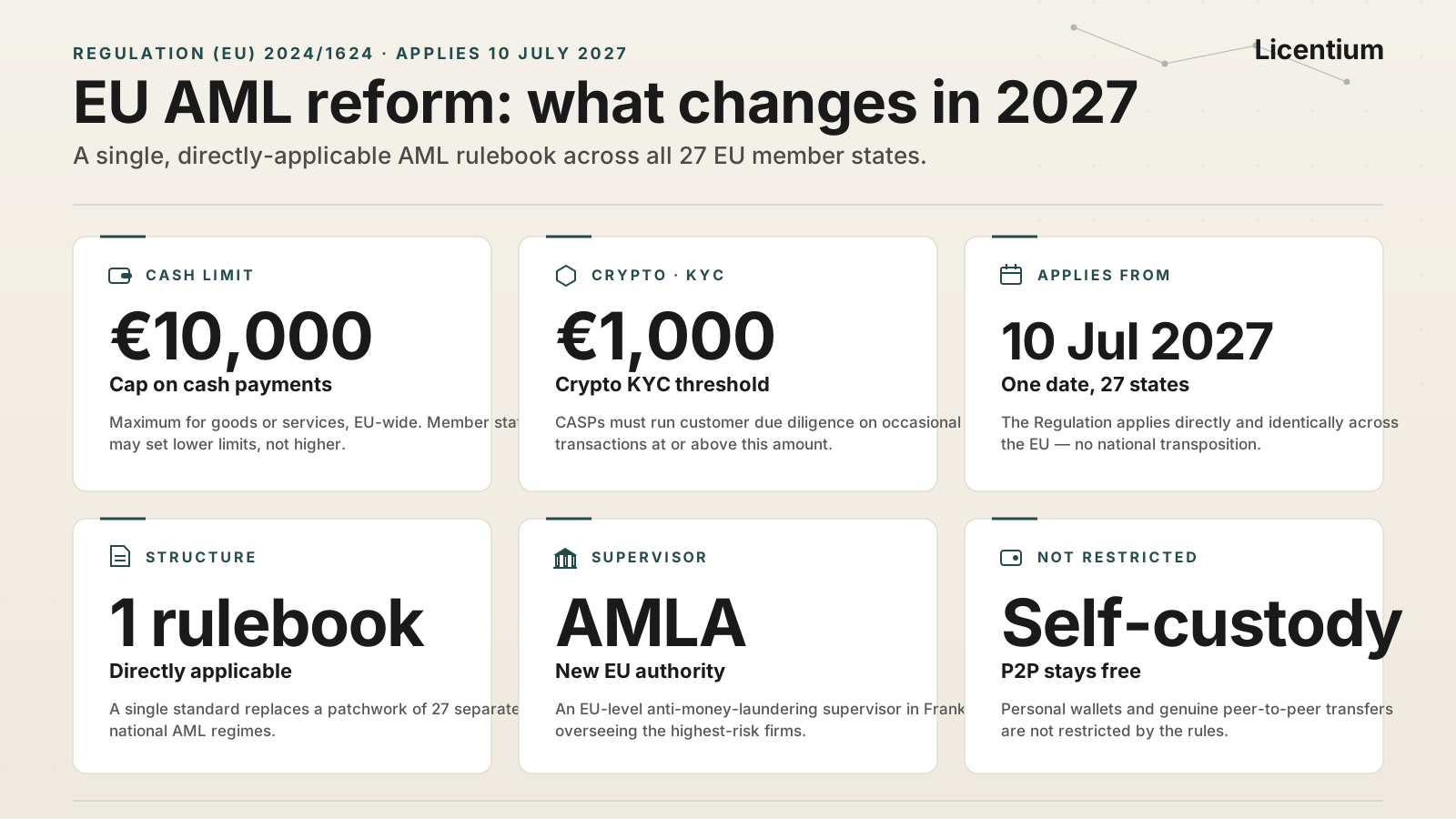
The EU’s new AML rules: a €10,000 cash cap and €1,000 crypto KYC from 2027
From 10 July 2027, the EU’s new Anti-Money Laundering Regulation caps cash payments at €10,000 and requires crypto services to run KYC on transactions from €1,000. What changes, who it affects, and how to prepare.
FSB Opens AI Adoption Sound Practices Consultation, 10 June 2026
The Financial Stability Board published a consultation report on sound practices for responsible AI adoption on 10 June 2026. It asks financial institutions and authorities for comments by 22 July 2026 on governance, risk management, data controls, model oversight, third-party dependencies, and incident management.

Reranking is the cheapest big win in legal retrieval
Adding a reranker was the single largest accuracy gain in the pipeline, and it cost almost nothing to add
CFTC Issues No-Action Relief for Crypto Perpetual Futures Conversion, 29 May 2026
The CFTC's Division of Market Oversight issued No-Action Letter 26-17 on 29 May 2026, permitting designated contract markets to convert existing perpetual-style digital commodity futures into true digital commodity perpetual futures without triggering Regulation 40.6 filing requirements. The letter expires 30 June 2026 and coincides with the Commission's first approval of a domestic bitcoin perpetual contract submitted by KalshiEX LLC.
EU Parliament Approves AI Act Simplification Amendments, June 2026
The European Parliament in June 2026 formally approved targeted amendments to Regulation (EU) 2024/1689, the Artificial Intelligence Act, as part of the Digital Omnibus package. The amendments defer application of Annex III high-risk AI obligations, introduce a ban on AI-generated non-consensual intimate imagery, and follow a political agreement between the Parliament and the Council of 7 May 2026.
Connecticut Enacts AI Disclosure and Chatbot Safety Law Public Act 26-15, 2 June 2026
Connecticut Governor Ned Lamont on 2 June 2026 signed Substitute Senate Bill No. 5, enacted as Public Act 26-15, into law. The statute imposes suicide prevention protocol obligations on AI chatbot operators, requires employers to disclose AI use in hiring and employment decisions, and mandates age verification, parental consent, and algorithmic content limits for minor users of social media platforms.
Discussion Draft of Great American AI Act Released by U.S. House Members, June 2026
Representatives Jay Obernolte and Lori Trahan on 4 June 2026 released a discussion draft of the Great American Artificial Intelligence Act, a bipartisan federal proposal to establish a national AI governance regime. The draft assigns primary regulatory authority to the Center for AI Standards and Innovation within the Department of Commerce and imposes audit and incident reporting requirements on frontier AI developers.
EU Council and Parliament Reach Political Agreement on AI Act Omnibus Simplification, May 2026
On 7 May 2026, the European Parliament and the Council of the EU reached a political agreement on the AI Omnibus regulation, amending the EU Artificial Intelligence Act. Key changes push high-risk AI system compliance to December 2027 and August 2028, add a ban on AI-generated non-consensual intimate content, extend SME exemptions to small mid-cap companies, and move the deadline for AI-generated content transparency to December 2026.
Manitoba Enacts Algorithmic Pricing Consent Rule and Public-Sector AI Governance Act, 1 June 2026
On 1 June 2026, the Manitoba Legislature granted Royal Assent to Bill 49 and Bill 51. Bill 49 amends the Business Practices Act to prohibit personalized algorithmic pricing without consumer consent. Bill 51 enacts the Public Sector Artificial Intelligence and Cybersecurity Governance Act, requiring government bodies, health authorities, universities, school divisions, and municipalities to publish AI accountability plans.
Canada Tables Protecting Privacy and Consumer Data Act with Automated Decision-Making Rules, June 2026
On 10 June 2026, Minister Evan Solomon tabled Bill C-36, the Protecting Privacy and Consumer Data Act, in Canada's Parliament. The bill replaces PIPEDA's private-sector provisions with mandatory meaningful consent, plain-language privacy explanations, and transparency requirements for automated decision-making that affects individuals. It is the most significant reform of Canadian private-sector privacy law in over 25 years.
UAE Establishes Federal Authority for Artificial Intelligence and Data by Decree, 14 June 2026
On 14 June 2026, Sheikh Mohammed bin Rashid Al Maktoum approved the establishment of the Federal Authority for Artificial Intelligence and Data, a unified cabinet-level body in the UAE. The Authority merges the UAE AI Office, the digital government sector of the Telecommunications and Digital Government Regulatory Authority, and the Emirates Data Office into one entity. It is led by Minister Omar Sultan Al Olama and reports directly to the UAE Cabinet.
OCC Proposes Reporting Forms for GENIUS Act Payment Stablecoin Issuers, June 2026
The Office of the Comptroller of the Currency published Bulletin 2026-24 on 12 June 2026, proposing weekly and quarterly reporting forms for permitted payment stablecoin issuers regulated under the GENIUS Act. The weekly Reporting Form PS-02 requires per-stablecoin reserve asset disclosures. The quarterly form covers financial condition data. Both forms are open for public comment until 11 August 2026.
Google Engineer Charged with Commodities Fraud on Polymarket Using Confidential Data, May 2026
On 27 May 2026, the U.S. Attorney for the Southern District of New York unsealed a criminal complaint charging Michele Spagnuolo, a Google staff software engineer, with commodities fraud, wire fraud, and money laundering. Spagnuolo allegedly used confidential internal Google Search data to place approximately $2.75 million in bets on Polymarket event contracts tied to Google's Year in Search report between October and December 2025, netting roughly $1.2 million in profit. The CFTC filed a parallel civil action seeking penalties and trading bans.
Georgia Enacts Payment Stablecoin Act, Establishing Issuer Licensing Regime, May 2026
On 11 May 2026, Georgia signed HB 1272 (Act 452), the Georgia Payment Stablecoin Act, into law. The statute directs the Georgia Department of Banking and Finance to license stablecoin issuers incorporated under Georgia or foreign law. Licensed issuers must maintain one-to-one reserves of eligible assets and may only engage in stablecoin issuance, redemption, reserve management, and related custodial activities. The law takes effect on the earlier of 18 January 2027 or 120 days after federal GENIUS Act implementing regulations are finalized.
European Commission Opens Targeted Consultation on MiCA Review, May 2026
On 20 May 2026, the European Commission launched a targeted consultation on Regulation (EU) 2023/1114, the Markets in Crypto-Assets Regulation (MiCA), running alongside a parallel public consultation. The targeted consultation spans 86 questions across four thematic blocks and invites responses from industry representatives and public authorities. Submissions close 31 August 2026, with results feeding into the Commission's review reports under Articles 140 and 142 of MiCA.
Italy Approves AI Act Implementing Decrees for Parliamentary Review, June 2026
On 10 June 2026, Italy's Council of Ministers approved two draft legislative decrees implementing Law No. 132/2025, the domestic AI statute aligned with EU Regulation 2024/1689. The decrees, announced in Press Release No. 177, cover national authority powers, AI in employment and education, biometric surveillance in law enforcement, civil liability for AI-caused harm, and new criminal offences. They are now subject to parliamentary advisory review before final promulgation.
Georgia Enacts Payment Stablecoin Act Establishing State Licensing Regime for Issuers, May 2026
Georgia enacted HB 1272, the Payment Stablecoin Act (Act 452), creating a state licensing and regulatory regime for payment stablecoin issuers. Licensed issuers must hold one-to-one reserves and are prohibited from paying interest or yield to holders. Provisions take effect on the earlier of 18 January 2027 or 120 days after the GENIUS Act's implementing regulations are finalised, with full enforcement beginning 18 July 2028.
White House Issues Executive Order 14409 on AI Innovation and Security, June 2026
On 2 June 2026, the White House issued Executive Order 14409, Promoting Advanced Artificial Intelligence Innovation and Security. The order directs federal agencies to upgrade government cybersecurity infrastructure, establishes a voluntary early-access program through which frontier AI developers may share model capabilities with federal authorities before deployment, creates an AI cybersecurity clearinghouse, and directs enforcement resources toward criminal misuse of AI systems.
European Commission Launches Targeted MiCA Review Consultation, 20 May 2026
On 20 May 2026, the European Commission opened a targeted consultation and a public consultation on the review of Regulation (EU) 2023/1114 on Markets in Crypto-Assets (MiCA). The consultations assess whether MiCA remains fit for purpose following full application from December 2024 and invite submissions from digital asset issuers, crypto-asset service providers (CASPs), financial institutions, technology providers, and public authorities. Responses are due by 31 August 2026.
CFTC and DOJ Charge Google Engineer with Prediction Market Insider Trading Using Confidential Data, 2026
The CFTC and the US Attorney's Office for the Southern District of New York charged Michele Spagnuolo, a Google software engineer trading as 'AlphaRaccoon' on Polymarket, with commodities fraud, wire fraud, and money laundering. Spagnuolo allegedly used confidential Google 'Year in Search 2025' data to trade at least 23 event contracts on Polymarket from October to December 2025, risking approximately $2.75 million and generating roughly $1.2 million in profits.
Italy Council of Ministers Approves Draft EU AI Act Implementing Decrees, 10 June 2026
On 10 June 2026, the Italian Council of Ministers (meeting n. 177) granted preliminary approval to two draft legislative decrees implementing Regulation (EU) 2024/1689 (the EU AI Act). The first decree covers national supervisory authority powers and AI use in education. The second addresses police use of AI and civil and criminal AI liability. Both implement the delegation in Law No. 132 of 23 September 2025 and remain subject to parliamentary committee review before final adoption.
White House Issues Executive Order 14409 Promoting Advanced AI Innovation and Security, 2 June 2026
President Trump signed Executive Order 14409, 'Promoting Advanced Artificial Intelligence Innovation and Security,' on 2 June 2026. The Order directs executive agencies to prioritize cyber defense of National Security Systems, Department of War information systems, and civilian federal infrastructure, and to protect US AI intellectual property from foreign adversary theft. The Order was published in Federal Register Volume 91, Number 108 on 5 June 2026.

Embedding Model Selection for Citation-Grounded Retrieval over European Union Financial and AI Regulation
We report a controlled empirical comparison of five text-embedding models for first-stage semantic retrieval over a corpus of consolidated European Union legislation governing crypto-assets, anti-money-laundering, digital operational resilience, and artificial intelligence.
OCC Interpretive Letter 1192: National Bank Act Preempts State Money Transmitter Licensing for Digital Asset Activities, May 2026
The OCC published Interpretive Letter 1192 on May 12, 2026, confirming that the National Bank Act preempts state money transmitter licensing laws for national banks conducting digital asset activities. The Letter arose from Fidelity Digital Assets' request for confirmation that Iowa's money transmitter law does not apply to its national trust bank operations. The OCC held that state money transmitter laws requiring national banks to obtain state licenses, or vesting states with visitorial authority over national banks, are preempted.
House Ways and Means Committee Holds Digital Asset Tax Legislative Hearing, June 9, 2026
The House Ways and Means Committee held a full-committee legislative hearing on June 9, 2026, examining eight bills and discussion drafts on digital asset taxation. The hearing, the Committee's first legislative hearing on digital asset tax rules in years, covered proposals addressing mining and staking income classification, de minimis transaction reporting exemptions, charitable deduction rules for crypto donations, and extension of wash-sale and anti-abuse provisions to digital assets.
Trump Signs Executive Order Promoting AI Innovation and Security, June 2, 2026
President Trump signed the Executive Order 'Promoting Advanced Artificial Intelligence Innovation and Security' on June 2, 2026, directing federal agencies to establish a voluntary cybersecurity arrangement for frontier AI models and create an AI cybersecurity clearinghouse. The Order bars mandatory federal licensing or permitting requirements for AI model development and release, and directs the Attorney General to prioritize enforcement against AI-enabled criminal activity.
CFTC Proposes First Federal Rulemaking for Prediction Market Event Contracts, United States, June 2026
On 10 June 2026, the U.S. Commodity Futures Trading Commission issued a Notice of Proposed Rulemaking on event contracts offered on designated contract markets. The proposal is the first CFTC rulemaking specifically addressed to prediction market contracts. It sets out a three-part public-interest test, establishes a 90-day review period for individual contracts, would categorically prohibit war and assassination contracts, and declines to prohibit sports wagering contracts. A 45-day public comment period closes approximately 25 July 2026.
European Commission Issues Draft Guidelines on High-Risk AI System Classification, EU, May 2026
On 19 May 2026, the European Commission published draft guidelines on the classification of high-risk AI systems under Article 6 of Regulation (EU) 2024/1689, the EU AI Act. A targeted public consultation is open until 23 July 2026. The guidelines aim to assist providers, deployers, and market surveillance authorities in determining which AI systems trigger the Act's most onerous compliance obligations. Final guidelines are expected before end of 2026.
European Commission Publishes Draft EU AI Act Transparency Guidelines on Deepfakes, EU, May 2026
On 8 May 2026, the European Commission published draft guidelines on the transparency obligations under Article 50 of the EU AI Act. The guidelines cover disclosure requirements for providers of AI chatbots, systems generating synthetic audio, image, video, or text, emotion recognition systems, and deployers of deepfake content. A public consultation closed on 3 June 2026. Final guidelines are expected by 2 August 2026, when the Article 50 obligations become applicable.
South Carolina Governor Signs S. 163 Creating Digital Asset and CBDC Framework, May 2026
South Carolina Governor Henry McMaster signed S. 163 into law on May 19, 2026, establishing statewide protections for digital asset use. The law bars state agencies from accepting or mandating central bank digital currency payments, protects the right to use digital assets as payment for goods and services, exempts digital asset miners and blockchain software developers from money transmitter licensing, and prohibits additional state taxes on cryptocurrency transactions.
CFTC Issues Notice of Proposed Rulemaking on Event Contracts and Prediction Markets, June 2026
The Commodity Futures Trading Commission published a Notice of Proposed Rulemaking on June 10, 2026, proposing amendments to 17 C.F.R. section 40.11 and a new Appendix F to Part 40. The proposals establish a 90-day contract-by-contract review process for event contracts on prediction markets that may involve activities enumerated in Section 5c(c)(5)(C) of the Commodity Exchange Act, including gaming, terrorism, war, assassination, and conduct unlawful under federal or state law.
France Enacts Decree 2026-60 Establishing Experimental JONUM Regime for Monetisable Digital Gaming Objects, February 2026
Decree No. 2026-60 of 4 February 2026, in force from 7 February 2026, establishes France's experimental regulatory regime for jeux à objets numériques monétisables (JONUM) under the loi SREN. The regime applies to games meeting four cumulative criteria: financial sacrifice, a chance element, access via an online platform, and the award of monetisable digital objects including NFTs and utility tokens. Operators must file a prior declaration with the Autorité nationale des jeux before offering JONUM to the public. Casino mechanics and cash payouts in legal tender are prohibited.
UK Crime and Policing Act 2026 Criminalises Unsafe AI Chatbot Supply, United Kingdom, April 2026
The UK Crime and Policing Act 2026 received Royal Assent on 29 April 2026. Section 255 creates three criminal offences for AI chatbot suppliers: deploying a chatbot that produces illegal content, failing to conduct an adequate risk assessment, and failing to mitigate identified risks of harm. Convictions on indictment carry a maximum sentence of five years' imprisonment. The Act brings AI chatbot providers within scope of the Online Safety Act 2023 illegal content obligations.
European Commission Opens Consultation on MiCA Review, Deadline 31 August 2026
On 20 May 2026, the European Commission launched a public consultation and a parallel targeted consultation on the review of Regulation (EU) 2023/1114 (MiCA). Authorized crypto-asset service providers, issuers of asset-referenced tokens and e-money tokens, financial institutions, and technology providers have until 23:59 CEST on 31 August 2026 to submit responses. The Commission will use the consultation to prepare a report under Articles 140 and 142, which may be accompanied by a legislative proposal to amend MiCA.
Senator Warren Demands CFTC Records on Prediction Market and Crypto Oversight in June 2026
Senator Elizabeth Warren sent a letter to CFTC Chairman Michael Selig demanding records on prediction market and crypto oversight by 18 June 2026. The demand follows a reported 25% CFTC workforce reduction and a drop in crypto enforcement actions from 58 in FY2024 to 11 since January 2025. Warren cited potential conflicts of interest in CFTC approvals of Polymarket and a vacated penalty for a crypto exchange.
Senator Warren Demands CFTC Records on Crypto and Prediction Market Oversight, June 2026
Senator Elizabeth Warren wrote to CFTC Chairman Michael Selig on or around 9 June 2026, demanding records on the agency's oversight of cryptocurrency and prediction markets by 18 June 2026. The demand covers staff separation records since January 2025, the administrative records behind no-action letters to Polymarket and Gemini, and all communications between prediction market operators and the CFTC connected to the Clarity Act. The Senator cited a 25% workforce reduction and a steep decline in enforcement actions.
NYDFS Proposes GENIUS Act-Aligned Payment Stablecoin Regulation, New York, June 2026
On 9 June 2026, the New York State Department of Financial Services Acting Superintendent Kaitlin Asrow announced a proposed regulation for payment stablecoin issuers. The proposal aligns DFS's existing June 2022 stablecoin guidance with requirements of the federal GENIUS Act, adds reserve concentration limits, and mandates risk management programs. A 10-day preproposal comment period opened on 9 June 2026, followed by a 60-day comment period upon publication in the State Register.
European Commission Opens MiCA Review Consultation with August 2026 Deadline
On 20 May 2026, the European Commission launched a targeted consultation on the functioning of Regulation (EU) 2023/1114 (MiCA). The consultation addresses scope gaps including DeFi, staking, NFTs, and lending activities not currently regulated under MiCA. Submissions close 31 August 2026 and will inform a potential legislative proposal to amend the regulation.
EBA and NYDFS Sign Cross-Border Stablecoin Supervisory Cooperation MoU, June 2026
On 2 June 2026, the European Banking Authority and the New York State Department of Financial Services signed a Memorandum of Understanding on supervisory cooperation for entities conducting cross-border stablecoin activities. The MoU was executed under Article 126 of Regulation (EU) 2023/1114 (MiCA), which authorises the EBA to conclude administrative arrangements with third-country supervisory authorities where equivalent confidentiality standards are confirmed.
European Commission Publishes Draft Guidelines on High-Risk AI System Classification, June 2026
The European Commission published draft guidelines to help providers and deployers of artificial intelligence systems determine whether a given system qualifies as high-risk under Annex III of Regulation (EU) 2024/1689, the EU AI Act. A targeted industry consultation was open until 23 June 2026, with the deadline extended to 23 July 2026. The Commission plans to adopt final guidelines by the end of 2026.
Australia's Gambling Reform Bill 2026 Targets Online Trade Promotions Starting January 2027
The Australian Government has introduced the Interactive Gambling Amendment (Stop the Gambling Ads) Bill 2026 to Parliament and announced amendments to the Interactive Gambling Act 2001 (Cth) commencing 1 January 2027. The reforms address subscription-based rewards programs structured as recurring lottery-style prize draws, which the Government characterises as 'shadow lottery' arrangements currently outside Commonwealth regulation.
European Commission Publishes Draft Guidelines on High-Risk AI Classification on 19 May 2026
On 19 May 2026, the European Commission published draft non-binding guidelines on the classification of high-risk AI systems under Article 6 of Regulation (EU) 2024/1689 (the EU AI Act). The guidelines address agentic and multi-component AI architectures. The Article 6(3) filter cannot be applied at the component level where an AI system contributes to a high-risk use case. A targeted consultation runs until 23 July 2026.
EBA and NYDFS Sign Stablecoin Supervisory Cooperation MoU on 2 June 2026
On 2 June 2026, the European Banking Authority and the New York State Department of Financial Services signed a non-binding Memorandum of Understanding to coordinate supervision of cross-border stablecoin activities. The agreement provides for quarterly data exchanges, joint inspections, and crisis coordination under the MiCA regime and New York's virtual currency licensing regime.
Colorado Enacts SB 26-189 Replacing Prior AI Consumer Rules with Automated Decision-Making Technology Obligations, 2026
Colorado SB 26-189, the Automated Decision-Making Technology Act, repeals and replaces the consumer AI protections in SB 24-205, establishing new obligations for developers and deployers of covered automated decision-making technology in consequential decisions. Developer obligations take effect 1 January 2027. Violations constitute deceptive trade practices under the Colorado Consumer Protection Act, enforceable by the Attorney General.
UK Designates 18 Cryptocurrency Exchanges Under Russia Sanctions Regulations, 26 May 2026
On 26 May 2026, the UK designated 18 cryptocurrency exchanges under The Russia (Sanctions) (EU Exit) Regulations 2019, including Huobi Global S.A., operator of HTX, and three Georgian Russia-focused exchanges. OFSI confirmed HTX is subject to UK financial sanctions by reason of Huobi's ownership. The action marks the first time the UK has directly sanctioned cryptocurrency exchanges in connection with Russian sanctions evasion.
European Commission Opens Consultation on Draft Guidelines for High-Risk AI System Classification Under Article 6, June 2026
The European Commission has published draft guidelines clarifying when an AI system qualifies as high-risk under Article 6 of Regulation (EU) 2024/1689 (AI Act). A targeted consultation is open until 23 June 2026. The guidelines are not legally binding but reflect the Commission's interpretation and will guide market surveillance authorities and AI providers in applying the high-risk classification rules.
Rwanda Publishes Law on Virtual Asset Business in Official Gazette, 28 May 2026
On 28 May 2026, Rwanda published its Law on Virtual Asset Business in the Official Gazette, entering into force upon publication. The Capital Market Authority (CMA) is designated as the lead licensing authority. The National Bank of Rwanda (BNR) holds co-regulatory authority over systemic risk and payment systems. Only incorporated legal entities may provide virtual asset services. Implementation regulations from the CMA and BNR are pending.
CFTC Approves Bitcoin Perpetual Futures Contract and SEC Issues Joint Crypto Securities Interpretation, 29 May 2026
On 29 May 2026, the U.S. Commodity Futures Trading Commission approved the listing of a bitcoin perpetual futures contract by KalshiEX LLC. The SEC and CFTC jointly issued an interpretation clarifying how federal securities laws apply to crypto assets, accompanied by a CFTC no-action letter permitting futures commission merchants to transfer customer crypto margin to foreign brokers. The coordinated actions are the first to bring perpetual crypto contracts into the U.S. regulatory system.
CFTC Proposes First Event Contract Rules for Prediction Markets, United States, June 2026
On 10 June 2026, the U.S. Commodity Futures Trading Commission released a notice of proposed rulemaking establishing a review process for determining whether event contracts fall within statutory prohibitions under Section 5c(c)(5)(C) of the Commodity Exchange Act. The proposal amends CFTC Regulation 40.11 and adds Appendix F to Part 40. It sets a three-part sequential test and a 90-day review window for individual contracts, paired with a multi-factor public interest analysis. CFTC Chairman Mike Selig described the measure as creating a durable, transparent process while permitting legitimate markets to operate.
Trump Signs Executive Order on AI Cybersecurity and Frontier Model Review, United States, June 2026
President Trump signed the Executive Order 'Promoting Advanced Artificial Intelligence Innovation and Security' on 2 June 2026, directing federal agencies to deploy AI-enabled cyber defenses within 30 days, establishing a voluntary arrangement for pre-release government access to covered frontier AI models within 60 days, and creating an AI cybersecurity clearinghouse coordinated by the Secretary of the Treasury. The order charges the Attorney General with prioritizing criminal enforcement under 18 U.S.C. 1028, 1030, and 1343 against those who use AI to unlawfully access or damage computer systems. No mandatory licensing or pre-clearance requirement for AI models is created.
Colorado Signs SB 189 Replacing State AI Act with Narrower Disclosure Law, May 2026
Colorado Governor Jared Polis signed Senate Bill 26-189 on 14 May 2026, repealing and replacing the Colorado Artificial Intelligence Act (SB 24-205) before its 30 June 2026 effective date. The replacement law removes the duty of care, mandatory impact assessments, and risk management programs for high-risk AI systems and institutes a disclosure-based regime covering automated decision-making technology used in consequential decisions spanning employment, financial services, healthcare, and housing. The new law takes effect on 1 January 2027.
European Commission Publishes Draft Guidelines Classifying High-Risk AI Systems Under Article 6, May 2026
On May 19, 2026, the European Commission published draft guidelines on the classification of high-risk AI systems under Article 6 of Regulation (EU) 2024/1689 (EU AI Act), open for consultation until June 23, 2026. The guidelines interpret key classification concepts and provide worked examples across eight Annex III sectors. The Commission has also postponed Article 6(2) compliance from August 2026 to December 2027 and Article 6(1) from August 2027 to August 2028.
Connecticut Enacts Sweeping AI Law Covering Employment, Healthcare, and Online Safety in June 2026
Connecticut Governor Ned Lamont signed Senate Bill 5 on June 2, 2026, enacting the Connecticut Artificial Intelligence Responsibility and Transparency Act (CART Act, Public Act 26-15). The law creates disclosure obligations for employers using AI in hiring and layoff decisions, safety protocols for chatbot operators, and content-provenance requirements for large-scale generative AI systems. Compliance deadlines run from October 2026 through January 2028.
New Zealand Online Casino Gambling Regulations 2026 Released, Effective July 2026
New Zealand released the Online Casino Gambling Regulations 2026 in June 2026, made under the Online Casino Gambling Act 2026 (Public Act 2026 No 14). The prohibition on unlicensed online casino gambling applies from 1 July 2026. The Act establishes a three-stage licensing regime for up to 15 operators, administered by the Secretary for Internal Affairs, with age-verification, harm-minimisation, and problem-gambler exclusion obligations.
US Tax Court Holds Crypto Staking Rewards Are Gross Income at Receipt, June 2026
On June 4, 2026, the United States Tax Court issued T.C. Memo. 2026-46 in Paschall v. Commissioner, the first Tax Court decision on whether proof-of-stake staking rewards are taxable upon receipt. The court entered decision for the Commissioner of Internal Revenue, holding that ADA staking rewards credited to petitioners' eToro account constituted gross income under IRC Section 61 at receipt. The opinion is non-precedential but is the first judicial merits ruling on this question.
CFTC Issues Policy Statement and Approves First Onshore Bitcoin Perpetual Contract, May 2026
On May 29, 2026, the CFTC approved KalshiEX LLC's BTCPERP contract as the first bitcoin perpetual futures contract listed on a US-registered designated contract market and issued a Policy Statement establishing that perpetual crypto contracts require individual Commission approval under Regulation 40.3. The actions bring the dominant form of global crypto derivative trading into the US regulated perimeter for the first time.
Hong Kong SFC and FSTB Conclude VA Advisory and Management Consultation, 26 May 2026
The Securities and Futures Commission (SFC) and the Financial Services and the Treasury Bureau (FSTB) of Hong Kong published consultation conclusions on proposed licensing regimes for virtual asset advisory service providers and virtual asset management service providers on 26 May 2026. The regimes are modelled on existing Securities and Futures Ordinance regulated activities and form the final segment of Hong Kong's full virtual asset regulatory architecture under the SFC ASPIRe roadmap.
European Commission Opens Consultation on MiCA Review, Deadline 31 August 2026
The European Commission launched a two-track consultation on the functioning of Regulation (EU) 2023/1114 on markets in crypto-assets (MiCA) on 20 May 2026. The consultation is mandated by Articles 140 and 142 of MiCA and runs until 31 August 2026. Responses from CASPs, ART and EMT issuers, financial institutions, and technology providers will inform a Commission report that may be accompanied by a legislative proposal to amend MiCA.
President Trump Signs Executive Order on AI Innovation and Security, United States, 2 June 2026
On 2 June 2026, President Donald Trump signed Executive Order 2026-11415, Promoting Advanced Artificial Intelligence Innovation and Security, published in the Federal Register on 5 June 2026. The order directs federal agencies to modernize government information systems, protect American AI intellectual property from foreign adversaries, and cultivate national AI capabilities. It establishes voluntary cooperation with the private sector and imposes no direct compliance obligations on private AI developers.
EU Parliament and Council Reach Provisional Agreement on AI Act Simplification, 7 May 2026
The European Parliament and Council reached a provisional political agreement on 7 May 2026 to streamline Regulation 2024/1689 laying down harmonised rules on artificial intelligence. The agreement, part of the EU Omnibus VII simplification package, extends application deadlines for high-risk AI systems, broadens exemptions to small mid-cap companies, and bans AI systems that generate non-consensual intimate images. Formal adoption by both institutions is expected before 2 August 2026.
MAS and Industry Publish AI Risk Management Toolkit for Singapore Financial Sector, 2026
The Monetary Authority of Singapore concluded Project MindForge Phase 2 in early 2026, publishing an AI Risk Management Operationalisation Handbook developed with a consortium of 24 banks, insurers, and capital market firms. The handbook provides practical implementation guidance across traditional AI, generative AI, and agentic AI systems, and applies alongside the MAS Guidelines for Artificial Intelligence Risk Management to establish supervisory expectations for Singapore-regulated financial institutions.
House of Lords Committee Publishes Report on UK Stablecoin Regulation, 3 June 2026
On 3 June 2026, the House of Lords Financial Services Regulation Committee published 'Stablecoins: waiting for regulation,' assessing the Bank of England's and the Financial Conduct Authority's proposed regulatory regimes for stablecoins in the UK. The Committee broadly supports the proposals but recommends reconsideration of holding limits, the requirement for unremunerated backing assets, and the proposed restriction on commercial banks issuing fiat-backed stablecoins.
FCA and Bank of England Call for Input on UK Wholesale Market Tokenisation, May 2026
On 18 May 2026, the Financial Conduct Authority, the Bank of England, and the Prudential Regulation Authority published a joint call for input setting out a shared vision for the safe adoption of tokenisation in UK wholesale financial markets. The consultation covers tokenised bonds, equities, and fund units and closes 3 July 2026. Responses will inform a joint roadmap aligned with the Government's Wholesale Financial Markets Digital Strategy.
EU Commission Publishes Draft High-Risk AI Classification Guidelines Under AI Act, May 2026
On 19 May 2026, the European Commission published draft guidelines under Article 6(5) of the EU AI Act (Regulation 2024/1689) to help providers, deployers, and market surveillance authorities determine when an AI system qualifies as high-risk. The guidelines cover two classification routes: systems used as safety components in products subject to Annex I harmonisation legislation, and systems falling within the Annex III use-case list. A targeted consultation closes 23 June 2026.
U.S. Executive Order Establishes Voluntary Frontier AI Pre-Release Review, 2 June 2026
On 2 June 2026, President Trump signed the Executive Order 'Promoting Advanced Artificial Intelligence Innovation and Security,' directing federal agencies to develop benchmarks for assessing AI models' cyber capabilities, establish an AI cybersecurity clearinghouse, and strengthen government defenses against AI-enabled threats. The Order creates a voluntary program under which AI developers may submit frontier models for government review up to 30 days before releasing them to other trusted partners. No mandatory licensing, pre-clearance, or permitting requirement is created.

AI Governance Compliance Stack
What compliance architecture should an organization implement to manage AI governance obligations under the EU AI Act, selected U.S. state AI laws, NIST AI RMF / NIST GenAI Profile, ISO/IEC 42001, vendor due diligence, system inventory, risk classification, and incident response?
Connecticut Senate Bill 5 Establishes AI Consumer Protections and Employment Obligations, May 2026
Connecticut Senate Bill 5, the C.A.R.T. Act, passed both chambers of the Connecticut General Assembly in May 2026 and awaits Governor Ned Lamont's signature. The bill requires operators of AI automated decision tools to disclose their use in employment, lending, and housing decisions, and mandates mental health crisis protocols for AI chatbot operators serving consumers.
FDIC Proposes BSA/AML Compliance Rules for Stablecoin Issuers Under the GENIUS Act, 2026
The FDIC Board approved two notices of proposed rulemaking in April 2026 implementing the Guiding and Establishing National Innovation for US Stablecoins (GENIUS) Act. One proposed rule imposes Bank Secrecy Act and sanctions compliance requirements on FDIC-supervised permitted payment stablecoin issuers. Comments on both proposals close 9 June 2026.
European Commission Opens Targeted Consultation on MiCA Review, Deadline 31 August 2026
On 20 May 2026, the European Commission launched a targeted consultation assessing whether the Markets in Crypto-Assets Regulation (MiCA) remains fit for purpose. The consultation covers decentralized finance, stablecoin scope, interplay with PSD3, cybersecurity, and cross-border equivalence for third-country crypto-asset service providers. Responses are due by 31 August 2026.
Trump Signs Executive Order on AI Security and Voluntary Pre-Release Review, 2 June 2026
On 2 June 2026, President Trump signed an Executive Order titled Promoting Advanced Artificial Intelligence Innovation and Security. The order directs federal agencies to harden government information systems against AI-enabled threats, establishes a voluntary pre-release review process for frontier AI models, and calls for inter-agency coordination to protect American AI intellectual property from adversarial exploitation.
FCA and Bank of England Publish Joint Vision on UK Wholesale Market Tokenisation, May 2026
On 18 May 2026, the Financial Conduct Authority and the Bank of England jointly published a call for input setting out their shared vision for tokenisation in UK wholesale financial markets. The paper commits the Bank to launching a live synchronisation service by 2028 and confirms tokenised equivalents of eligible assets may be used as central bank collateral. Feedback closes 3 July 2026.
Agentic AI Liability and Autonomous Decision-Making
When an agentic or autonomous AI system makes, recommends, ranks, screens, contracts, or otherwise materially influences a decision, who bears legal liability, and what legal duties govern autonomous decision-making?
SEC Proposes Token Taxonomy Clarifying Federal Securities Laws for Crypto Assets, March 2026
In March 2026, the SEC proposed an interpretive release (Release No. 33-11412, File No. S7-2026-09) establishing a token taxonomy and clarifying the application of federal securities laws to crypto assets. The taxonomy designates digital commodities, digital collectibles, digital tools, and qualifying payment stablecoins as generally outside the securities perimeter. Only tokenised traditional securities remain subject to registration and disclosure requirements.
UK HM Treasury Publishes Draft SI on Stablecoin Payment Services Exemption, April 2026
In April 2026, HM Treasury published a draft statutory instrument amending the Financial Services and Markets Act 2000 (Cryptoassets) Regulations 2026. The draft SI proposes to exempt firms providing stablecoin payment services from the cryptoasset dealing and arranging authorisation requirements pending broader payment services reform, avoiding a dual-authorisation burden ahead of the October 2027 deadline.
European Commission Publishes Draft Guidelines on High-Risk AI Classification Under Article 6, 2026
The European Commission has published draft guidelines clarifying when AI systems qualify as high-risk under Article 6 of the EU AI Act (Regulation (EU) 2024/1689). The guidelines address two classification routes and provide practical examples of in-scope and out-of-scope AI systems. Public consultation closes 23 June 2026.
India Notifies Promotion and Regulation of Online Gaming Rules 2026, Effective 1 May 2026
India's Ministry of Electronics and Information Technology notified the Promotion and Regulation of Online Gaming Rules, 2026 on 22 April 2026, with effect from 1 May 2026. The rules establish the Online Gaming Authority of India under the Promotion and Regulation of Online Gaming Act, 2025, and require operators to register online money games before offering them to players.
EU Council and Parliament Agree to Simplify AI Act and Delay High-Risk Deadlines, May 2026
On 7 May 2026, the Council of the EU and European Parliament negotiators reached a provisional political agreement on the Digital Omnibus on AI Regulation. The agreement delays mandatory high-risk AI compliance dates to 2 December 2027 and 2 August 2028, extends simplified obligations to small mid-cap companies, and introduces a new ban on AI-generated non-consensual intimate imagery.

Privacy, GDPR, and Personal Data in AI Models
When does the GDPR treat data used in, generated by, or retained in AI models as “personal data,” what legal bases and obligations apply to model training and deployment, and what are the consequences if an AI model was developed using personal data unlawfully?

Native Tokenization of Equity
The working topic is whether a token or DLT ledger can be legally constitutive of equity ownership and transfer, rather than a mirror of an off-chain register, a custodial entitlement, or a synthetic exposure.
SEC Proposes Registered Offering Reform with Implications for Digital Asset Issuers, 19 May 2026
On 19 May 2026, the U.S. Securities and Exchange Commission proposed Rule 33-11418, amending the framework governing registered public securities offerings under the Securities Act of 1933. The proposal would expand Form S-3 access to significantly more issuers, extend shelf registration to nearly all public companies, and preempt state securities law for all registered offerings, with material implications for digital asset companies seeking to raise capital in U.S. registered offerings.
CFTC Charges Google Engineer with Insider Trading in Prediction Market Event Contracts, May 2026
The U.S. Commodity Futures Trading Commission filed a civil complaint against a Google software engineer, charging him with misappropriating confidential nonpublic data about Google's Year in Search list for 2025 to trade event contracts on Polymarket, a decentralised finance prediction market on the Polygon blockchain, in violation of the Commodity Exchange Act.
European Commission Opens Dual Consultation on MiCA Scope, Stablecoins and CASPs, 20 May 2026
On 20 May 2026, the European Commission's Directorate-General for Financial Stability, Financial Services and Capital Markets Union launched two simultaneous consultations reviewing Regulation (EU) 2023/1114 (MiCA): a public consultation for all stakeholders and a targeted technical consultation for industry, covering the regulation's scope, stablecoin treatment, and crypto-asset service provider obligations.
European Commission Publishes Draft Guidelines on High-Risk AI System Classification, 19 May 2026
The European Commission published draft guidelines on 19 May 2026 on classifying AI systems as high-risk under Article 6 of Regulation (EU) 2024/1689. The guidelines are open for targeted consultation until 23 June 2026. They are not legally binding but represent the Commission's interpretive position and will guide market surveillance authorities in enforcement.
EU Council and Parliament Agree to Delay High-Risk AI Compliance Deadlines, 7 May 2026
On 7 May 2026, the European Parliament and Council of the European Union reached a provisional political agreement under the Digital Omnibus package to amend Regulation (EU) 2024/1689 (the EU AI Act). The agreement postpones the application of high-risk AI obligations under Articles 6(1) and 6(2) and adds a new prohibition on AI-generated non-consensual intimate imagery. Formal adoption is expected before 2 August 2026.
Colorado Enacts Senate Bill 26-189 Replacing Colorado AI Act with ADMT Law, 14 May 2026
On 14 May 2026, Colorado Governor Jared Polis signed Senate Bill 26-189, repealing the 2024 Colorado AI Act and replacing it with the Colorado Automated Decision-Making Technology in Consequential Decisions Act. The new law takes effect 1 January 2027. It preserves consumer notice requirements but eliminates mandatory risk management program obligations and annual impact assessments.
NYDFS Issues Two Industry Letters on Frontier AI Cybersecurity Risks, 21 May 2026
On 21 May 2026, the New York Department of Financial Services issued two Industry Letters directed at entities regulated under 23 NYCRR Part 500. The first addresses heightened cybersecurity risks posed by frontier AI models. The second provides guidance on protective measures in an elevated threat environment. Neither letter imposes new legal requirements, but both signal NYDFS examination expectations for covered entities.
New Zealand Online Casino Gambling Act 2026 Enters Into Force, 1 May 2026
New Zealand's Online Casino Gambling Act 2026 received Royal Assent on 27 April 2026 and entered into force on 1 May 2026. The Act establishes a licensing regime for up to 15 online casino operators and prohibits new offshore providers from serving New Zealand customers. Existing offshore operators may continue under transitional arrangements until 1 December 2026.
UK Cryptoassets Regulations 2026 Set Full Regulatory Regime to Commence October 2027
The Financial Services and Markets Act 2000 (Cryptoassets) Regulations 2026, Statutory Instrument 2026 No. 102, designates specified cryptoasset activities as regulated activities under the Financial Services and Markets Act 2000, with the regime coming into force on 25 October 2027. Firms must apply to the FCA for authorisation from 30 September 2026, with the application window closing 28 February 2027. The regime covers stablecoin issuance, custody, trading platform operation, dealing, arranging, and staking.
UK Regulators Issue Joint Statement on Frontier AI Cyber Resilience, 15 May 2026
On 15 May 2026, the Financial Conduct Authority, Bank of England, and HM Treasury issued a joint statement identifying frontier AI models as a material cybersecurity threat requiring immediate action from regulated financial firms and financial market infrastructures. The statement does not introduce new rules but carries supervisory weight, placing frontier AI risk within existing operational resilience obligations and calling on boards to demonstrate active oversight.
NYDFS Issues Dual Industry Letters on Frontier AI Cybersecurity Risks, 21 May 2026
On 21 May 2026, the New York Department of Financial Services issued two coordinated Industry Letters under Acting Superintendent Kaitlin Asrow. The first identifies heightened cybersecurity risks from frontier AI models that amplify the speed, scale, and potency of attacks against regulated entities. The second provides prescriptive guidance on additional measures in a heightened threat environment, covering attack-surface reduction, threat detection, and resilience planning.
AUSTRAC Launches VASP Supervisory Campaigns as AML/CTF Reforms Take Effect, 2026
The Australian Transaction Reports and Analysis Centre has launched two targeted supervisory campaigns into the virtual assets sector as Australia's revised anti-money laundering and counter-terrorism financing legislation reshapes obligations for virtual asset service providers. Obligations for most newly classified VASPs took effect from 31 March 2026, with travel rule requirements commencing 1 July 2026. New VASPs must register with AUSTRAC by 29 July 2026.
DTCC Connects Tokenization Service to Stellar Public Blockchain, 27 May 2026
On 27 May 2026, the Depository Trust and Clearing Corporation announced its forthcoming DTC tokenization service will connect to the Stellar public blockchain, advancing a multi-chain settlement strategy for tokenized securities held in DTC custody. The service, authorized by SEC no-action letter in December 2025, targets initial tokenized security trades in July 2026 with a full commercial launch in October 2026. Over 50 financial firms are participating in development.
European Commission Opens Targeted Consultation on MiCA Review, 20 May 2026
On 20 May 2026, the European Commission launched a targeted consultation on the review of Regulation (EU) 2023/1114 on Markets in Crypto-Assets (MiCA). The consultation invites digital asset issuers, crypto-asset service providers, financial institutions, and industry bodies to assess whether MiCA's provisions remain fit for purpose following first-application experience since December 2024.
Missouri AG Sues CoinFlip Cryptocurrency ATM Network Over Consumer Protection Violations, 20 May 2026
On 20 May 2026, Missouri Attorney General Catherine Hanaway filed suit in the Circuit Court of Jasper County against GPD Holdings LLC, operating as CoinFlip, the self-described world's largest cryptocurrency ATM network by transaction volume. The petition alleges CoinFlip violated the Missouri Merchandising Practices Act by knowingly facilitating fraud through its 140-plus Missouri kiosks and charging excessive fees on affected transactions.
European Commission Publishes Draft Guidelines on High-Risk AI Classification Under AI Act, 19 May 2026
On 19 May 2026, the European Commission published draft guidelines on the classification of high-risk artificial intelligence systems under Article 6 of Regulation (EU) 2024/1689 (the AI Act). Open for targeted consultation until 23 June 2026, the guidelines aim to support uniform application of high-risk classification rules by providers, deployers, and market surveillance authorities across EU member states.
Colorado Governor Signs SB 26-189, Replacing 2024 AI Act Effective 1 January 2027
Colorado Governor Jared Polis signed Senate Bill 26-189 on 14 May 2026, repealing and replacing the 2024 Consumer Protections for Artificial Intelligence Act. The revised law narrows its predecessor's scope, replacing duties of care and risk management obligations with pre-use notice, post-adverse-outcome disclosure, and consumer rights tied to covered automated decision-making technology. The law takes effect 1 January 2027.
US Executive Order 14405 Directs Federal Regulators to Review Fintech and Digital Asset Frameworks, 19 May 2026
President Trump signed Executive Order 14405, "Integrating Financial Technology Innovation into Regulatory Frameworks," on 19 May 2026. The Order directs the SEC, CFTC, OCC, FDIC, CFPB, and NCUA to complete a 90-day review identifying regulations, guidance, and supervisory practices that impede fintech innovation, fintech-bank partnerships, and charter applications in digital assets. The review window closes around 17 August 2026.
European Commission Consults on Draft Guidelines for High-Risk AI Classification Under AI Act Article 6, Deadline 23 June 2026
The European Commission published draft guidelines on the classification of high-risk AI systems under Article 6 of Regulation (EU) 2024/1689 (the EU AI Act) and opened a targeted public consultation running to June 23, 2026 at 22:00 CET. The guidelines interpret Article 6's two classification routes and the self-assessment procedure allowing providers to conclude that certain Annex III systems pose no significant risk of harm.
Trump Signs Executive Order 14405 Directing Fintech and Crypto Regulatory Integration, 19 May 2026
President Donald Trump signed Executive Order 14405, 'Integrating Financial Technology Innovation into Regulatory Frameworks,' on May 19, 2026. The order directs the Treasury, SEC, CFTC, OCC, FDIC, NCUA, and CFPB to identify rules and sub-regulatory guidance impeding fintech and digital asset businesses, propose revisions or repeals, and report to the President within 180 days. It was published in the Federal Register on May 22, 2026 as document 2026-10399.
CFTC Division of Enforcement Issues New Cooperation Policy, 19 May 2026
The Commodity Futures Trading Commission's Division of Enforcement issued CFTC Staff Letter No. 26-15 on 19 May 2026, replacing all prior cooperation advisories. The policy establishes a structured path to full declination for entities that voluntarily self-report violations, provide full cooperation, effect timely remediation, and make full restitution. Penalty reductions of up to 75 percent are available for parties who cooperate but do not qualify for declination.
California Governor Newsom Signs AI Workforce Executive Order, 21 May 2026
California Governor Gavin Newsom signed an executive order on 21 May 2026 directing multiple state agencies to study and respond to artificial intelligence's impact on the workforce. The Labor and Workforce Development Agency must review WARN Act obligations, severance standards, and collective bargaining practices involving AI within six months. The Employment Development Department must document AI-related layoffs and publish a real-time sector-level employment impact dashboard.
California Governor Newsom Issues Executive Order N-6-26 on AI Workforce Disruption Assessment, 21 May 2026
California Governor Gavin Newsom signed Executive Order N-6-26 on May 21, 2026, directing state agencies to build monitoring and policy infrastructure for potential AI-driven labor market disruption. The order mandates deliverables within 180 days, including WARN Act revision recommendations, a sectoral workforce impact dashboard, and policy proposals on severance standards, transition insurance, and expanded training programs.
Colorado Replaces AI Act with SB26-189 on Automated Decision-Making, Effective 1 January 2027
Governor Jared Polis signed Senate Bill 26-189 on May 14, 2026, repealing and replacing Colorado's original Artificial Intelligence Act (SB24-205). The new law reorients compliance obligations around transparency and disclosure for deployers of automated decision-making technology used in consequential decisions affecting Colorado residents. Core requirements take effect January 1, 2027.
OCC Grants Augustus Bank Conditional Approval for AI-Native Stablecoin National Bank Charter
The Office of the Comptroller of the Currency issued Conditional Approval No. CA1358 on 11 May 2026 for Augustus Bank, N.A. to charter as a full-service US national bank. The institution is designed to operate as an AI-native clearing bank with a wholly-owned stablecoin subsidiary, targeting a Q3 2026 launch.
FCA, Bank of England and HM Treasury Set Frontier AI Supervisory Expectations, May 2026
On 15 May 2026, the Financial Conduct Authority, the Bank of England, and HM Treasury published a joint statement setting out supervisory expectations for regulated firms on cybersecurity and operational resilience risks posed by frontier AI models. Boards and senior management are expected to demonstrate active understanding of these risks.
Colorado Enacts SB 26-189 Replacing Prior AI Consumer Protections Law, Effective January 2027
Governor Jared Polis signed Colorado SB 26-189 on 14 May 2026, repealing and replacing Senate Bill 24-205, Colorado's prior AI consumer protections statute. The new law regulates automated decision-making technology in consequential decisions and takes effect 1 January 2027, giving companies a seven-month compliance window.
European Commission Publishes Draft High-Risk AI System Guidelines Under EU AI Act, May 2026
The European Commission published draft guidelines on 19 May 2026 clarifying which AI systems qualify as high-risk under Article 6 of Regulation (EU) 2024/1689. The guidelines set out practical examples and classification criteria, with a public consultation open until 23 June 2026.
FCA, Bank of England and HM Treasury Warn Firms on Frontier AI Cyber Risks, May 2026
On May 15, 2026, the FCA, Bank of England, and HM Treasury issued a joint statement identifying frontier AI cyber capabilities as an active systemic risk to financial services firms. The statement sets out supervisory expectations for governance, vulnerability management, automated defence deployment, and incident recovery under existing rules. No new regulations were issued; the authorities indicated that current obligations apply to frontier AI-driven threats immediately.
Colorado Enacts Automated Decision-Making Technology Law, Replacing 2024 AI Act, May 2026
Colorado Governor Jared Polis signed SB 26-189 into law on May 14, 2026, repealing and replacing the original Colorado AI Act (SB 24-205). The new law regulates automated decision-making technology in consequential decisions, requiring deployers to conduct impact assessments, disclose ADMT use to affected individuals, and provide opt-out rights. The Act takes effect July 1, 2026.
European Commission Publishes Draft High-Risk AI Classification Guidelines Under AI Act, May 2026
On May 19, 2026, the European Commission published draft guidelines interpreting Article 6 of Regulation (EU) 2024/1689 on classifying high-risk AI systems. The guidelines provide worked examples by Annex III sector and are open for targeted consultation until June 23, 2026. Though not legally binding, they will guide national market surveillance authorities and shape enforcement practice across EU member states.
OCC Grants Preliminary Conditional Approval to Augustus Bank for Stablecoin Charter, May 2026
The Office of the Comptroller of the Currency granted Augustus Bank, N.A. a preliminary conditional approval to charter a national bank with a stablecoin-issuing subsidiary in Dallas, Texas. The approval references the GENIUS Act (12 U.S.C. § 5901 et seq.) and attaches conditions on capital, governance, and stablecoin reserve management before the bank may open. The OCC retains the right to rescind the approval.
Senator Warren Challenges OCC Over National Trust Charters for Crypto Companies, May 2026
Senator Elizabeth Warren, Ranking Member of the Senate Banking Committee, sent a letter to OCC Comptroller Jonathan Gould in May 2026 challenging at least nine national trust company charters granted to crypto businesses. Warren argues the charters exceed OCC authority under 12 U.S.C. § 92a because the holders do not conduct fiduciary trust activities and instead operate as de facto banks outside standard bank safety requirements.
European Commission Publishes Draft AI Act Transparency Guidelines Under Article 50, May 2026
The European Commission published draft guidelines on May 7, 2026, on the implementation of transparency obligations under Article 50 of the EU AI Act. The draft sets out disclosure requirements for AI systems interacting with individuals and systems generating synthetic content. Obligations under Article 50 become applicable on August 2, 2026, and the consultation period closes June 3, 2026.
California DFPI Orders Hermes Bitcoin to Shut Down 42 Kiosks for DFAL Violations, May 2026
California's Department of Financial Protection and Innovation ordered Anh Management, LLC, operating as Hermes Bitcoin, to cease all digital financial asset kiosk operations in California by May 20, 2026. The settlement agreement resolves DFPI findings that Hermes Bitcoin violated the Digital Financial Assets Law across its 42 Southern California kiosk locations.
Colorado Governor Signs SB 26-189 Replacing Consumer AI Act with ADMT Rules, May 2026
Colorado Governor Jared Polis signed Senate Bill 26-189 into law on May 14, 2026. The Act repeals Senate Bill 24-205 from 2024 and establishes new obligations for developers and deployers of automated decision-making technology in consequential decisions, shifting from a broad algorithmic accountability regime to a targeted transparency and consumer rights framework.
UK Jurisdiction Taskforce Publishes Non-Binding Report on Control of Digital Assets, March 2026
The UK Jurisdiction Taskforce's Control Panel, led by Lord Justice Sir Antony Zacaroli, published its Report on Control of Digital Assets on March 19, 2026. The Report provides non-binding practical guidance on how legal and technical control arises in digital asset systems under English law, supporting the Property (Digital Assets etc) Act 2026.
European Commission Issues Draft Guidelines on High-Risk AI Classification Under Article 6
The European Commission published draft guidelines on the classification of high-risk AI systems under Article 6 of the EU AI Act, open for targeted consultation until June 23, 2026. The guidelines interpret the two-tier classification test and provide practical examples of systems that do and do not qualify as high-risk under Annex I and Annex III of the AI Act.

AI Training Data, Copyright, and Transparency: A Comparative Legal Analysis
This analysis compares the U.S., California, EU, and U.K. positions and highlights the practical split.
British Virgin Islands Confirms OECD CARF Adoption with First Crypto-Asset Information Exchanges in 2028
The British Virgin Islands has committed to the OECD's Crypto-Asset Reporting Framework (CARF), with the first exchanges of crypto-asset information scheduled for 2028. BVI-based reporting Crypto-Asset Service Providers will collect transaction, identity, and tax residence data from 2027 onward. The BVI International Tax Authority is the competent authority. CRS 2.0 entered force in the BVI on 1 January 2026 and now includes crypto-assets and CBDCs within scope.
Trump Executive Order Integrates Fintech and Digital Assets Into Federal Payment Rails on 19 May 2026
President Donald Trump signed the Executive Order titled "Integrating Financial Technology Innovation Into Regulatory Frameworks" on 19 May 2026. The order directs federal banking regulators, including the Federal Reserve, to reconsider barriers that limit fintech and digital asset firms from obtaining bank charters, federal payment account access, and regulated banking partnerships. Regulators must report within 90 days. The Federal Reserve must complete a Reserve Bank account evaluation within 120 days.
APRA and ASIC Issue Joint Industry Letters on AI Risk and Cyber Resilience, April and May 2026
The Australian Prudential Regulation Authority published an open letter to all regulated entities on 30 April 2026 setting expectations for governance of AI and AI agents. The Australian Securities and Investments Commission followed with an 8 May 2026 letter to licensees calling for urgent action on cyber resilience against AI-enabled threats. Both regulators warn that existing prudential and operational risk standards already cover AI use and that supervisory action will follow identified gaps.
UK Jurisdiction Taskforce Publishes Non-Binding Report on Control of Digital Assets, 19 March 2026
The UK Jurisdiction Taskforce (UKJT), chaired by the Master of the Rolls Sir Geoffrey Vos, published its Report on Control of Digital Assets on 19 March 2026. The Report sets out non-binding guidance on how factual control of digital assets operates and how that control supports legal analysis of ownership and proprietary interests under English law. It follows the Law Commission's Final Report on Digital Assets and supports the developing common law of digital asset property.
California DFPI Orders Hermes Bitcoin to Cease Crypto Kiosk Operations Under DFAL, 18 May 2026
The California Department of Financial Protection and Innovation announced a consent order on 18 May 2026 requiring Hermes Bitcoin, the operator of 42 crypto kiosks across Southern California, to cease all digital financial asset business in the state by 20 May 2026. The DFPI alleged violations of the Digital Financial Assets Law (DFAL), the California Consumer Financial Protection Law, and federal anti-money laundering rules. Restitution totals $174,874.28 with a $1 million suspended administrative penalty.

High-Risk AI Under the EU AI Act
How should an organization determine whether an AI system is classified as high-risk under the EU AI Act, and what implementation obligations follow from that classification?

Matter-route inference: focus areas as retrieval constraints for official sources
A focus area should not be a label attached to a page diff; it should be a matter route that binds official source, source class, change unit, user scope, and decision record.

From public URL to official record: source-route inference in Horizon
Horizon treats the URL as an observation, then tests which official route gives the cleanest record, the safest fetch path, and the strongest proof of change.
China Issues Interim Measures on Anthropomorphic AI Interaction Services, Effective 15 July 2026
On 10 April 2026 the Cyberspace Administration of China issued the Interim Measures for the Administration of Anthropomorphic AI Interaction Services together with the National Development and Reform Commission, the Ministry of Industry and Information Technology, the Ministry of Public Security, and the State Administration for Market Regulation. The Measures regulate virtual companions, AI chatbots, and emotionally responsive digital assistants. The Measures take effect on 15 July 2026.
FDIC Approves Notice of Proposed Rulemaking on Payment Stablecoins Under GENIUS Act, 7 April 2026
The Federal Deposit Insurance Corporation approved a Notice of Proposed Rulemaking on 7 April 2026 implementing the GENIUS Act for payment stablecoin issuers. The proposal sets a two-business-day redemption obligation, custodial and safekeeping duties, reserve-asset rules, and clarifies the treatment of tokenized deposits. Reserves backing a payment stablecoin do not pass through deposit insurance to holders. Comments close 60 days after Federal Register publication.
Georgia Enacts SB 540 Conversational AI Safety Act, Effective 1 July 2027
Georgia Governor Brian Kemp signed Senate Bill 540 in spring 2026, enacting the state's first dedicated AI companion chatbot statute. The Act takes effect on 1 July 2027. Operators must provide parental controls, age assurance for sexually explicit features, and privacy tools to minor users. The Attorney General may bring civil enforcement actions with penalties of up to 10,000 dollars per knowing violation, plus compensatory damages and attorneys' fees.
Ireland Gambling Regulatory Authority Begins Issuing Remote Betting Licences from 1 July 2026
The Gambling Regulatory Authority of Ireland opened B2C betting licence applications through its online portal on 9 February 2026 and will issue the first remote betting licences from 1 July 2026. In-person operators transition off legacy Revenue Commissioner permissions by 1 December 2026. The Authority may impose fines of up to 20 million euros or 10 percent of annual turnover under the Gambling Regulation Act 2024.
European Commission Opens Consultation on Draft High-Risk AI Classification Guidelines, 19 May 2026
The European Commission published draft Guidelines on 19 May 2026 to clarify when an AI system falls into the high-risk category under the EU AI Act. Three documents cover Article 6 in general, the Annex I product-safety route, and the Annex III use-case route. The Commission accepts feedback from providers, deployers, and market surveillance authorities until 23 June 2026.

MiCA Goes Under Review: What's On the Table, and What to Do Before 31 August
On 20 May 2026, the European Commission launched two consultations on the functioning of MiCA — a short public one and a 65-question targeted one for industry, supervisors and central banks — both closing 31 August 2026. The responses will feed the Article 140 and 142 review reports and likely a 'MiCA 2' legislative proposal.
UK Bar Standards Board publishes guidance on barrister use of AI, 18 May 2026
On 18 May 2026, the Bar Standards Board published Guidance on the Use of Artificial Intelligence and Other Technologies. The guidance applies existing BSB Handbook duties to AI use by barristers in England and Wales. It warns against free generative AI tools whose terms allow provider retention of input data, and clarifies when disclosure of AI use is required to clients, courts and the regulator.
Supreme Court of Victoria issues AI Practice Note SC Gen 25, 14 May 2026
On 14 May 2026, the Supreme Court of Victoria issued Practice Note SC Gen 25 on the use of artificial intelligence by court users, replacing the May 2024 Guidelines for Litigants. The Practice Note requires meaningful human verification of AI output, identification of AI-generated portions of court documents and special caution with affidavits and witness statements.
BoE, FCA and HM Treasury issue joint frontier AI cyber statement, 15 May 2026
On 15 May 2026, the Bank of England, the Financial Conduct Authority and HM Treasury published a joint statement on frontier AI models and cyber resilience. The authorities say current frontier models already exceed skilled human attackers in speed, scale and cost, and direct regulated firms to lift board oversight, vulnerability management, third-party controls, protective measures and recovery capability.
Central Bank of Ireland publishes Notice of Intention on crypto MCC requirements, April 2026
On 13 April 2026, the Central Bank of Ireland published a Notice of Intention to amend the Minimum Competency Code 2017 to cover staff of Crypto-Asset Service Providers. The proposed Addendum adds crypto-assets as Category 9 to MCC Appendix 1 and aligns with the application date of the ESMA MiCA Guidelines on knowledge and competence on 28 July 2026.
ADGM proposes crypto mining commercial licensing in Discussion Paper No. 1 of 2026
In January 2026, the Abu Dhabi Global Market Registration Authority issued Discussion Paper No. 1 of 2026 proposing a commercial licensing regime for crypto mining activities in or from ADGM. The proposal treats crypto mining as a licensable commercial activity rather than a regulated financial service. Consultation responses were accepted until 20 March 2026.
Colorado Governor Polis Signs SB 26-189 Replacing the Colorado AI Act on 14 May 2026
Colorado Governor Jared Polis signed SB 26-189 on 14 May 2026. The act repeals and replaces Colorado's 2024 artificial intelligence statute. It removes the prior duty of care, risk management programs and impact assessments. New disclosure, notice, and human-review obligations bind developers and deployers of automated decision-making technology used in consequential decisions. The Attorney General enforces violations as deceptive trade practices under the Colorado Consumer Protection Act. The law takes effect 1 January 2027.
US Senate Banking Committee Advances CLARITY Act in 15-9 Bipartisan Vote on 14 May 2026
The United States Senate Committee on Banking, Housing, and Urban Affairs voted 15-9 to advance H.R. 3633, the Digital Asset Market CLARITY Act of 2025, on 14 May 2026. Two Democratic senators joined committee Republicans. The bill assigns regulatory lines between the Securities and Exchange Commission and the Commodity Futures Trading Commission for digital asset spot markets. The measure now moves to a full Senate vote.
South Korea National Assembly Passes FETA Amendment on Virtual Asset Transfers, 7 May 2026
The Republic of Korea's National Assembly passed a Partial Amendment to the Foreign Exchange Transactions Act at plenary session on 7 May 2026. The amendment creates a new virtual asset transfer business category. Operators that send or receive digital assets across the Korean border must register with the Minister of Economy and Finance. Unregistered operations face up to three years in prison. The amendment takes effect six months after promulgation.
European Commission Publishes Draft Article 50 AI Act Transparency Guidelines on 8 May 2026
The European Commission published draft guidelines on the transparency obligations under Article 50 of Regulation (EU) 2024/1689, the AI Act, on 8 May 2026. The guidelines cover provider duties for AI systems that interact with people, generate synthetic content, perform emotion recognition or biometric categorisation, and produce deepfakes. A targeted consultation runs until 3 June 2026. The Article 50 obligations apply from 2 August 2026.
Connecticut Passes SB 5, the AI Responsibility and Transparency Act, on 11 May 2026
The Connecticut General Assembly passed Senate Bill 5, now branded the Artificial Intelligence Responsibility and Transparency Act, on 11 May 2026. The act binds developers and deployers of automated employment-related decision technology, layers on whistleblower protections for frontier model staff, and adds AI disclosures to WARN notices filed with the Department of Labor. Governor Ned Lamont is expected to sign. Most provisions take effect from 1 October 2026, with interactive disclosure rules following on 1 October 2027.

Prediction Markets Are Becoming the Next Major Federalism Fight
Prediction markets are becoming a U.S. federalism fight between CFTC-regulated derivatives markets and state gambling regulators. Their likely legal future is a category-based regime shaped by preemption, product design, and market-integrity controls.
Minnesota enacts SF 3868 prohibiting virtual currency kiosks, 5 May 2026
Governor Tim Walz signed Minnesota Senate File 3868 into law on 5 May 2026. The Act prohibits virtual currency kiosks statewide. The prohibition takes effect 1 August 2026. Operators must remove kiosks from any location accessible or visible to the public by 31 December 2026. Minnesota joins Indiana and Tennessee as the third US state to prohibit crypto kiosks.
APRA letter to industry on AI risk management and governance, 30 April 2026
On 30 April 2026 the Australian Prudential Regulation Authority issued a letter to all regulated entities setting expectations on AI risk management. The letter follows a targeted thematic review of selected large banks, insurers, and superannuation trustees in late 2025. APRA names four weak areas: governance, cyber security, supplier risk, and assurance. Where entities fail, APRA will escalate to supervisory and enforcement action.
EU Parliament and Council reach Digital Omnibus deal on AI Act, 7 May 2026
On 7 May 2026 the European Parliament and the Council of the EU reached a provisional agreement on the Digital Omnibus on AI. The deal postpones the high-risk AI application dates, brings the transparency and watermarking compliance date forward to 2 December 2026, adds a new prohibition on AI generated CSAM and non-consensual intimate content, and clarifies AI Office competence over general-purpose AI systems.
Connecticut enacts Public Act 26-15 regulating AI in employment, May 2026
On 11 May 2026 the Connecticut General Assembly passed Substitute Senate Bill 5. Governor Ned Lamont signed it as Public Act 26-15. The Act imposes deployer and developer duties for AI tools used in employment decisions, codifies that automated decision-making is no defense to discrimination claims, and adds labor notice obligations for AI-driven layoffs. Employment rules phase in from 1 October 2026.
SEC and CFTC sign coordination MOU and joint crypto interpretation, March 2026
On 11 March 2026 SEC Chairman Paul Atkins and CFTC Chairman Michael Selig signed a Memorandum of Understanding for coordinated digital asset oversight. On 17 March 2026 the two agencies jointly issued an interpretation on how the federal securities laws apply to crypto assets and crypto transactions. The MOU supersedes the agencies' 2018 MOU and sets six core areas for harmonised rulemaking.
Senate Banking Committee advances Digital Asset Market CLARITY Act, 14 May 2026
On 14 May 2026 the United States Senate Committee on Banking, Housing, and Urban Affairs voted 15 to 9 to advance the Digital Asset Market CLARITY Act. The bill divides supervisory authority over digital assets between the Securities and Exchange Commission and the Commodity Futures Trading Commission, addresses spot market trading, and creates registration categories for digital commodity exchanges, brokers, and dealers.
Colorado General Assembly passes SB 26-189 rewriting its AI consumer protection law, May 2026
The Colorado General Assembly passed Senate Bill 26-189, repealing and replacing the 2024 consumer artificial intelligence statute. The new text governs covered automated decision-making technology used in employment, housing, lending, insurance, healthcare, education, and essential government services. Obligations begin 1 January 2027 and are enforced by the Colorado Attorney General under the Colorado Consumer Protection Act.
Australian Government releases formal response to online gambling reform inquiry, 12 May 2026
On 12 May 2026 the Australian Government released its formal response to the House of Representatives Standing Committee on Social Policy and Legal Affairs report titled You win some, you lose more. The package restricts wagering advertising during live sport, strengthens BetStop, addresses online lottery products, harmonises match-fixing offences, and commits AU$112.7 million over five years to gambling harm reduction. Most reforms commence 1 January 2027.
Hong Kong SFC permits secondary trading of tokenised authorised investment products, April 2026
The Securities and Futures Commission of Hong Kong issued two circulars on 20 April 2026: one revising guidance on the tokenisation of SFC-authorised investment products and one opening secondary trading of those tokenised products on SFC-licensed virtual asset trading platforms. Settlement may use regulated stablecoins issued under the Stablecoins Ordinance or tokenised deposits, with round-the-clock trading permitted.
EU Council and Parliament agree to simplify AI Act, extend high-risk deadlines, 7 May 2026
On 7 May 2026 the Council and Parliament reached a provisional agreement on the Commission's Digital Omnibus on AI. High-risk obligations under the AI Act will apply from 2 December 2027 for biometrics, critical infrastructure, employment, migration, and education systems, and from 2 August 2028 for AI integrated into regulated products. The grace period for synthetic-content transparency drops from six months to three.

Indonesia's MoF Regulation 108/2025 Activates Crypto-Asset Tax Reporting from 2026
Indonesia's Ministry of Finance issued Regulation No. 108 of 2025 (MoF 108) implementing the Crypto-Asset Reporting Framework. The rule sets statutory reporting duties for Crypto Asset Service Providers and brings payment service providers and licensed e-wallet operators under the financial information reporting scheme. First reporting covers the 2026 calendar year, due to the Directorate General of Taxes by 30 April 2027.

Colorado Legislature Passes SB 189 Repealing and Replacing the Colorado AI Act, 12 May 2026
On 12 May 2026, the Colorado General Assembly passed SB 189, which repeals the Colorado Artificial Intelligence Act (SB 24-205) and replaces it with a disclosure-focused statute covering automated decision-making technology. The bill drops the duty of care, risk management programmes, and impact assessment duties. Governor Polis is expected to sign. The new statute takes effect on 1 January 2027.

Cayman Islands Brings Tokenised Funds Acts into Force, 24 March 2026
The Cayman Islands' Mutual Funds (Amendment) Act, 2026 and Private Funds (Amendment) Act, 2026 came into force on 24 March 2026. The Acts add statutory definitions and operating requirements for tokenised mutual funds and tokenised private funds. The Cayman Islands Monetary Authority (CIMA) supervises tokenised vehicles under the same regime that applies to traditional funds.
EU Council and Parliament Reach Provisional Agreement on AI Act Digital Omnibus, 7 May 2026
On 7 May 2026, the Council of the European Union and the European Parliament agreed provisional amendments to Regulation (EU) 2024/1689 (the AI Act). The deal postpones high-risk AI compliance dates, defers watermarking duties to December 2026, and adds a prohibition on non-consensual intimate imagery generators. Formal adoption is pending.
European Commission Publishes Draft AI Act Article 50 Transparency Guidelines, 8 May 2026
On 8 May 2026, the European Commission published draft Guidelines on transparency obligations under Article 50 of Regulation (EU) 2024/1689 (the AI Act) and opened a public consultation. The draft clarifies disclosure duties for chatbot operators, deepfake creators, emotion-recognition system deployers, and synthetic content producers. Comments close on 3 June 2026.
Pennsylvania sues Character.AI over chatbot impersonation of licensed psychiatrist
On 5 May 2026 the Pennsylvania Department of State filed suit against Character Technologies, Inc., alleging that AI chatbots on its platform engaged in the unauthorized practice of medicine. State investigators found a chatbot named Emilie offered mental health diagnoses, claimed Pennsylvania licensure with a fake licence number, and stated it could prescribe medication. The Commonwealth seeks a preliminary injunction.
UK ICO opens consultation on automated decision-making after Data (Use and Access) Act
The Information Commissioner's Office launched a consultation on draft guidance for solely automated decision-making under the Data (Use and Access) Act 2025. The Draft Guidance is the ICO's first detailed reading of how the DUAA changes Article 22 UK GDPR. The consultation closes on 29 May 2026. A statutory code of practice on AI and ADM is expected later in 2026.
FinCEN and OFAC propose AML, CFT and sanctions rules for stablecoin issuers
On 8 April 2026 the US Treasury's FinCEN and OFAC issued a joint Notice of Proposed Rulemaking implementing AML, countering the financing of terrorism and sanctions compliance obligations for permitted payment stablecoin issuers under the GENIUS Act. The Proposed Rule treats issuers as financial institutions under the Bank Secrecy Act. Comments are due 9 June 2026. Final rules would take effect twelve months after issuance.
EU lawmakers reach political agreement to delay AI Act high-risk obligations
On 7 May 2026 the Council of the EU and the European Parliament reached political agreement on the Digital Omnibus on AI. Annex III high-risk obligations are pushed to 2 December 2027. The Article 50 transparency grace period for AI-generated content shrinks to three months ending 2 December 2026. Member states have until 2 August 2027 to set up regulatory sandboxes.
India's Promotion and Regulation of Online Gaming Act 2025 Took Effect on 1 May 2026
India's Promotion and Regulation of Online Gaming Act, 2025 came into force on 1 May 2026. The Ministry of Electronics and Information Technology notified the Promotion and Regulation of Online Gaming Rules, 2026 on 22 April 2026. The Act bans online money games of skill, chance, and mixed formats. The Act recognises e-Sports as legitimate competitive sport. Operators serving Indian users must withdraw real-money offerings or face penalties.
Virginia, Kentucky, and Wisconsin Enact Virtual Currency Kiosk Licensing Laws
Three US states enacted virtual currency kiosk laws in April 2026. Virginia House Bill 665, Kentucky Senate Bill 189, and 2025 Wisconsin Act 226 each impose licensing duties on kiosk operators. The laws layer in transaction limits, customer disclosures, and fraud protections aimed at scams targeting older adults. Effective dates and limit thresholds differ across the three regimes. Operators with multistate footprints must reconcile diverging compliance calendars.
Federal Court Pauses Enforcement of Colorado AI Act on April 27, 2026
On 27 April 2026, Magistrate Judge Cyrus Y. Chung of the U.S. District Court for the District of Colorado paused enforcement of the Colorado Artificial Intelligence Act, Senate Bill 24-205. The order followed a suit filed by xAI Corp. seeking a preliminary injunction. Attorney General Phil Weiser cannot pursue alleged violations of the 2024 statute within 14 days of the court ruling on that motion. The statute's 30 June 2026 implementation date remains scheduled.
New York AG Secures $5 Million Settlement from Uphold Over CredEarn Yield Product
On 29 April 2026, New York Attorney General Letitia James announced a settlement with Uphold HQ Inc. The crypto platform must pay over $5 million to investors who lost money in CredEarn, the yield product issued by Cred LLC. Uphold must also register as a broker with the Office of the Attorney General and adopt new third-party diligence requirements. The action rests on findings that Uphold misleadingly promoted CredEarn before Cred collapsed in 2020.
Australia: 30 June 2026 deadline for digital asset firms to apply for an AFS licence
ASIC has set 30 June 2026 as the cut-off for digital asset financial service providers in Australia to apply for an Australian Financial Services licence, or risk operating in breach of the law.
Federal court pauses enforcement of the Colorado AI Act
A federal court has stayed enforcement of Colorado's SB 24-205 weeks before its 30 June 2026 effective date, leaving one of the country's most far reaching state AI laws on hold.
South Africa's prediction markets sit in a regulatory grey zone
An ENS analysis maps how prediction market contracts in South Africa cut across crypto regulation, exchange control and the law of derivatives, exposing a gap that regulators have yet to close.
FCA Publishes Policy Statement PS26/7 on Fund Tokenisation via DLT, United Kingdom, April 2026
The Financial Conduct Authority (FCA) published Policy Statement PS26/7: Progressing Fund Tokenisation on 30 April 2026, along with final rules amending the FCA Handbook. PS26/7 sets out guidance for asset managers on how to use distributed ledger technology (DLT) within the FCA's existing rules when tokenising funds, and introduces an optional Direct to Fund (D2F) dealing model. The policy statement and rules are operative with immediate effect upon publication. The controlling authority for
FCA Opens Pre-Application Support for UK Cryptoasset Authorisation, PASS from 11 May 2026
The Financial Conduct Authority (FCA) announced on 30 April 2026 that cryptoasset firms preparing for the new Financial Services and Markets Act 2000 (Cryptoassets) Regulations 2026 (the Crypto Regime) may request pre-application meetings via its Pre-Application Support Service (PASS) starting 11 May 2026. Pre-application meetings are free of charge and give firms the opportunity to discuss their regulatory plans and ask questions before submitting a formal authorisation application or
India Notifies Promotion and Regulation of Online Gaming Rules 2026, Effective 1 May 2026
India's Ministry of Electronics and Information Technology (MEITY) notified the Promotion and Regulation of Online Gaming Rules, 2026 (the Rules) on 22 April 2026, pursuant to the Promotion and Regulation of Online Gaming Act, 2025 (the Act). The Rules took effect from 1 May 2026. The Act was enacted by Parliament in August 2025 and replaced, to the extent of conflict, state-specific gambling legislation and the Information Technology (Intermediary Guidelines and Digital Media Ethics Code)
UK Supreme Court Overrules Aerotel Test for AI Patent Eligibility in [2026] UKSC 3
The Supreme Court of the United Kingdom delivered judgment in Emotional Perception AI Limited (Appellant) v Comptroller General of Patents, Designs and Trade Marks (Respondent) [2026] UKSC 3 on 11 February 2026. The Court allowed the appeal unanimously, set aside the UKIPO's decision refusing the patent application, and remitted the matter to the UKIPO for assessment of novelty and inventive step. The decision has immediate operative effect and withdraws the UKIPO's 30 January 2025 guidelines
MAS Consults on Prudential Treatment of Cryptoassets on Permissionless Blockchains, Singapore, April 2026
The Monetary Authority of Singapore (MAS) published Consultation Paper P009-2026 on 17 April 2026, proposing a framework for the prudential treatment of cryptoassets held on permissionless blockchains. The consultation is open until 18 May 2026 at 11:59 PM. The paper addresses the classification of permissionless-blockchain cryptoassets for capital adequacy, credit risk, and liquidity risk purposes under Singapore's banking and financial institution regulations. MAS proposes to allow banks to
Australia Enacts Corporations Amendment (Digital Assets Framework) Act 2026, ASIC Issues Implementation Roadmap
The Corporations Amendment (Digital Assets Framework) Act 2026 (the DAF Act) passed the Australian Parliament on 1 April 2026, received Royal Assent on 8 April 2026, and will commence on 9 April 2027. On 20 April 2026, the Australian Securities and Investments Commission (ASIC) published its implementation roadmap setting out the regulatory guidance and operational standards it will develop over the 18-month transition period. The DAF Act and the ASIC roadmap are operative in the preparatory
UK FCA Applies Existing Regulatory Rules to Artificial Intelligence in Financial Services, 2024
The UK Financial Conduct Authority (FCA) published its formal approach to artificial intelligence in financial services in 2024, declaring that it would not introduce a bespoke AI-specific rulebook. The approach is operative: the FCA applies its existing Principles for Businesses, Consumer Duty, operational resilience standards, and Senior Managers and Certification Regime (SM&CR) accountability rules to AI systems deployed by regulated firms. The FCA simultaneously launched an AI Lab to
California Governor Newsom Issues Executive Order N-5-26 on AI Procurement Standards, March 2026
California Governor Gavin Newsom issued Executive Order N-5-26 on 30 March 2026. The order is in effect immediately upon issuance and directs the California Government Operations Agency (GovOps) to develop a plan for new state contracting processes and best practices for AI companies seeking state contracts. The order is at the executive direction stage: GovOps must produce the procurement plan within a specified period, and no statutory changes are required. The California Department of
EU DAC8 Directive Mandates Crypto-Asset Reporting by Member State Tax Authorities from 2026
Council Directive (EU) 2023/2226 of 17 October 2023, known as DAC8, entered into force on 12 December 2023 and amended Directive 2011/16/EU on administrative cooperation in the field of taxation. Member States must transpose DAC8 into national law by 31 December 2025, with the reporting obligations applying to reportable transactions completed from 1 January 2026 onward. DAC8 is fully operative as of the 2026 reporting year, with the first automatic exchange of information between tax
US FDIC Approves Proposed Rule Implementing GENIUS Act for Payment Stablecoins, April 2026
On 7 April 2026, the Federal Deposit Insurance Corporation (FDIC) Board of Directors voted at an open board meeting to approve a notice of proposed rulemaking (NPR) to implement the Guiding and Establishing National Innovation for U.S. Stablecoins (GENIUS) Act. The proposed rule is at the notice-and-comment stage and will be published in the Federal Register, with public comments accepted for 60 days following publication. The proposed rule would apply to FDIC-supervised permitted payment
Colorado AI Act SB24-205 Takes Effect February 2026 as Enforcement Delayed Pending Rulemaking
Colorado Senate Bill 24-205, the Colorado Artificial Intelligence Act (the "AI Act"), entered into force on 1 February 2026 pursuant to its statutory effective date following enactment by Governor Jared Polis on 17 May 2024. The law requires developers and deployers of high-risk artificial intelligence systems to use reasonable care to protect consumers from known or reasonably foreseeable risks of algorithmic discrimination. The Colorado Attorney General stated in a court filing that the
UK High Court Continues Cryptoasset Freezing Injunction Against Unknown Persons, January 2026
On 23 January 2026, Mr Justice Waksman of the Business and Property Courts of England and Wales (Commercial Court) handed down judgment in Smithers & Anor v Persons Unknown Category 1 & Ors [2026] EWHC 207 (Comm), continuing a freezing injunction over cryptocurrencies originally granted on 13 November 2025. The claim arises from the alleged wrongful removal of cryptocurrencies held by the claimants, who were deceived into parting with the assets by unnamed primary respondents. The judgment
Ireland Court of Appeal Sets AI Disclosure Rules for Litigation Parties, March 2026
On 26 March 2026, the Court of Appeal of Ireland handed down judgment in Guerin v O'Doherty [2026] IECA 48, in which the President of the Court, Ms Justice Costello, set out guidelines on the use of artificial intelligence by parties in litigation. The judgment addresses the procedural obligations arising when AI tools assist in preparing written submissions and marks the first time an Irish appellate court has issued structured AI-use guidelines binding on parties appearing before it. The
UK Automated Decision-Making Rules Under Data (Use and Access) Act 2025 Enter Force, February 2026
The Data (Use and Access) Act 2025 (Commencement No. 6 and Transitional and Saving Provisions) Regulations 2026, S.I. 2026/82, brought section 80 of the Data (Use and Access) Act 2025 into force on 5 February 2026. Section 80 replaces Article 22 of the UK General Data Protection Regulation with a new four-article automated decision-making structure. The commencement is at the final, operative stage. The controlling authority is section 80 of the Data (Use and Access) Act 2025 (c. 18), which
UK Stablecoin Payments: HM Treasury Publishes Draft Amending SI to Cryptoassets Regulations, April 2026
On 21 April 2026, HM Treasury published a draft statutory instrument (SI) and accompanying policy note proposing amendments to the Financial Services and Markets Act 2000 (Cryptoassets) Regulations 2026. The draft SI is at the consultation stage; Treasury is inviting written responses from industry participants until close of business on 22 May 2026. No provisions are yet in force. The controlling authority is the Financial Services and Markets Act 2000 (Cryptoassets) Regulations 2026, made
CSA Launches Project Tokenization to Examine Distributed Ledger Technology in Canadian Capital Markets, March 2026
On March 31, 2026, the Canadian Securities Administrators (CSA) announced the launch of Project Tokenization, a formal initiative within the CSA Collaboratory, to examine how distributed ledger technology (DLT) intersects with Canada's existing securities laws. The initiative is in the active engagement phase. The CSA invited a broad range of market participants to participate in regulatory workshops, with the first workshop scheduled in Calgary on April 9, 2026, and a second in Toronto on
FDA and EMA Issue Joint Guiding Principles of Good AI Practice in Drug Development, January 2026
In January 2026, the U.S. Food and Drug Administration (FDA), through its Center for Drug Evaluation and Research (CDER) and Center for Biologics Evaluation and Research (CBER), jointly published with the European Medicines Agency (EMA) a set of ten guiding principles for the use of artificial intelligence (AI) in drug and biological product development. The document is final and published; it carries no binding legal force as a regulation but constitutes authoritative guidance from two of
CSA and CIRO Issue Guidance on Prediction Market Regulation in Canada, April 2026
On April 2, 2026, the Canadian Securities Administrators (CSA) and the Canadian Investment Regulatory Organization (CIRO) jointly issued a public notice reminding industry participants and investors of the existing regulatory requirements that govern prediction markets and event contracts in Canada. The notice is at the final, published stage and carries immediate compliance effect across all CSA jurisdictions. The controlling authority is the securities and derivatives legislation applicable
UK FCA Publishes CP26/13 Cryptoasset Perimeter Guidance Consultation, April 2026
The Financial Conduct Authority (FCA) published Consultation Paper CP26/13 ("Cryptoasset Perimeter Guidance") in April 2026, seeking public comment on draft guidance that defines which cryptoasset activities will require FCA authorisation under the new UK regulatory regime. The consultation is at the open consultation stage, with responses due by 3 June 2026. The FCA plans to publish final perimeter guidance in autumn 2026 and final rules in policy statements in summer 2026. The controlling
UK ICO Publishes Report and Draft Guidance on AI and Automated Decision-Making in Recruitment, March 2026
On 31 March 2026, the Information Commissioner's Office (ICO) published a report and draft guidance on automated decision-making (ADM) in recruitment. The ICO engaged more than thirty employers and issued written notices to sixteen organisations using ADM in hiring. Those sixteen organisations committed to implementing recommended improvements. The report and draft guidance address the full lifecycle of AI-driven recruitment tools, from CV screening to scoring of online assessments. The
Licentium: Applied Legal Research for Crypto and AI Products
Licentium is a legal-tech research and execution team for crypto, digital-asset, and AI products. We help teams classify their product, choose the right licence path, prepare filing materials, and keep operations aligned with public rules after launch.
Tokenization of Real-World Assets: Legal Challenges and Considerations
Tokenising real-world assets sits at the intersection of securities law, custody, AML, and property law. A walk-through of the technical process, the legal challenges, and the use cases driving adoption.
Understanding Utility Tokens under MiCA: Classification, Requirements, and Issuers' Obligations
MiCA defines utility tokens narrowly. This guide explains where utility tokens sit in the MiCA classification, what disclosures issuers must make, and which exemptions apply.
NFTs and Intellectual Property: A Comprehensive Legal Guide for Creators and Investors
How copyright, fair use, and licensing apply to NFTs. A practical guide for creators and investors on what they actually own when they mint or buy a non-fungible token.
A Comprehensive Guide to DAO Governance: Key Principles and Best Practices
The principles, frameworks, and best practices behind effective DAO governance. From decentralisation and transparency to multi-sig wallets and dispute resolution, with notes on jurisdictional risk.
Understanding DAO Voting Mechanisms: Challenges, Ideas, and Risks
One token one vote, quadratic, conviction, holographic. The voting mechanisms DAOs actually use, what each one optimises for, and the legal risks each one creates.